Sona will use the funds to further develop its cancer treatment technology.
Halifax-based Sona Nanotech Inc. has raised $2.53 million through an oversubscribed private placement to fund further development of its Targeted Hyperthermia Therapy oncology treatment.
The company, whose shares trade on the Canadian Securites Exchange, announced Aug. 10 that it had closed the financing with the issuance of 8,423,372 common shares at 30 cents per share. Sona had originally announced July 31 that it planned to raise up to $2.4 million through the sale of up to eight million shares.
The additional shares increased the amount raised above the original target by about $127,000.
Sona said it plans to use the net proceeds to advance studies supporting the clinical development of its THT treatment, as well as to continue research and development and fund general working capital.
THT is Sona's experimental cancer treatment technology. The company has been developing a system intended to use targeted heat to treat tumours.
The financing included participation by company directors, who subscribed for a total of 300,000 shares. Sona classified the participation as related-party transactions under Canadian securities regulations.
The company said it relied on exemptions from formal valuation and minority shareholder approval requirements because the value of the transactions involving the directors did not exceed 25 per cent of Sona's market capitalization.
The company has been working on THT as an oncology treatment and says the financing will support studies needed for its clinical advancement. The July 31 announcement said the financing was subject to customary conditions and approval from the Canadian Securities Exchange.
Sona shares rose 1.5 percent on Monday to close at 35 cents, giving it a market capitalization of $42.5 million.
Galaxia Closes $4.2M Seed Round
The Halifax company plans to expand its satellite tech operations.
Galaxia has closed an oversubscribed $4.5 million funding round to support the expansion of its satellite technology and space infrastructure business.
The Halifax-based company said in a press release Thursday the financing was co-led by Montreal-based Amiral Ventures and Invest Nova Scotia. Other investors included Reaction Dynamics and Anges Québec.
Galaxia said the capital will be used to accelerate the development of satellite systems, hybrid space networking technologies and sovereign space capabilities aimed at commercial and government customers.
“This is a clear signal of alignment between our vision and market demand,” said Galaxia CEO Arad Gharagozli in the statement. “We are building the foundation for a new class of space systems which deliver intelligence, not just data. This funding enables us to scale that capability, strengthen sovereign capacity, and accelerate the transition to real-time, software-defined operations in orbit.”
Galaxia develops onboard computing technology that combines communications, networking and mission software into a single architecture designed to provide real-time insights from satellites. The company said its technology is based on Canadian intellectual property and is intended to support secure domestic space capabilities.
The financing comes as governments and private-sector organizations increase investment in satellite systems for defence, national security and commercial uses. Galaxia said demand is growing for space infrastructure that can operate with greater autonomy and provide faster access to information.
Chris Morrissey, deputy minister of Nova Scotia’s Department of Growth and Development and chief executive of Invest Nova Scotia, said the province’s companies are developing technologies for global markets and that the agency is supporting Galaxia’s work in defence and commercial space systems.
Galaxia is developing satellite platforms and mission infrastructure for commercial, civil and defence customers. Through its MissionOne program and spacecraft platforms, the company is working on technologies intended to support Canadian and allied space capabilities.
In 2023, the company received $1.7 million from the Canadian Space Agency to launch the first two in a “constellation” of satellites equipped with its edge computing technology.
“Galaxia is truly a trailblazer in sovereign space infrastructure and has demonstrated its leadership in making real-time Earth observation a reality," said Frederic Bastien, Managing Partner at Amiral Ventures. "This investment in Canadian innovation fits squarely within our resilience thesis."
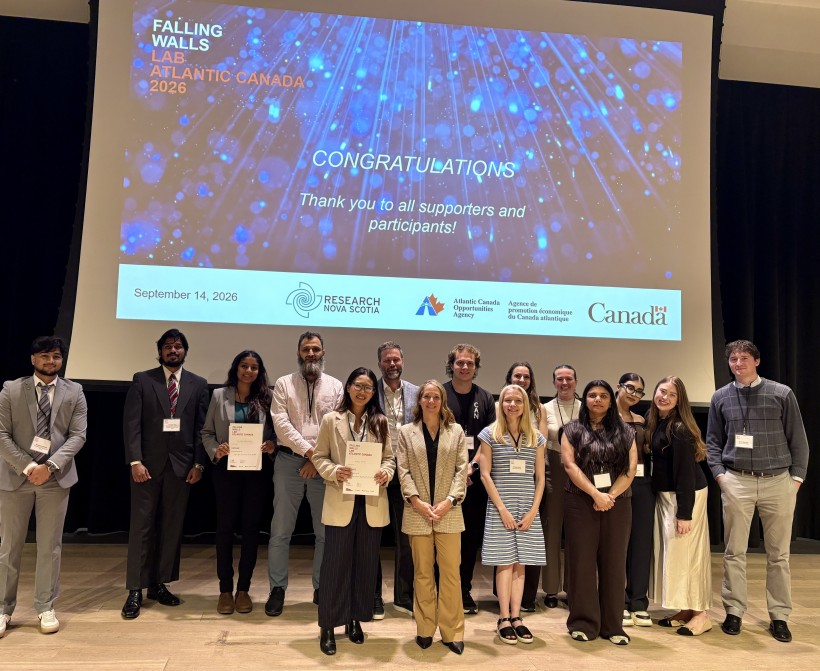
Tran, a master’s candidate in biomedical engineering, won the competition Monday at Halifax Central Library with a three-minute presentation titled “Breaking the Wall of Sample Volume: Big Diagnostics from Tiny Volume.”
She was one of 14 participants from universities across Atlantic Canada who competed in the event, which was hosted by Research Nova Scotia and supported by the Atlantic Canada Opportunities Agency.
Tran’s research uses biomarker capture and detection to conduct diagnostic tests with about half the blood volume normally required. The approach is intended to reduce the need for repeated blood-sample collection when patients or research subjects cannot provide sufficient volume for conventional testing.
The research could be particularly useful in bloodwork involving infants and older adults, as well as research subjects for whom larger samples are difficult to obtain.
“Winning Falling Walls Lab Atlantic Canada means so much to me because it gives me an opportunity to represent our province and share the work our lab has been so excited about,” Tran said in a statement.
“It’s a simple approach that could change diagnostic testing by pulling more information from a smaller sample, across nearly every area of disease.”
As the Atlantic Canada winner, Tran will represent the region at the Falling Walls Lab Global Finale in Berlin on Nov. 6. The event is part of the Falling Walls Science Summit.
She will compete against 100 winners from Falling Walls Labs around the world in the Emerging Talents category. The competition will select a “Breakthrough Winner,” who will have an opportunity to appear at the Falling Walls Breakthroughs of the Year event alongside leading scientists.
The Halifax competition featured researchers from a range of disciplines. Participants presented their research in three-minute pitches before a jury made up of experts from academia, business and government.
Stefan Leslie, CEO of Research Nova Scotia, said the finalists presented research ideas addressing global challenges.
The second place prize went to Orion Wiersma of Dalhousie University who aims to use 3D ultrasound to address bottlencks in orthopedic care. He won $500. Third place went to Kavindya Samarakoon, also a Dal student, who aims to use grape seeds to treat metabolic disease. She won $250.
The Falling Walls Lab is an international competition designed to give emerging researchers an opportunity to present research and ideas in short presentations.
Dal Demo Day Set for Oct. 6
The 23 participants come from universities or colleges across Canada
Dal Innovates will hold its annual Demo Day on Oct. 6, featuring teams from across the country that have participated in the AI2Market, Campus2Market and Lab2Market programs.
The event will be held at the Joseph Strug Concert Hall on the Dalhousie University campus, beginning at noon. The pitches begin at 1:30 p.m.
The participants have completed the Launch stream of three programs offered through post-secondary institutions across the country:
Lab2Marketsupports research-driven teams commercializing academic discoveries.
Campus2Market supports student founders developing solutions rooted in their lived experience and emerging market needs.
AI2Market supports student teams building novel AI-first products that address real-world problems across sectors.
The following are the 23 teams — 17 of which are from Atlantic Canada — that will pitch at Demo Day:
AI2Market Launch
ADPTIV AI
Ahmed Elouby, Bassam Kamal and Youssef Ahmed
University of Prince Edward Island
Empowering people to stay on track with an AI fitness coach that adapts nutrition and training plans, backed by kinesiology and NASM standards, to fit users’ schedules, cravings and setbacks.
Agrivanna
Amirhossein Foroughi
University of Calgary
Enabling farmers to manage grazing operations more efficiently through virtual fencing, AI recommendations and offline-first hardware built for working ranches.
CurioSeed
Yuhan Fu and Muhammad Faisal
Dalhousie University, University of Ottawa
Helping kids build confidence and reinforce their learning by teaching it back to a personal AI buddy, an AI-native learning companion.
Locus Fit
Jackson Chambers
Dalhousie University
Fixing training analytics for paddle sport coaches with a platform that turns GPS, heart rate and strength data into fatigue and technique insights.
Nova Contracts
Starla Burns
Dalhousie University
Modernizing local B2B commerce by providing a secure platform for small businesses to list and bid on everyday contracts.
NovaFlux AI
Abdussalam Mohamed and Hamed Aly
Dalhousie University
Optimizing solar energy systems for operators and owners by integrating solar panels, charge controllers, inverters and batteries into a unified AI-driven platform that automatically adjusts to changing weather and load conditions.
PetBuddy
Rabjot Kaur and Parth Bindra
Dalhousie University
Helping pet owners monitor their dogs’ health with an AI-enabled smart collar that tracks daily patterns and sends simple alerts when something seems off.
Recordium
Max Mascini, Harpreet Jaggi and David Campbell
Dalhousie University
Enabling B2B salespeople to remember, organize, act on and automate the management of customer conversations through a single app.
Campus2Market Launch
Align
Kaila Hamawi and Victoria Fauzel
Dalhousie University
Helping young professionals build better habits by combining AI-powered planning with accountability through friends and shared communities.
BeSociable Medias Inc.
Jason Phonchareon and Olivian Sanderson
University of New Brunswick, Saint Mary’s University
Connecting students by matching them with peers who share common interests through an online platform that makes it easier to attend campus events together.
CheapyEats
Guanxiang Wang and Yifan Huang
Dalhousie University
Lowering food and delivery costs through a limited selection of popular items, batch preparation by restaurants and consolidated delivery by drivers, allowing users to enjoy delivery at dine-in prices.
Gluten Free Living
Emma McGill
Saint Mary’s University
Helping people living with gluten-related dietary restrictions by building an app that acts as a hub for information and resources.
Lokd Technologies Ltd.
Gabriel Shimoon and Jacob Shimoon
Dalhousie University
Taking on digital distraction by giving students, parents and professionals tools to reclaim their attention in spaces where focus matters most.
NeuraSpectra Technologies Inc.
Sarthak Soni
Nova Scotia Community College
Bridging the gap between neural activity and actionable intelligence through portable, AI-native BCI systems designed to help researchers decode the human brain in real time.
Prescription Tenders
Chidozie Michael Nzekwe and Omerole Izuchukwu Darlington
Cape Breton University
Transforming Canada’s pharmacy landscape with a two-sided platform that supports last-mile prescription delivery and connects neighbouring pharmacies to redistribute inventory, ensuring patients receive medications and reducing waste.
Referro
Ahmed Abdelmoaty and Mohamed Hiba
Dalhousie University
Enabling students and recent graduates to land job referrals through an AI networking coach that finds people to contact, writes personalized messages and prepares users for coffee chats.
Your Academic Choice
Ibrahim Haddad and Anthony Safatli
Dalhousie University
Connecting students who are uncertain about their future with experienced peers to help them make informed decisions about majors, graduate programs and career pathways.
Lab2Market Launch
AllerEase
Yiran Xie and Kedar Gaikwad
NSCAD University, Saint Mary’s University
Helping people with food allergies make safer grocery decisions through a personalized product-filtering system that reduces uncertainty and cognitive load.
CareAssist
Ahmad Rezaie Mianroodi
Dalhousie University
Helping chronic disease management teams capture patient values before visits and turn complex treatment options into clear trade-offs, so decisions are aligned, timely and easier to follow through on.
DeepSimu
Amir Zarei and Peyman Setoodeh
University of New Brunswick
Enabling non-technical users to learn and apply artificial intelligence more easily, quickly and affordably through a coding-free deep-learning framework.
Mavia
Abderraouf Haddouni
ÉTS Montréal
Streamlining patient intake and clinical documentation for healthcare professionals by automating patient anamnesis through an AI-powered medical pre-consultation platform.
Nourify AI
Hajer Mejri
University of Montreal
A secure, explainable AI-backed automation platform that streamlines the administrative workflow for real estate brokers.
Pure Air Nova
Aliakbar Isari and Hatef Yousefian
University of British Columbia
Redefining air purification with a smart, quiet, customizable and low-maintenance system for diverse indoor needs.
Dryve Enters CTA Program in Sweden
The NS company is moving beyond pilot production of its cathode active materials.
Dr. Chris Burns, inset, is the CEO of Dryve Battery Materials, whose pilot facility is in Dartmouth.
Dryve Battery Materials has been selected for a Canadian government program designed to help the Dartmouth-based company develop business opportunities in Sweden’s growing battery industry.
The company, which is developing a process for manufacturing cathode active materials, will participate in the Sweden Battery Value Chain Special Edition Canadian Technology Accelerator 2026-27, delivered by the Trade Commissioner Service of Global Affairs Canada.
The program will include virtual market preparation followed by an in-market program in Stockholm and the surrounding region in November. Dryve is expected to take part in site visits, business-to-business meetings and Battery Innovation Days 2026 as it seeks potential customers, partners and investors in Sweden and elsewhere in Europe.
“Selection for the Sweden Battery Value Chain CTA is an important step in Dryve’s international commercialization strategy,” said Burns in a statement released Thursday. “The program provides a valuable opportunity to engage directly with potential customers, partners and investors in Sweden and across the European battery ecosystem as we advance the commercialization of our dry, pCAM-free cathode technology.”
The company’s selection comes as it moves from pilot-scale production toward customer qualification and commercial applications. Earlier this month, Dryve said it shipped 100 kilograms of nickel-manganese-cobalt (NMC) cathode material to an American cell and materials company for evaluation. It described the shipment as its largest sample to date.
The 100-kilogram shipment is intended to allow the customer to evaluate Dryve’s material at a scale beyond typical laboratory samples, while providing the company with an opportunity to demonstrate its manufacturing process at larger volumes.
Dryve is commercializing a patented dry process that produces nickel-based cathode active materials without using precursor cathode active materials, known as pCAM, or conventional wet chemical processing.
The company operates an integrated pilot facility in Nova Scotia with an annual production capacity of 100 tonnes. It is currently sampling materials with cathode producers, battery manufacturers and automotive original equipment manufacturers while pursuing customer qualification, commercial partnerships and technology licensing opportunities.
Dryve said its technology has demonstrated performance competitive with commercially available cathode materials. Independent engineering work has indicated that the process could reduce capital and operating costs, manufacturing complexity and environmental impacts associated with conventional cathode production.
The company said it has patents granted in Japan, the United States, Europe and China, with recent patent allowances in South Korea.
Sweden has been developing a battery value chain as part of its clean-energy and industrial strategy. The Canada-Sweden Strategic Partnership Agreement identifies critical minerals, clean technologies, industrial cooperation and innovation as areas for collaboration.
The Canadian Technology Accelerator program was established in 2013 to help Canadian technology companies explore opportunities in international markets. Global Affairs Canada says more than 1,100 companies have participated in the program since its launch, reporting $842 million in new capital, more than $328 million in new revenue, and more than 1,100 new partnerships and 3,300 jobs.
Inside Wellnify’s Bid to Create Preventive Wellness
The company aims to boost health and relieve the strain on health systems.
Wellnify CEO Travis McDonough
On a cold Tuesday morning in February, Travis McDonough sits at the front of a packed conference room in the Halifax Convention Centre, listening intently. He's been invited to the WHEN (Women's Health Equity Now) Movement, an initiative launched by the IWK Foundation to transform healthcare for women+ across the Maritimes and Canada.
McDonough is confident that Wellnify, his new wellness tech platform, can play a key role in creating better health equality for women in Canada.
From the new mom to the sedentary teenager to the senior craving social interaction, McDonough says Wellnify is built to take any community of users through a full range of gamified preventive wellness and community engagement. The goal is to make a lasting impact across society, gradually helping ease the strain on Canada's healthcare system.
It's a long way from the first chapter of McDonough's career.
Originally from Halifax, he studied kinesiology at Dalhousie University, then spent close to a decade in Ireland. After building multidisciplinary clinics for elite athletes, he returned to Canada and launched Kinduct in 2012.
Kinduct's athlete management platform pulled medical, sports training, and performance data into one place for coaches, trainers and physicians, helping professional sports organizations flag injury risk and make evidence-based decisions instead of gut calls. By the time McDonough sold the company to motion-capture company mCube in 2020, more than 650 teams across the NHL, NBA, NFL and MLB had used it, according to Kinduct.
Wellnify, which McDonough co-founded with fellow Halifax native Duncan Addison, is a platform to be implemented through governments, schools, employers and health systems. Users are dropped into a daily "Wellness Quest" spanning categories such as Body, Mind, Spirit, and Community. Positive community actions, like picking up litter, volunteering, donating blood, and buying local, all count toward group rewards like grocery discounts or free bus passes.
Longevity Research
McDonough said the model traces back to research his team conducted on some of the world's longest-living, most connected communities.
"We went to places like the world's Blue Zones, and we studied the Amish," McDonough says. "The common denominator wasn't that they all had access to things to create a good life. It was that they prioritized serving others in their community. So, we're creating intentionality and gamification around paying it forward."
Physiological theory plays into the platform's design.
"There's something called oxytocin that we secrete when we do things for other people, that's Mother Nature's way of keeping tribes and clans alive through millennia," he adds. "We're trying to tap into that oxytocin secretion, so people feel good about themselves and about the people they're living with."
So far, it's the platform's one community tab – its most social feature – that's getting the most traffic.
McDonough sees a role for the platform inside the healthcare system itself, not just alongside it.
"Physicians will use it to prescribe wellness, just like they do pharmaceuticals," he notes. "We're not just pushing exercise. One of the key components to a healthy community is doing things for other people in your community."
McDonough offers a concrete example of what that could look like at the community level.
"At a community centre, you'd have your physician, but you'd also have your nutritionist, your kinesiologist, your midwife – a whole portfolio of allied healthcare practitioners," McDonough says. "Wellnify lets you carry your own strength coach and your own nutritionist with you. At a moment's notice, you could say, 'I'm an 80-year-old man who lives in Pictou County, I've got osteoarthritis, and I have an $80 nutrition budget, tell me what I need to eat to reduce the inflammation in my blood.' And boom, it spits it out: here's exactly what to eat, click this button to add it to your shopping cart."
The company has run more than 30 pilots across North America. In Nova Scotia, in partnership with Invest Nova Scotia and the Nova Scotia Health Innovation Hub, community rollouts have taken place in Pictou County, Cape Breton, and Yarmouth, along with scholarships supporting Dalhousie student-athletes.
Users Increasing Activity
According to pilot data provided by Wellnify, early results show an average increase of roughly 2,500 daily steps per user, and more than 72 percent of users are moving from below the recommended 150 minutes of weekly activity.
Some of the content driving that engagement comes from outside organizations, McDonough said.
"We've got partners who serve as content partners: the Menopause Society, the Canadian Men's Health Foundation, and the largest senior care provider in the country (Shannex)," he says. "They have all this content, and it just sits on a website. We pull it into our platform and configure a digital ecosystem specific to the population they serve."
In February, Wellnify.ai powered the 2026 Healthier Texas Community Challenge. This eight-week statewide initiative connected more than 3,200 schools, employers, and municipalities into a single digital ecosystem. Wellnify reported 300 million steps logged, 50,000 activities completed and an 85 percent activation rate over the challenge.
More data is on the horizon back here in Canada, with Wellnify on the cusp of a similar deal with another province.
A national ambition is already taking shape. McDonough recently led a delegation to Ottawa for meetings with officials across three federal departments, including the Prime Minister's Office, as part of a broader effort called The Healthiest Nation Project. The initiative currently tabled would extend Wellnify's model into a shared, publicly backed wellness infrastructure for the country.
The pitch to Ottawa leaned on more than principle. McDonough has framed the initiative as a source of new economic activity for Atlantic Canada, estimating 35 direct jobs and more than 20 indirect ones, concentrated in the region and built through collaboration across all four Atlantic provinces. The idea would be established alongside a funding model designed to wean itself off government support over time, with private sponsors eventually underwriting specific populations, programs and challenges on the platform.
He added that the project could also generate data on balance and functional movement as well as community participation such as volunteerism and blood donation.
Healthcare Transformation
McDonough is also working with a group he calls the Canadian Healthcare Transformation Lab, put together by the Health Leadership Academy - McMaster University and Canadian Medical Association.
"It's essentially 35 people, like the president of the Canadian Medical Association, the CEO of the Canadian Space Agency, the head of Indigenous healthcare across Canada, the head of the nurses' union, three chief medical officers from the insurance companies," he says. "We've been pulled together to try to reimagine the Canadian healthcare system."
Over several weeks, the group modelled out four possible futures for Canadian healthcare.
"We ran four scenarios," McDonough says. "One was the healthcare system as it stands today. Another moved provincial responsibility toward the federal government. The third moved it toward community or municipal control, with federal guardrails but local decision-making. And the last was 'AI for all' – putting tools in the hands of the masses, the way India is doing with cell phones."
No single scenario won out, he said.
"It came out as a combination of the third and fourth scenarios; community-driven, with digital infrastructure, but with a fairly tight scope federally, so there's still the ability to connect with other communities for buying power," he notes. "The one thing we know is that it can't exist as it is today, because the healthcare system is buckling."
That framing of prevention as infrastructure, rather than an afterthought, is one McDonough traces back to his own family.
His grandfather, Lloyd Shaw, and his mother, Alexa McDonough, were central to the creation and evolution of Canada's New Democratic Party. The latter also became a national trailblazer for women in politics.
"I acknowledge that I was born rounding third base, and I don't feel guilty for the privilege I was born into," he says. "What I do feel is that sense of obligation and agency to take what I've been given and help other people. That's why I love that phrase: 'that societies grow great when old people plant trees whose shade they'll never sit under.'
"That's the mission we're on. We're thinking about this three, four, five generations from now, because that's the mindset we need to really solve the problem we're in."
Virtual Hallway Launches Asklepius
The product uses AI to answer critical questions for clinicians.
Halifax-based Virtual Hallway has launched Asklepius, an artificial intelligence tool designed to help Canadian clinicians find evidence-based answers to clinical questions.
The company said Asklepius combines AI with information from Canadian clinical sources, including more than 500 clinical guidelines, provincial formularies, Health Canada drug monographs and drug information from the Canadian Pharmacists Association. Virtual Hallway announced the launch in a press release on Friday.
The tool is intended for questions that can be answered through clinical evidence, while Virtual Hallway’s existing platform connects clinicians with specialists when a question requires another clinician’s experience or perspective.
"As a physician, you have a question, and the answer lives somewhere, but finding it fast, and trusting what comes back, that's the challenge,” said Virtual Hallway COO and Co-Founder Dr. Daniel Rasic in the statement. “Virtual Hallway has the network of specialists and clinicians who trust each other. Asklepius adds a knowledge layer to the same trusted network resulting in better answers for our health system, developed by people who work inside it.”
Asklepius has been tested in a limited launch over the past six months by 725 physicians and nurse practitioners across Canada. Virtual Hallway said their feedback was used to shape the product before its wider release.
The company cited research published in JAMA Internal Medicine indicating that clinicians raise 57 questions for every 100 patients they see. It said finding answers can take significant clinical time and that unanswered questions can contribute to uncertainty, potentially resulting in referrals or emergency department visits.
Asklepius was developed in Canada by a team that includes practicing physicians and is designed specifically for the Canadian healthcare system. Virtual Hallway said the system’s responses are verifiable and grounded in Canadian sources, and that Canadian specialists continuously review the tool.
The company said Asklepius is intended to support, rather than replace, clinical judgment.
The tool is available at no cost to licensed Canadian physicians, nurse practitioners, pharmacists, registered nurses, physician assistants and resident physicians.
Virtual Hallway was founded by Rasic, Dr. Jacob Cookey, Justin Hartlen and Dr. Luke Napier. The company operates a peer-to-peer consultation platform that connects healthcare professionals with specialists and also provides accredited continuing medical education lectures.
Virtual Hallway is based in Halifax and is 100 per cent Canadian-owned and operated. Its specialist consultation service is currently available in Ontario, Alberta, Saskatchewan, Nova Scotia, Prince Edward Island and Newfoundland and Labrador.
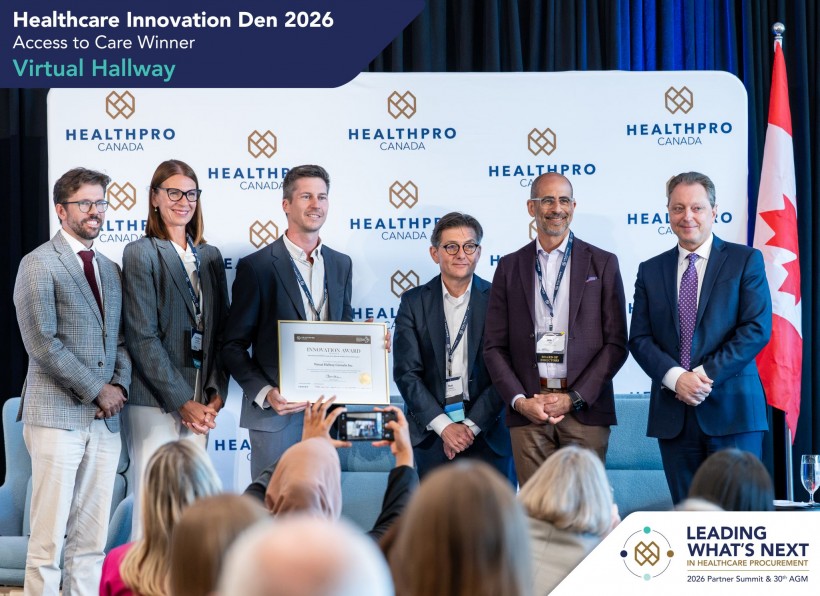
The company was named CanHealth’s Company of the Year in 2025 and received Digital Health Canada’s 2026 Clinical and Care Delivery Transformation Award and HealthPro’s 2026 Healthcare Innovation Winner award.
Hermetik Acquired by Qapture Investments
The Halifax company aims to generate stable income streams from cryptocurrencies.
Brendan MacNeil, Head of Decentralized Finance.at Qapture
Bermuda-based investment manager Qapture Investments has acquired the on-chain yield strategies and operational infrastructure of Halifax-based Hermetik Trading Technologies Inc. and named Hermetik founder Brendan MacNeil the Head of Decentralized Finance.
The parties announced the deal in a press release last week but did not release financial details.
MacNeil launched Hermetik three years ago with the backing of Saint John-based investment group East Valley Ventures. The company specializes in on-chain yield strategies, which plot the best way to develop stable income streams from notoriously volatile cryptocurrencies, such as lending them out and collecting interest.
MacNeil will join Qapture and work with its founder Frederick Pye, who previously led Montreal-based 3iQ Corp, which is best known as the first Canadian crypto fund to list publicly. Pye exited 3iQ in 2023 when it was acquired by Monex Group, Inc. of Japan. He now operates a family office, whose digital asset management arm is Qapture.
MacNeil has about a decade of experience in the digital asset sector and received support in growing his company from Propel and Versos AI CEO Chris Keevill. At Qapture, he will oversee strategies involving yield optimization, risk management and automated execution.
“Digital assets are going through a generational inflection point – evolving from speculation to sophisticated asset management strategies,” MacNeil said in a release. “Combined with Hermetik’s on-chain yield strategies, there is a real opportunity here to capture the institutional transition from traditional to on-chain markets.”
The Hermetik acquisition complements Qapture’s existing eight-year track record in directional digital asset strategies. Daniel Pye, Qapture’s president and chief operating officer, said the addition of MacNeil and the Hermetik technology would allow the company to offer strategies across a wider range of risk profiles.
Hermetik employed five people and three of them, including MacNeil, are based in Halifax.
Qapture also announced the acquisition of Flammarion Partners Ltd., a British Virgin Islands Approved Manager. The company has been renamed Qapture Investments (BVI) Ltd. and will serve as investment manager for Qapture’s Bermuda-domiciled funds and separately managed accounts.
The BVI Financial Services Commission’s Approved Manager regime allows Qapture to manage professional funds and discretionary managed accounts with aggregate assets of up to US$400 million. The company said the structure complements its Bermuda private fund as it works toward obtaining an investment-business licence from the Bermuda Monetary Authority.
Qapture said its longer-term goal is to build an investment management platform capable of offering institutional investors a range of on-chain strategies as digital assets become more integrated into traditional financial markets.
SmallBizRIOT Coming to Moncton
The event allows business owners to share what went wrong and what worked.
A one-day business conference will bring real-world stories, practical ideas and structured networking to business people gathering in Moncton.
On Thursday, October 22, entrepreneurs, business owners, managers and advisors from across the region will gather in Moncton for the inaugural OMISTA Credit Union SmallBizRIOT Conference. The idea is to bring together people who have built, operated, managed and advised businesses, organizers said in a press release. Speakers will share challenges they encountered firsthand.
“Most business owners don’t need another person telling them they should increase sales, improve systems or hire better people,” said SmallBizRIOT organizer David C. Barnett.
“The useful conversation is how. What did another business owner actually try? What happened? What would they do differently? Those are the conversations we want people having at RIOT.”
He said the event is a compilation of ideas from conferences that he has attended over the last few years.
The day will revolve around four themes:
Revenue — attracting customers, increasing sales, improving margins and creating stronger business models.
Innovation — adapting to change, experimenting with new ideas, embracing technology and remaining relevant as markets evolve.
Operations — fixing bottlenecks, improving processes and systems, managing workflow and making businesses run more effectively.
Team — hiring, leadership, culture, communication, accountability and building organizations where people can perform.
Networking Without the Awkward Networking – the event is being structured to create conversations throughout the day.
“We don’t want somebody to look around at the end of the event and realize they spent the entire day sitting beside the same two people,” Barnett said. “If there are people in that room who could become a customer, supplier, advisor, collaborator or simply a valuable contact, we want to help create the opportunity for them to meet.”
The new feature was developed using NVIDIA technology.
Versos AI Chief Executive Chris Keevill
Versos AI announced Wednesday it has developed an agentic system using NVIDIA technology to help artificial intelligence companies search for and assemble video datasets for model training.
The Saint John company is demonstrating the new capability at IBC2026 in Amsterdam this week. The system allows users to describe the type of video footage they need in plain language, after which the platform translates the request into structured criteria and searches video at the scene and frame level.
The system evaluates potential footage against requirements such as subject matter, actions, environments, duration, resolution, format, language, production quality and permitted uses. It then assembles footage that meets the specified criteria into a structured dataset.
“AI teams should be able to search for the data they need to train new models the same way they would describe it to a colleague,” said Versos Co-Founder and CEO Chris Keevill. “The people building AI deserve to benefit from it just like everyone else, and our agentic interface makes that happen by streamlining the process for curating training data.”
Versos, which joined the NVIDIA Inception accelerator in June, said the system is designed to address a process that can involve manually searching large video libraries, reviewing individual clips and organizing selected footage for delivery.
The workflow also incorporates licensing and provenance information. It searches footage that has been prepared for controlled AI licensing while maintaining information about ownership, licensing and the source of the content.
The agentic system was built using NVIDIA and LangChain technologies. NVIDIA's CUDA Toolkit is used to accelerate inference within Versos' Video Library Intelligence Platform, which analyzes footage at the scene and frame levels.
Versos said its architecture is model-agnostic. Although Nemotron Ultra is being used to run the agents, the workflow can also operate with other open-weight or frontier AI models, depending on customer requirements for performance, cost or deployment.
For video library owners, the system is intended to provide a way to respond to specific requests from AI companies without manually reviewing an entire library for every request.
Versos AI, which closed a $1.85 million equity round last December, was founded to provide infrastructure for licensing video content for AI model training. Its Video Library Intelligence Platform analyzes and indexes video at the frame level, allowing content to be searched and organized for potential AI applications.
The company will demonstrate the technology at IBC2026 from Sept. 11 to 14. Keevill is scheduled to speak at the conference's Ignite Stage on Sept. 12.
Falling Walls Atlantic Set for Sept. 14
The winner will head to the international finals in Berlin.
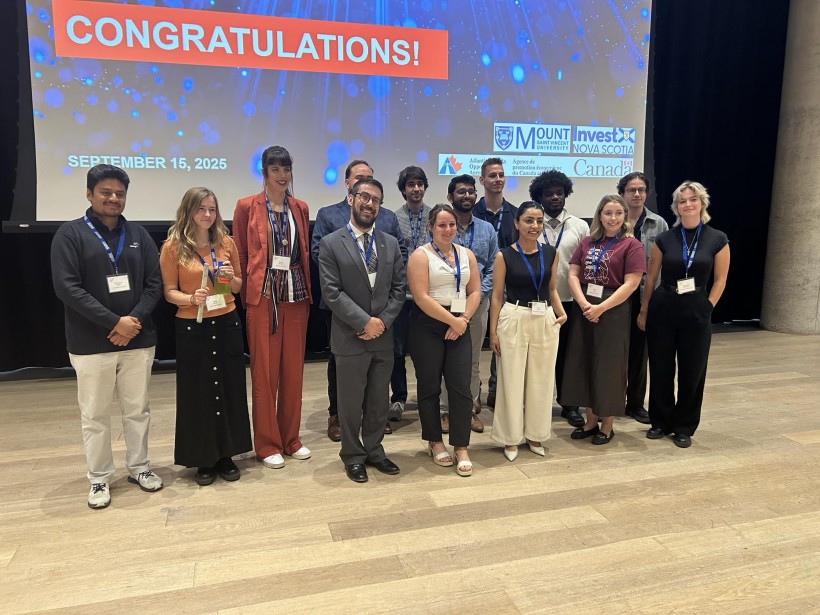
Falling Walls Atlantic Participants from 2025
Falling Walls Lab Atlantic Canada will hold its annual three-minute pitch competition at the Halifax Central Library on Sept. 14, sending one Atlantic Canadian researcher to the international finals in Berlin.
The event, hosted by Research Nova Scotia and supported by the Atlantic Canada Opportunities Agency, will feature 14 students and early-career researchers from across Atlantic Canada.
Each participant will have three minutes to present a research idea to a live audience and explain what “wall” they hope to break through. A panel of judges will select the Atlantic Canadian winner.
The winner will represent the region at the Falling Walls Lab Global Finale in Berlin in November, where they will join 100 finalists from around the world.
The finalists were selected from applicants across the region and represent a range of disciplines, institutions and research areas.
Falling Walls Lab is an international pitch competition for students and early-career researchers. Participants are required to explain their research or an innovative idea in three minutes.
The 2024 Atlantic Canadian competition was won by Dalhousie University student Dina Rogers, who later received the Science Breakthrough of the Year award in the Emerging Talents category at the global Falling Walls event. Her research focused on a method for deconstructing waste so that plastic constituents could be reused.
This year's event will take place from 6 to 8 p.m. in Paul O’Regan Hall at the Halifax Central Library. Admission is free, with registration recommended.
Invest Nova Scotia’s RevUp! Program Seeks Applicants
The program covers 75 percent of eligible project costs, up to $150,000.
Invest Nova Scotia has opened its RevUp! Program, which offers up to $150,000 to help Nova Scotia businesses enter new geographic markets or national/international supply chains.
RevUp! is designed for established, high-growth Nova Scotia small and medium-sized enterprises with the resources and strategy to pursue new market opportunities.
Applicants must:be a Nova Scotia-registered business in good standing; have annual revenues of more than $2 million and at least 15 full-time equivalent employees, among other requirements..
Before submitting an application, businesses should:
Contact their Regional Business Development Advisor to discuss whether their project aligns with RevUp!
Develop a clear new market entry strategy and identify the specific barriers the project will address
Confirm that the proposed project is execution-ready and has defined start and end dates
Prepare a Schedule of Eligible Project Costs
Obtain Statements of Work from consultants or service providers, where applicable
Prepare supporting financial information and cost estimates
Halifax Founder Launches Social Golf App
The app allows users to find golfing partners.
David Sears, Founder of PartnR
David Sears, a Halifax-based geologist, has created PartnR, an app that helps golfers connect with playing partners, organize rounds, track scores, explore Canadian courses, and build a digital golf passport.
Surprisingly, perhaps, Sears, who recently returned to Halifax after working as an independent contractor in the oil and gas industry in Calgary, created the app himself with the help of AI.
“The developing work wasn’t hard using AI,” he told Entrevestor. “The AI explained what program to use and I started from there. The AI gave me some code. I copied and pasted it, and ran hundreds of tests…
“I drove my wife mad actually. It was all I was doing after work and on weekends over the summer. The experience of knowing how to do this – even if this idea doesn’t work – has given me the confidence to think I can develop my own ideas and help others with theirs.”
Following a soft launch, Sears is currently seeking to expand the app’s users and gather feedback before holding a hard launch next golfing season.
Over the winter, he will be expanding PartnR to golf simulators. He said the same issues arise for finding playing partners for golf simulators during the colder months.
The app, now available on the Canadian App Store, also includes more than 2,000 Canadian golf-course profiles; 439 collectible course passport stamps; GPS and weather features; rankings, achievements and player statistics. Sears said there are many golfing apps but they tend not to focus on finding partners. Most also charge paid subscriptions to access a lot of the information. He intends to keep his app free to use.
“I have lot of subscriptions myself and I didn’t want to ask users to pay another 70 to 80 bucks a year.”
The app will also be community driven. For example, users will have the option of sharing their saved course information.
Sears hasn’t yet figured out how to create a revenue stream but he’s keen to gain users across Canada.
“My goal is for everyone in Canada to always be able to find a golfing partner. It’s the same problem across the country.”
And he’s progressing in his knowledge as a developer. He has already created a Halifax-themed Snakes and Ladders game for his sons, ages six and four.
“My boys are obsessed with it,” he said.
Boundless Discovery Closes US$2M Seed Round
The Halifax company is developing comprehensive maps of critical markets.
Halifax-based Boundless Discovery has raised a US$2 million (C$2.8 million) seed round to develop an artificial intelligence-powered platform that maps and analyzes critical markets.
The company, founded in late 2024, issued a recent press release saying the financing came from venture capital funds in the United States and United Kingdom, family offices, and executives in the technology, energy and financial sectors. It did not disclose the names of the investors.
Boundless Discovery combines open-source intelligence, artificial intelligence and analysis to create models of markets that track assets, companies and other actors, as well as flows and dependencies across entire value chains. It says the platform will create “the world’s most comprehensive living, atomic models of critical markets.”
The company has spent the past year developing its AI system while working with hedge funds, private equity firms and forensic investigators, according to the company.
Boundless Discovery is now launching what it calls its Core Market coverage, which provides maps and analysis of entire value chains. Nuclear energy is the first sector covered by the platform.
“We're very proud of the group of investors who have decided to back us,” CEO Peter Gale said in the statement. “Now it's time to prove they made the right choice.”
The company said its approach is designed to provide detailed information about the microeconomic components of markets while analyzing them at a broader scale.
Boundless Discovery describes its technology as combining open-source intelligence with AI and human analysis. The company’s first nuclear-energy analysis is available publicly as a free deep dive.
The $1.2M fund has already invested in four companies connected to the Island.
Cape Breton Capital Group has launched a new $1.2 million angel investment fund focused on early-stage companies with connections to Cape Breton.
The Cape Breton Future Fund, or CBFF, will invest in qualifying small businesses that are registered in Nova Scotia and have a meaningful connection to Cape Breton. That connection can include research and development activity, executive leadership, a headquarters location, or local employment and wages, said the company in a press release.
The fund is backed by 22 angel investors, including 11 who are joining Cape Breton Capital Group for the first time. The investors bring experience in areas including entrepreneurship, technology, operations, finance and sector-specific expertise.
“The creation of the Cape Breton Future Fund is a testament to the belief our angels have in supporting the continued development of startups connected to Cape Breton,” Cape Breton Capital Managing Director Paul Harrington said.
The organization said the CBFF, its second fund, has already invested in four companies:
Aeon Blue Inc. – This Sydney-based company is developing technology that delivers sustainable e-fuels while simultaneously capturing carbon dioxide and generating high-value co-products. In May, Aeon Blue was named the Startup Venture of the Year at the Canadian Cleantech Awards.
SEVO Biosciences Inc. – SEVO is developing oral aquaculture vaccines using engineered microalgae. delivery systems
BryoSphere Biotechnologies Inc. – This company manufacturers skincare products using chemicals found in moss. It says its proprietary moss biomanufacturing platform enables production of high-quality bioactive ingredients at large scales.
And alterBiota Inc. -- Sydney-based alterBiota has developed a concrete additive, deltaC, made with biochar, a carbon-rich material produced from forestry byproducts. The company said last December the product had graduated from the R&D phase to commercial production as construction industries sought lower-carbon materials.
Harrington also credited Nova Scotia's Venture Capital Tax Credit (VCTC) with helping the group attract private investment.
“The VCTC played a meaningful role in helping us attract investors and provide critical early support to startups through private investment,” he said.
The fund continues the investment mandate of Cape Breton Capital Group's original fund, supporting early-stage businesses with roots or other significant connections to Cape Breton while they develop markets beyond the region.
Cape Breton Capital Group is already looking ahead to another fund. The group said it is seeking to establish a third investment vehicle focused on businesses connected to rural Nova Scotia.
The Rounds Acquired by Native Touch
The purchaser is a Toronto firm specializing in digital marketing.
The Rounds CEO Tim Rice
The Rounds, the Halifax-based company that developed a social network for medical professionals, has exited after being acquired by Native Touch, a Toronto digital advertising firm.
In an interview, CEO Tim Rice said that The Rounds – whose corporate name is Boondoc Technologies Inc. – was sold in May to Native Touch, which owns a portfolio of companies that have synergies with the Halifax company’s network.
The parties did not release the financial details of the transaction. What Rice did stress is that the eight-member team is remaining in Halifax and growing, with a few openings currently posted.
“One really important aspect is we're still going to be an Atlantic-based company, with headquarters here in Halifax,” said Rice, who said he will remain with the company. “We continue to plan to grow the team within the Atlantic provinces, which is a really exciting aspect of this transaction.”
Co-Founders Blair Ryan, Will Harris and Michael Clory started the company in 2012 with the belief that physicians and other medical practitioners commonly encounter problems in treating patients that they simply don’t know the answers to. They decided that doctors could find solutions by canvassing a broad range of their peers, some of whom may have encountered similar problems.
The team developed a secure, closed network that verified medical professionals could join free. The company monetized the network by selling sponsorships to corporations that wanted to reach the medical community, and this is the part of the business that has found synergies with Native Touch.
The company experienced a surge of growth during the pandemic and today operates largely in Canada with strength in a few specific segments of medical practices, said Rice. The areas of strength are family physicians, general practitioners, nurses, and pharmacy. Areas that The Rounds has branched into more recently include dermatology, gastroenterology, rheumatology, infectious diseases, neurology, and pediatrics.
“The newest one that we're just launching right now, which is really exciting, is . . . a new community for optometry,” said Rice. “And we anticipate that that will be our fastest-growing community over the next six to 12 months.”
About a year ago, the company and its board began to consider growth through a corporate transaction, whether by acquiring or merging with another company, or being acquired. They eventually settled on Native Touch, which specializes in mobile-first and omnichannel programmatic advertising.
The Rounds last raised capital in 2023, when it completed its Series A round, which came in at a total of $6.7 million. Atlanta-based Panoramic Ventures and Invest Nova Scotia were major contributors to that and previous rounds. East Valley Ventures also invested in the company over the years.
During the interview, Rice heaped special praise on his team, which grew the business during the uncertainty of the pandemic and dealt well with the stresses of being taken over.
“This team was super-resilient,” said Rice. “Going through an acquisition takes a toll on everyone just because there's so much work that goes behind it and a lot of stress. The team handled it so professionally and made it much easier for me to manage.”
We’re on Holiday Until Labour Day
As we do every summer, we're taking a break in August -- only it's a bit longer than usual this year.
We find there's little news to write about it in the period before Labour Day. And if something newsworthy does happen, there are few readers around to read about it.
We're heading to the beach with a stack of good books -- forgive the shameless plug. We will be back in early September with more news.
A Call for New Attitudes in NS
Ian Thompson's new book lists reasons for optimism in the province.
In his splendid book Nova Scotia’s Lost Century: Can We Change Course?, Ian Thompson zeroes in on an all-important but immeasurable factor in the province’s underperformance since Confederation: our loss of confidence.
Our historical underconfidence is a treacherous subject for a pundit, as it tends to raise hackles. Former Prime Minister Stephen Harper was vilified in 2002 when he spoke of the need to change Atlantic Canada’s “culture of defeatism”. But citing such revered Bluenosers as Robert Stanfield and Mike Savage, Thompson shows that Harper was not alone in bemoaning the weak gusto in our collective psyche.
“Confidence, or lack of confidence, can affect prosperity,” writes Thompson. “Nova Scotian economist John Graham wrote that communities suffering from continuing economic failures and wasted public resources often fall into a ‘depressed psychological state.’ Confidence, ambition, and investment suffer.”
Thompson casts a broad net when assessing what the province has done well and badly in the past century and a half. While the economic under-performance is central to his thesis, he delves into myriad facets of the province’s life, devoting one chapter to our success in paddling and another to our production of hockey stars.
Thompson is uniquely positioned to analyze the state of the province, as he has thrived in the business community. He led the MT&L public relations firm (now National PR) and served as Deputy Publisher of The Chronicle-Herald. In the public sector, he was the Deputy Minister of the province’s development department. And before all that, he was a hell of a journalist. I covered Halifax City Hall for the Herald in the early 1980s and Thompson was still revered for the job he had done in that role a decade earlier.
He also has an historian’s eye, and catalogues the various blows that Nova Scotia has suffered from policy-makers in Ottawa – from Sir John A. Macdonald’s National Policy of 1878 to C.D. Howe’s decisions favouring Central Canadian industry during the Second World War to Harper’s moves to seize offshore gas revenue early in this century.
“While many of us blamed Ottawa for our underdevelopment, Ottawa wasn’t the only problem,” writes Thompson. “We often declined to develop our own resources, believing the risks were too high or, perhaps, the task beyond our abilities. We often said ‘no’ instead of engaging in the hard work of understanding the science or finding sensible compromise.”
As well as handing money to multinationals that were soon gone, Nova Scotians and their governments were too quick to turn their backs on economic opportunity. Fracking and uranium-mining were banned for decades, and excessive regulations were placed on the aquaculture industry, says Thompson. He notes that Nova Scotians are reluctant to change their ways, even when change could produce greater wealth, which would translate into better healthcare, education and social supports.
But the tide, says the author, is turning.
Thompson focuses on three events that have helped to rewire our luddite mindset: Halifax-based Irving Shipbuilding won the national shipbuilding contract; Nova Scotia and other Atlantic Provinces handled the COVID-19 epidemic better than most other jurisdictions; and the province produced three of the greatest hockey players in the world in Sidney Crosby, Nathan MacKinnon, and Brad Marchand.
“In Ships, COVID-19, and hockey we scored more than a hat-trick,” says Thompson. “In those victories, and in the thousands of small deeds in which countless Nova Scotians supported each other, we gave ourselves more reason to be confident than at any time over the last hundred and fifty years. We proved to ourselves, and to the world, that we can take on mammoth challenges and win. We proved that, even when the odds are against us, we can overcome.”
Thompson sees one factor – linked to the first of those factors – that could finally help Nova Scotia find its economic footing. There is a new awareness of the potential of ocean industries and oceantech. The shipbuilding contract led to the creation of COVE in Dartmouth, the opening of the DIANA accelerator, and the growth of oceantech. He’s similarly excited by Premier Tim Houston’s plan to develop offshore wind farms. He describes marine industries writ large as “a glorious once-in-a-century opportunity”.
Though he doesn’t single out the startup community in such glowing terms, Thompson believes the province must capitalize on its innovators and research facilities to develop products that can be sold to the rest of the world. It’s all part of the changing attitude that Thompson hopes will ensure the province doesn’t lose another century.
Editor’s note: Though Nova Scotia’s Lost Century won’t be officially released until Sept. 23, Thompson tells me it has been on sale at some bookstores, including Bookmark on Spring Garden Road.
CVCA Data Shows Feast or Famine on the East Coast
NB and NL accounted for 96% of Atlantic Canada's VC funding in the first half.
It was feast or famine in the Atlantic Canadian venture capital arena in the first half of 2026, with New Brunswick and Newfoundland and Labrador accounting for 96 percent of the funds raised.
The Canadian Venture Capital and Private Equity Association, released its quarterly VC data on Tuesday, showing that New Brunswick booked $31.6 million in the six months to June 30. Newfoundland reported $21 million on three deals.
Nova Scotian startups raised $2 million on two deals, and no venture capital was raised by Prince Edward Island companies.
“Atlantic Canada shows up in this half's data more than usual,” said the CVCA in a note to Entrevestor. “New Brunswick recorded $30.6 million across seven VC deals, up from $2.7 million from the same period in 2025. Newfoundland and Labrador recorded $21 million across three deals, triple its deal count from the same period in 2025.”
However, the data from the country’s main association for private capital is not all good. It revealed earlier this year that Atlantic Canadian startups raised a piddly $22.4 million in the first quarter, and now it’s showing little improvement in the second quarter with a total of $31.2 million. The second-quarter tally broke down as $23.7 million on four deals in New Brunswick, $5.5 million on two deals in Newfoundland and Labrador, and a pair of Nova Scotia deals worth $2 million.
The bright spot, of course, has been New Brunswick and its 10X growth year-on-year. The province received a boost in May when Fredericton-based cybersecurity company Lastwall closed a $16 million round led by BDC Capital’s StrongNorth Fund. The New Brunswick numbers were especially heartening given that the province only raised a total of $15 million in VC in all of 2025.
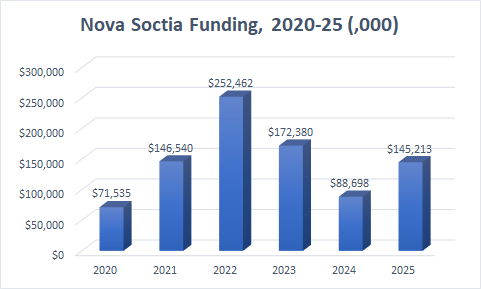
At the other end of the spectrum, the Nova Scotia data is concerning, given that it’s the region’s most populous province and often accounts for more funding than the other provinces. About a year ago, the CVCA was reporting that Nova Scotian startups had raised about $32 million in funding – 16 times as much as the 1H26 figure.
The mixed results in Atlantic Canada took place as the CVCA reported that VC funding across the country increased in dollar terms but did so on fewer deals.
The report says $2.7 billion was invested across 250 VC deals in Canada, whereas the figures were $2.3 billion on 274 deals in the same period a year earlier. The dollar value rose 17 percent while the number of deals fell 9 percent.
“Canadian investors kept capital moving through a period that would have halted most markets," said CVCA Chief Executive Benjamin Bergen in a press release. "As rounds get larger, more of the world's investors come to the table, a sign of how much Canadian companies can attract at scale. The work ahead is building more of the capacity to lead those rounds at home, so Canada captures more of the upside."
Couturier Named CEO of Green Imaging
Co-Founder Derrick Green has moved into the newly created role of chief technology officer.
Fredericton-based Green Imaging Technologies has appointed Norm Couturier as chief executive officer while Co-Founder Derrick Green has moved into the newly created role of chief technology officer.
The changes took effect July 15 and are intended to give separate executive oversight to the company's commercial operations and technology development.
Couturier had served as chief operating officer for the past two years, overseeing commercial operations. As CEO, he will be responsible for leading the company's business growth while continuing its commercial expansion.
Green, who previously served as CEO, will now focus on technology strategy, research and development, and the company's long-term innovation agenda in his role as CTO.
"This is a transition that reflects the natural and exciting maturation of Green Imaging Technologies," said Board Chair David Wagner in a statement. "The Board has tremendous confidence in both Norm and Derrick. By dedicating our strongest commercial leader to the CEO role and channelling Derrick's extraordinary technology expertise into an elevated CTO mandate, we are positioning GIT to pursue growth and innovation at a pace and depth that a unified executive model simply cannot match.”
Couturier said he plans to build on the company's recent commercial momentum. Green said the CTO position will allow him to concentrate on advancing the company's technology and supporting its engineering and research teams.
Green Imaging Technologies develops Nuclear Magnetic Resonance imaging technology for commercial and industrial applications. The company said it has expanded its customer base, entered new market channels and strengthened its intellectual property portfolio over the past two years.
The company said the revised executive structure is designed to support its next stage of development by separating responsibility for business operations from responsibility for technology leadership.
Founded in Fredericton, Green Imaging Technologies develops proprietary imaging systems based on Nuclear Magnetic Resonance technology for use in a range of industrial and commercial markets. The company said its focus on technology development will remain central to its competitive strategy under the new leadership structure.
Natural Products Canada Lands $50M from Feds
The funding will help support agri-food innovation.
The federal government has announced $50 million in funding for Natural Products Canada (NPC) to help expand Canada's agri-food innovation sector through a project valued at $94.8 million.
The funding, provided through the Strategic Response Fund, will support NPC's efforts to commercialize Canadian agrifood and bio-based technologies and increase their adoption in domestic and international markets.
According to the government, the project is expected to create more than 550 jobs and contribute more than $1.8 billion to Canada's gross domestic product. The investment will also enable NPC to establish a Capacity Building Fund to support food manufacturing and processing projects aimed at increasing domestic production, strengthening supply chains and improving food security.
The funding forms part of the federal government's National Food Security Strategy, which seeks to increase domestic food production, improve access to affordable food and reduce Canada's dependence on imported food products.
Charlottetown-based Natural Products Canada is a national not-for-profit organization that works with companies developing food and bio-based technologies. It provides funding, commercialization support and connections to investors and industry partners.
Established in 2015, NPC has worked with more than 1,800 early-stage Canadian companies and has directly invested in more than 100 businesses. The organization says those investments have helped attract $622 million in follow-on capital and contributed about $900 million to Canada's GDP.
The latest funding builds on about $25 million in federal support announced in 2021 through the Strategic Response Fund for an earlier NPC initiative.
The Strategic Response Fund supports business-led innovation networks involving companies, universities and research institutions. Under the program, funding is distributed by the lead organization to project partners and recipients.
The government said the National Food Security Strategy is intended to strengthen Canada's food system by supporting innovation, expanding domestic production capacity and improving the efficiency and resilience of food supply chains.
Tribe Supports 70+ Founders with Small Grants
A total of $50K in grants produced more than $270K in revenues.
Tribe Network says more than 70 Black, Indigenous, and racialized entrepreneurs across Atlantic Canada received support through its 2025–26 Start Small Grant Program.
The Halifax-based organization released the program's results on Tuesday, it provided a total of $50,000 in grants through the program, and the recipients generated more than $270,000 in revenue.
Funded by Emera Inc., the program during the 2025–26 period provided grants ranging from $500 to $1,000 to early-stage entrepreneurs, many of them receiving funding for the first time.
In addition to financial support, participants were offered mentorship and access to the organization's entrepreneurial network.
"The Start Small Grant has shown us that early-stage founders don't need much to get moving — they need the right support at the right moment," said Savior Joseph, founding board chair of Tribe Network. He said the program has helped companies progress from developing prototypes to launching products and generating sales.
Mike Roberts, chief human resource officer at Emera Inc., said the company supports the initiative because it helps entrepreneurs establish businesses, create jobs and contribute to regional economic development.
Tribe Network said Emera has contributed more than $800,000 over the past five years to support programs aimed at Black, Indigenous, and racialized entrepreneurs in Atlantic Canada.
The partnership has funded initiatives including the IDEA Fellowship and the Start Small Grant Program. Tribe Network said Emera's support has also helped provide mentorship, programming, shared workspaces and access to its broader entrepreneurial ecosystem.
According to the organization, more than 200 entrepreneurs and community leaders have benefited from these contributions to date.
Tribe Network describes itself as an innovation organization that supports Black, Indigenous, and racialized entrepreneurs in Atlantic Canada through programming, mentorship and ecosystem connections.
Site 20/20 Lands $745K ACOA Loan
The funding will help the Dartmouth company expand operations.
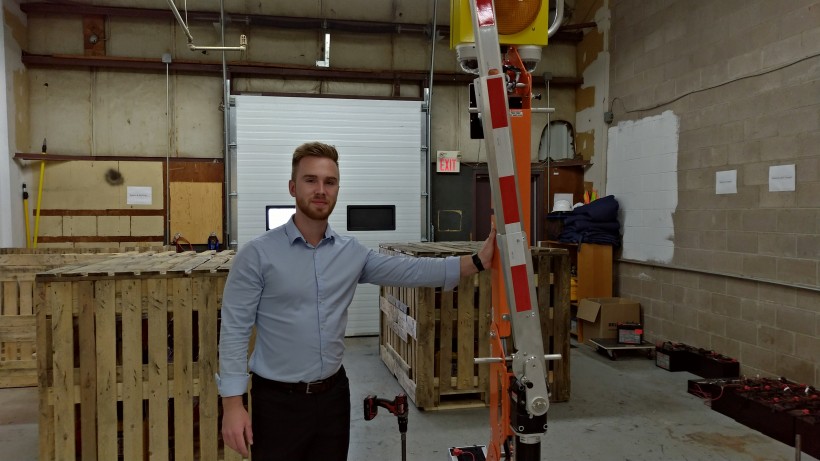
Site 20/20 CEO Mitch Hollohan
Atlantic Canada Opportunities Agency has approved a $745,000 loan to Dartmouth-based Site 20/20 to help the traffic-control technology company expand its operations and increase production capacity.
The funding, announced Monday, will support the company as it accelerates product development, reduces costs, improves service delivery and expands into new markets.
Site 20/20 plans to retrofit a larger facility with advanced manufacturing and assembly areas, research and development prototyping labs, and upgraded information technology infrastructure. The expansion is expected to create 50 to 60 jobs while increasing the company's capacity to meet growing demand, said the ACOA statement.
“This support will help us expand our manufacturing capacity, accelerate innovation, and create new skilled employment opportunities here in Nova Scotia,” CEO Mitch Hollohan said in the statement. “Most importantly, it strengthens our ability to deliver safer, smarter, and more efficient traffic control solutions to communities across Canada and beyond.”
Founded in Dartmouth, Site 20/20 develops technology designed to improve safety in road construction zones. Its flagship product, the Guardian SmartFlagger, is intended to replace human traffic flaggers with an automated system that combines portable traffic signals with a physical barrier that can be lowered to stop vehicles.
The company has recorded rapid growth in recent years. It has appeared on Deloitte's Technology Fast 50 ranking of Canada's fastest-growing technology companies for three consecutive years. In the 2025 rankings, it placed sixth after reporting revenue growth of 6,721 percent over the previous four years.
Site 20/20 secured a significant investment in August 2024 from New York-based investment firms New Mountain Capital and Energy Impact Partners. The companies did not disclose the value of the investment. At the time, New Mountain Capital said Site 20/20 had generated more than $250 million in revenue since its founding.
The ACOA financing is intended to strengthen the company's manufacturing capabilities as it continues to expand its presence in Canada and international markets.
Elle, MD Closes $1.1M Pre-Seed Round
The money will fund clinical trials at The Ottawa Hospital.
Nova Scotia medtech startup Elle, MD Technologies has raised C$1.1 million in an oversubscribed pre-seed financing round to support the first human clinical trial of its non-hormonal contraceptive device.
The New Minas-based company said the funding will allow it to begin its First-in-Human clinical trial of Livv at The Ottawa Hospital.
Livv is a non-hormonal vaginal contraceptive ring designed to provide birth control without the hormones used in many existing contraceptives. The company says the device is intended to reduce the side effects and trade-offs associated with common birth control methods, including oral contraceptives and intrauterine devices, or IUDs.
In a LinkedIn post announcing the financing, founder and CEO Dr. Jennifer Johnston thanked investors, advisors and the company's staff for supporting the business as it reaches the clinical testing stage.
“This funding takes us to a milestone we've been working toward for a long time, our First-in-Human clinical trial at The Ottawa Hospital,” she said.
The financing round included investments from H Venture Partners, Invest Nova Scotia, the New Brunswick Innovation Foundation (NBIF), CBDC Hants-Kings, Queen's University Tricolour Venture Fund, Spring Invest Together and Startup TNT. Physician Robin LeBlanc also participated in the round.
Johnston founded Elle, MD in 2022. She is a family physician and an assistant professor at Dalhousie University School of Medicine.
The funding builds on earlier support the company has received from Atlantic Canadian innovation agencies. Last October, Invest Nova Scotia invested $100,000 in the company, matching a previous $100,000 investment from NBIF.
Elle, MD has also gained national recognition. Earlier this year, it was selected as a winner in the Emerging Category of the CIX Startup Awards, Canada's largest showcase of innovative technology companies. The awards recognize early-stage and growth-stage startups selected by a panel of North American investors.
The latest financing is expected to fund the company's next stage of development as it moves from product development into human clinical testing, a key regulatory milestone for medical technologies. Success in the Ottawa trial would provide data on the safety and performance of the Livv device as Elle, MD continues the process of bringing the product to market.
UNB Launches Entrepreneurship Network
The network comprises 7 programs supporting entrepreneurship and innovation.
The University of New Brunswick has launched the UNB Network for Entrepreneurship and Innovation, a new initiative that brings together the university's entrepreneurship programs and organizations within a single network.
In a message to partners, Acting President and Vice-Chancellor Kathy Wilson said the Network will serve as a central hub for UNB's entrepreneurial assets, with the goal of making it easier for entrepreneurs, researchers and external partners to collaborate.
The university said the initiative is intended to strengthen interdisciplinary collaboration, expand support for startups and build on the estimated $125.5 million economic impact generated by UNB startups and spinoff companies.
Dr. Dhirendra Shukla has been appointed the inaugural executive director of the Network. The Network team can be reached at entrepreneurship@unb.ca.
The Network includes seven existing entrepreneurship-focused organizations and programs:
International Business & Entrepreneurship Centre (IBEC), which supports entrepreneurship research, education and international business development.
J. Herbert Smith Centre for Technology Management and Entrepreneurship, which delivers entrepreneurship education and experiential programs for students and researchers.
Wallace McCain Institute, which provides leadership development and peer-learning programs for entrepreneurs and business leaders.
Pond-Deshpande Centre, which promotes social innovation and entrepreneurial thinking through education and community partnerships.
Barrett Chair in Entrepreneurship for Digital Transformation, which advances research and teaching on entrepreneurship and digital transformation.
McKenna Institute, which supports innovation and digital transformation through research, policy work and collaboration with industry and government.
Axis Accelerator, which helps researchers and entrepreneurs commercialize technologies and launch new ventures.
Wilson said the university intends to work with partners through the new Network to strengthen entrepreneurship in New Brunswick and across Canada.
Tech Summit Introduces The Founders’ Floor
The region's premier tech event hopes for more participation by startups.
The Atlantic Technology Summit, which will take place in Dartmouth and Saint John on Nov. 18, is inviting startup founders to participate in this year's event in a new way.
The organizers are introducing The Founders' Floor, a dedicated showcase for Atlantic Canada's earliest-stage companies.
Every participating founder will receive a showcase space and an opportunity to tell attendees exactly what they are seeking, whether it's a technical co-founder, angel or seed capital, their first 10 paying customers, an enterprise pilot partner, or operator mentorship.
"It's a chance for the region's investors, operators, and builders to meet the companies that will define what comes next in Atlantic Canada's tech ecosystem," the organizers said in a social media post.
The cost is $500 per startup, and applications are open on the ATS website.
The summit is aimed at founders, executives, IT leaders, security professionals, and other technology decision-makers from across Atlantic Canada.
The conference agenda will feature discussions on practical AI adoption, cyber resilience, cloud management, and workforce development. Topics are expected to include moving AI initiatives from experimentation to operational use, strengthening digital trust and risk management, controlling technology costs, and developing in-house technical capabilities.
The keynote speaker will be Ramy Nassar, futurist, author, and former Head of Innovation at Mattel.
Early-bird registration is open until July 31 at a cost of $125. Organizers say the summit is designed for business leaders and technology professionals involved in building, purchasing, modernizing, or securing digital systems and services.
Tickets to join the audience at the ATS are available here.
Propel Adds 2 Board Members
Kumaran Thillainadarajah and Jason Cleaversmith have joined the accelerator's board.
Propel, Atlantic Canada's technology accelerator, has appointed Kumaran Thillainadarajah and Dr. Jason Cleaversmith to its board of directors, adding two technology-sector leaders with experience in scaling companies and supporting entrepreneurs.
Thillainadarajah is co-founder and chief technology officer of Smart Skin Technologies, a Fredericton company that previously participated in Propel's accelerator programs. Smart Skin develops industrial sensing technology used by pharmaceutical, food and beverage manufacturers to improve production processes.
A spinout from the University of New Brunswick, Smart Skin Technologies has received several industry awards, including recognition at the World Beverage Innovation Awards and as one of Canada's Top 10 Established Foodtech Leaders in 2025. Thillainadarajah has also been named one of RBC's Top 25 Canadian Immigrants for his contributions to Canada's technology sector.
Cleaversmith serves as executive director of incubation and infrastructure at the PEI BioAlliance, where he oversees the organization's Emergence incubation program and bioscience infrastructure initiatives.
His career has included senior roles in biotechnology and aquaculture, including positions with the Center for Aquaculture Technologies, AKVA Group Scotland, the Scottish Aquaculture Innovation Centre and Novartis Aqua Health in Prince Edward Island. He has also advised early-stage companies through the international aquaculture accelerator HATCH Blue.
"Propel has always been powered by founders and leaders who understand what it takes to build exceptional companies," said Propel Chair Barry Bisson in a statement. "Kumaran and Jason each bring invaluable experience, strategic perspective, and a passion for supporting the next generation of entrepreneurs. We're thrilled to welcome them to the Board."
Propel supports technology startups across Atlantic Canada through founder development, coaching, mentorship and partnerships aimed at helping companies grow. The accelerator works with founders across a range of technology sectors and focuses on helping early-stage companies build businesses capable of expanding into global markets.
SiftMed Closes Funding Round
The St. John's company says it has now raised more than $10M since it launched.
Co-Founder and CEO Holly Hill
St. John's-based SiftMed has raised a new round of financing led by Staircase Ventures of Toronto, bringing the company's total funding to more than $10 million as it expands its artificial intelligence platform for medical claims.
Existing investors Pelorus VC and a group of Verafin founders also participated in the round, the company said. SiftMed did not disclose the amount of the latest investment.
Founded to streamline the review of complex medical records, SiftMed develops AI software that helps insurance carriers, independent medical examiners, legal teams and life care planners organize, analyze and extract information from medical claims.
“We started SiftMed to uncover facts that change lives,” said Co-Founder and CEO Holly Hill in a statement. “This round means we get to do that at a bigger scale, in the part of the industry that needs it most.”
Though the statement didn’t say so, the funders are obviously impressed with the company’s strong growth. In April, Hill said SiftMed recorded 10X revenue growth in 2025 and was targeting 4X growth of annual recurring revenue in 2026.
In the statement, the company said its platform is designed to reduce the time required to review claims by 50 to 70 per cent by identifying information such as pre-existing conditions, treatment gaps and evidence related to causation. The system also links its findings to the original source documents to provide an audit trail.
Hill said the new capital will allow the company to focus on the insurance sector, where claims volumes are increasing and insurers are seeking tools that can improve the consistency and speed of medical reviews.
According to the company, the funding will be used to enhance reporting and auditability features, expand its insurance-focused product and engineering teams, and grow its customer base among insurance carriers, independent medical examiners and legal organizations.
SiftMed said its software supports the claims process from document intake and organization through AI-assisted analysis, producing reports that trace every conclusion back to the underlying medical records. The platform is intended to help insurers standardize claim reviews while providing documentation that can withstand regulatory or legal scrutiny.
The company now employs about 30 people in St. John's and is hiring for positions in product development, engineering and marketing.
SiftMed closed a funding round of $2.7 million in late 2023 and previously said that it raised $2.7 million in 2025.
Youth Program Seeks Applicants
The deadline to enter the Youth Impact Challenge is Monday
The Youth Impact Challenge is accepting applications for its 2026 Summer Innovation Challenge, offering funding and mentorship to young Canadians developing projects with social or environmental impact.
The organization is hoping more young Atlantic Canadian entrepreneurs will apply by the deadline at end-of-day on Monday, July 20.
The virtual program is open to teams of at least three founders between the ages of 16 and 25 who are based in Canada. International students are also eligible to apply. Applicants must be working on an idea that has received less than $5,000 in previous funding.
The organization said it has supported more than 4,000 young people since launching its first Summer Innovation Challenge in 2020.
The competition is aimed at youth-led initiatives addressing environmental or social issues. Examples of eligible projects include community urban gardens, mobile apps that help revitalize Indigenous languages, clean energy promotion programs, climate-focused social media campaigns, sustainable clothing exchange platforms, and machine learning tools for improving underwater surveys.
The top 20 teams selected for the challenge will each receive $500 in seed funding and advance to the program's next stage. Participants will also receive mentorship, workshops and networking opportunities.
The finalists will compete in a live grand final, where the winning team will receive a $3,000 grand prize. In total, the organization said it will provide more than $15,000 in funding through the program.
Shitangshu Roy, the Halifax-based executive director of the Youth Impact Challenge, said the organization is encouraging applications from across Canada, with a particular focus on increasing participation from Atlantic Canada.
More information and application details are available on the Youth Impact Challenge website. The application deadline is Monday, July 20, at 11:59 p.m. PDT.
Procedureflow Launches Agentic API in Beta
The API ensures bots follow approved business procedures.
Saint John-based Procedureflow has launched a beta version of its Agentic API, a product designed to help enterprises ensure artificial intelligence agents follow approved business procedures rather than relying on open-ended reasoning.
The company said the API allows customer-facing chatbots, voice assistants and automation platforms to access the same version-controlled workflows that employees already use through Procedureflow's platform. The goal is to improve consistency, compliance and oversight as organizations deploy AI in customer service and back-office operations.
Procedureflow said many organizations in sectors such as financial services, insurance, healthcare and government are eager to expand their use of AI, but remain concerned about the risks of inaccurate or inconsistent responses. AI systems often rely on unstructured documents and human oversight, creating the possibility of incorrect answers or actions that fall outside company policy.
The new API is intended to address those concerns by directing AI agents through structured, step-by-step workflows instead of allowing them to generate responses from a broad collection of documents.
The company said the API provides a single source of operational knowledge for both employees and AI systems. Business teams can update workflows as procedures change without depending on software developers, while organizations retain an audit trail showing the steps an AI agent followed.
"Enterprises don't have an AI ambition problem, they have an AI trust problem," said Procedureflow CEO Daniella DeGrace in a statement. "Our Agentic API lets organizations put their AI agents on the same approved, governed paths their best people already follow."
The beta program is aimed at organizations in highly regulated industries that already have a specific AI application they want to test. Procedureflow said it will work directly with participating customers to define use cases, enable the API within their existing environments and validate results before broader deployment.
General availability of the Agentic API is planned for later this year.
Founded in 2015, Procedureflow develops software that converts operating procedures into visual workflows designed to guide employees through complex tasks. The company says the same structured workflows can now be used to govern AI agents, allowing organizations to maintain a consistent set of procedures for both human workers and automated systems.
Procedureflow’s last funding round was an $11.8 million raise in 2022.
MedReddie Signs European Partnership
Health Proc Europe serves about 5,000 hospitals in 30 countries.
MedReddie CEO Kara LeBlanc
Saint John-based MedReddie has signed a strategic partnership with Health Proc Europe Association, an organization representing healthcare procurement professionals serving about 5,000 hospitals in 30 European countries.
Under the agreement, Health Proc Europe will deploy MedReddie's artificial intelligence procurement platform across its Communities of Practice, using the technology to help hospital procurement teams develop evaluation criteria, identify suppliers and support purchasing decisions.
MedReddie said its AI Co-pilot is designed to reduce the time and complexity involved in sourcing medical equipment, supplies and other healthcare innovations. The platform generates procurement criteria, provides market intelligence and supports request-for-proposal processes.
The company said the partnership marks both a commercial agreement and a broader strategic collaboration aimed at expanding the use of AI in healthcare procurement across Europe.
"This operational shift replaces resource-intensive manual research with data-driven insights," said MedReddie Founder and CEO Kara LeBlanc in a statement. She added that the partnership could help health systems standardize value-based procurement while complying with regulatory requirements.
Health Proc Europe CEO and Co-Founder Elisa Frenz said the AI platform would help member organizations make procurement decisions using real-time data and support the wider adoption of value-based procurement practices.
“Deploying the MedReddie AI Co-pilot across our Communities of Practice is a transformative step for our members,” Frenz said. “This collaboration empowers our hospital networks to optimize decisions using real-time data, upskilling procurement teams and allowing us to seamlessly scale value-based procurement across Europe and beyond in partnership with industry partners.”
The statement also said the partnership is intended to strengthen commercial ties between Canada and Europe by making it easier for health technology companies to expand into new markets.
MedReddie said the agreement will help create new pathways for Canadian and European health-tech companies to market products across the two regions while supporting more efficient healthcare supply chains.
Founded in Saint John, MedReddie develops AI software for healthcare procurement. In November, the company said it had raised $1.55 million in equity financing and secured $500,000 in grants, bringing its latest funding round to $2 million.
The equity portion was led by MaRS Investment Accelerator Fund, with participation from the New Brunswick Innovation Foundation, Business Development Bank of Canada’s Thrive Lab, and strategic angel investors.
Health Proc Europe Association is a European network focused on advancing procurement practices in healthcare systems through collaboration, education and shared standards.
Tributes Pour in for Gerry Pond
The investor and ecosystem builder passed away last week.
Gerry Pond
On Friday, we began collecting tributes to the late Gerry Pond, the investor and former Chair of Mariner Partners, with the hopes of presenting them on a single page.
There has been an outpouring of personal remembrances of Pond on social media – far too many for us to collate. So here is a selection of just a few of the tributes:
Susan Holt
Premier of New Brunswick
Gerry Pond was a pioneer and leader in the ICT sector, from his days as CEO of NBTel to his successful business ventures and his role in co-founding numerous ICT powerhouses in our province. appointed to the Order of New Brunswick in 2013 and an Order of Canada recipient, Gerry’s impact on New Brunswick and Canada was profound.
He leaves behind a legacy of entrepreneurial spirit, hard work, and tenacity.
On a personal note, Gerry was a mentor, a challenger, an inspiration and a friend to me. I will miss our conversations and the twinkle in his eye. (Taken from the Premier’s social media post)
Barry Bisson
Board Chair of Propel
Gerry will always be the father of Propel. Gerry founded what would become the region's pan-Atlantic technology accelerator, built on a simple but powerful belief: when technology founders become exceptional leaders and master sales, they build exceptional companies. Those companies create jobs, attract investment, and inspire the next generation of entrepreneurs.
That philosophy continues to define Propel today. Every founder we support, every company that scales, and every entrepreneur who chooses to build from Atlantic Canada carries forward the legacy Gerry envisioned from the beginning. We are deeply honoured to continue building upon the foundation he created and to ensure his vision lives on through the next generation of Atlantic Canadian innovators.
Claudio Rojas
CEO of the National Angel Capital Organization
Gerry Pond was one of my earliest mentors at the National Angel Capital Organization. He cared deeply about entrepreneurs and gave generously of his time and experience to help founders grow their companies. After a career in telecom leading NBTel and Aliant, he became one of Atlantic Canada’s most influential technology investors, helping launch a series of successful companies through Mariner Partners and East Valley Ventures, among them Radian6, Q1 Labs, iMagicTV and Shift Energy. In 2020, NACO was honoured to recognize Gerry with its Lifetime Achievement Award, for the many ways he served founders and strengthened Canada’s innovation economy. His legacy lives on through the entrepreneurs, senior leaders and angel investors he mentored and championed.
Benjamin Bergen
CEO of the Canadian Venture Capital and Private Equity Association
Gerry's passing is a hard loss for New Brunswick and for the founders he spent his life backing. He met them at his office in Saint John and put his own money behind them, back when the region had almost no venture capital to offer. He backed scores of companies around the Maritimes.
Radian6 and Q1 Labs were among his early bets. CVCA named the Radian6 exit its Venture Capital Deal of the Year in 2011. The upside that came back stayed in New Brunswick and went into the next founders, and into Propel ICT and the Pond-Deshpande Centre at UNB, which he co-founded.
Our condolences to his family, and to the many people across Atlantic Canada who knew him well.
Jeff White
CEO of the New Brunswick Innovation Foundation
Gerry Pond's impact on New Brunswick's startup ecosystem is impossible to overstate. He didn't just build successful companies - he built people, he built confidence, and he helped build an entire ecosystem that continues to create opportunities for entrepreneurs across our province.
Personally, Gerry was my mentor, my trusted advisor and one of the most influential people in my career. He challenged me to think bigger, believe in people, and focus on what could be built rather than what stood in the way. Those lessons continue to shape how I lead today.
For NBIF, Gerry's legacy is woven into our history. He served on our Board during pivotal years, helped shape our direction, and believed deeply that New Brunswick founders could build globally competitive companies. That belief remains at the heart of everything we do.
His passing is a tremendous loss for our province, but his influence will continue to be felt through every founder he encouraged, every leader he mentored, and every company that exists because Gerry opened a door and believed it was possible.
Cathy Simpson
CEO of TechImpact
Gerry believed deeply in people and their abilities in a way that made you feel seen and that made him a remarkable mentor, investor, leader, and friend. The size of the Atlantic Canadian tech industry and the innovation that has come out of the region has so many threads that lead back to him. We were fortunate to have a champion who believed in what could be achieved long before we believed it ourselves.
Senator Colin Deacon
Not much has been left unsaid about Gerry Pond other than the fact that he inspired the non-biblical use of the term “archangel.” He led the creation of unicorns before we called them “unicorns.” His intentions, efforts and investments were all aimed at inspiring us all to aim higher and to keep strengthening our Region — to achieve our potential. Quite an astonishing legacy.
Remembering Gerry Pond
As tributes appear online, we pay our respects to the late investor and mentor.
Gerry Pond
I first saw Gerry Pond in action on Feb. 19, 2015, at a post-secondary education conference hosted by the Association of Atlantic Universities.
I’d met Gerry before. In fact, I was lucky enough to chat with him often over the last fifteen years, and was one of the legion of friends and admirers saddened last week to learn he had died at the age of 82. His impact was felt more in the Maritime provinces than in Newfoundland and Labrador, but I feel comfortable in saying that he did more than any other individual (and most organizations) to make the Atlantic Canadian startup community what it is today.
An entrepreneur to the marrow, Gerry spent a career identifying problems and finding solutions. And I witnessed how he did it during that education conference in 2015.
It was your typical conference with your typical functionaries delivering their typical speeches crammed with your typical platitudes. This was an education conference so the platitudes dealt with the importance of education and the need for more funding. I was one of a handful of journalists on hand, all of us wondering how we’d leave there with a story for the next day’s publication.
Gerry Pond was the 15th speaker of the day. He identified a problem: too few business school graduates entered the workplace with international sales skills. Then he announced a solution: he would personally donate $500,000 to any Atlantic Canadian university that set up an international sales program. (He said the winner could add the words “and marketing” if it liked, but the goal had to be the training of sales people.)
The effect on the crowd was astonishing. This guy wasn’t just talking. He was proposing a solution and doing something to improve the business environment in Atlantic Canada. It set wheels in motion that eventually led to UNB Saint John offering an MBA program in Business Development and Professional Sales.
I’d first met Gerry when he was the Chair of the second Invest Atlantic conference, which took place in 2011, shortly after Radian6 had announced its US$326 million exit. During his keynote, Gerry outlined a vision of a pan-regional startup community. He argued that none of the four Atlantic Provinces was big enough to do it on their own, everyone needed to help each other.
It’s a theme I heard from him frequently. We met for breakfast once in Fredericton and it turned into a three-hour discussion, during which he compared the startup community to the settlers of old. If you needed to build a house or a barn, your neighbours would all come around and help, in part because they knew they’d need your help when the time came for them to build a barn. No one could do it alone.
As with the UNBSJ sales program, Gerry was integral to the launch of several startup support organizations, such as Propel and the Pond-Deshpande Centre. More than anything, he invested directly in companies and spent countless hours mentoring entrepreneurs and serving on their boards.
I can speak with some authority here as Gerry Pond was a huge supporter of Entrevestor, especially in our early days, serving as the keynote at an event we held in Fredericton. He invested in our daughter’s company, Aurea Technologies, and served on its board. He was a huge support to our daughter, Cat.
This really hits at the core of Gerry Pond’s legacy. For the past 150 years, Atlantic Canada’s leading export has been its young people, with the most promising being the most likely to leave. Gerry Pond worked tirelessly to create opportunity for young people in this region–not just the emerging entrepreneurs but also their employees, many of whom got their first work experience at a startup.
He invested in scores of companies, and I can’t think of anyone who did more to help young Maritimers learn and prosper here, at home. These young people and their companies will continue to thrive, as will the legacy of Gerry Pond.
East Coast Startups Win $325K at Startupfest
AgroGene, Finleaf and 3dBiofibR each win six figures.
Three Atlantic Canadian startups walked away with $325,000 – more than one-third of the prize money on offer – at Startupfest in Montreal last week.
AgroGene Solutions of Moncton, Finleaf Technologies of Brooklyn, NS, and 3dBioFibR of Halifax all captured six-figure prizes at the annual tech and entrepreneurship festival. The three-day event, which attracts startups from across Canada and beyond, handed out $825,000 in prize money in its Winners’ Circle this year.
“With more prizes than ever and multiple categories increasing in value since last year, we saw hundreds of scaling startups hustling in the Startupfest Village over the past three days,” the organizers said in a statement. “We take great pride in our Winners’ Circle, a group of world-class founders, and we're thrilled to announce the winners of our 2026 investment prizes and grants.”
AgroGene Solutions received the $100,000 Best of the Fest Investment Prize, the headline prize at the competition.
Led by Co-Founder and CEO Pascale Michaud, AgroGene is developing advanced genetic solutions to improve crop productivity and sustainability through comprehensive honeybee hive diagnostics. Michaud, a molecular biologist, was also named “Emerging Innovator” at last year’s InnovateNB awards.
Finleaf Technologies won a total of $125,000 as it took the $100,000 Canadian Impact Investment 2026 Prize, as well as a $25,000 Startup in Residence grant.
Led by Danielle Maitland, Myrna Gillis, and Mike O’Keefe, Finleaf has developed circular economy technologies for converting aquaculture waste into phosphorus-rich fertilizers for agriculture.
3dBioFibR won the $100,000 Dual-Use and Sovereign Tech Investment Prize. The company was founded in 2020 by CEO Kevin Sullivan and Chief Scientific Officer John Frampton, a biomedical engineering professor from Dalhousie University. The company has developed a process to produce industrial quantities of collagen fibres, which are the tough, flexible protein fibres that make up connective tissues throughout the body.
Last year, 3dBioFibR closed a $3 million funding round.
You can find a complete list of winners from the Startupfest Winners’ Circle here.
Gerry Pond Passes Away
Pond was the driving force behind the startup movement in the Maritimes.
Gerry Pond
Gerry Pond, the former telecom executive who championed the startup movement in Atlantic Canada, passed away peacefully on Wednesday. He was 82 years old.
A former CEO of New Brunswick Telecom, Pond was the driving force behind the startup movement in New Brunswick and was an early investor in Radian6 and Q1 Labs, two of the region’s most successful startups. He was the founding CEO of Mariner Partners and its investment arm, East Valley Ventures.
“Widely known and loved, Gerry was an inspiring leader to many people in New Brunswick and across the Maritimes,” said a note released on behalf of the family by Versos AI Founder and CEO Chris Keevill – one of the myriad entrepreneurs supported by Pond. “An Order of Canada recipient, Gerry was recognized through numerous awards for his contributions as an innovator, builder and champion for prosperity in New Brunswick. Gerry’s impact on many people, the businesses he helped build, and the community at large will be felt for generations to come.”
Gerry Pond spent more than 45 years in Canada's information and communications technology sector, helping shape both the telecommunications industry and Atlantic Canada's startup ecosystem.
As chief executive officer of NBTel and later president of its successor, Aliant Telecom, Pond led the company through a period of deregulation in the Canadian telecommunications industry. During his tenure, NBTel became known internationally for its adoption of new technologies and innovation.
Born in Quebec and raised in New Brunswick, Pond earned a Bachelor of Arts from the University of New Brunswick and completed executive education programs at Harvard University, McGill University and the University of Western Ontario.
After leaving the telecom industry, Pond became one of Atlantic Canada's most influential tech investors and entrepreneurs. He was chair and co-founder of Mariner Partners and helped launch a series of successful technology companies, including iMagicTV, Q1 Labs, Brovada Technologies, Radian6, Shift Energy and Cirrus9.
He also co-founded several organizations that support entrepreneurship, including Propel ICT, the Pond-Deshpande Centre at the University of New Brunswick and East Valley Ventures, an incubator focused on helping entrepreneurs build technology companies in Atlantic Canada.
Pond received numerous honours for his contributions to business, education and entrepreneurship. They included the Canadian Information Productivity Association's Innovator of the Year Award and Hall of Fame in 1997, the New Brunswick Knowledge Industry Recognition and Achievement Awards Person of the Year in 2002, the Queen Elizabeth II Golden Jubilee Medal in 2003, and induction into the New Brunswick Business Hall of Fame in 2007. He also received honorary doctorates from the University of New Brunswick and Saint Mary's University.
National recognition continued in later years. Pond was named Canadian Angel of the Year in 2011 by Techvibes and KPMG, received the Canadian Red Cross Humanitarian Award for New Brunswick in 2012, was honoured as a Champion of Public Education by The Learning Partnership and appointed to the Order of New Brunswick in 2013, and received the Canadian Startup Awards' Lifetime Achievement Award in 2014. He was named the inaugural Business Development Bank of Canada Entrepreneurship Champion in 2015, received the EY Atlantic Lifetime Achievement Award in 2017, was appointed a Member of the Order of Canada the same year, and received the National Angel Capital Organization's Lifetime Achievement Award in 2020. When InnovateNB launched its Hall of Fame in 2022, the first inductee was Gerry Pond.
Pond was known to be generous with both his time and his investment dollars. When he headed East Valley Ventures, the group invested in scores of companies in the Maritimes. He met with countless entrepreneurs, either at his office in Saint John or at the events he attended regularly, delivering candid advice and often becoming an early investor. He often said East Valley supported entrepreneurs far more through mentorship than the money invested.
In his 2019 book Unicorns in the Woods, author Gordon Pitts summed Pond up this way: “Think of Pond as your loveable old uncle who could be a bit grouchy at times but always remembered you at Christmas.”
Pond is survived by his wife Anne, daughter Suzanne and son Gregory.
MTME: Next To Be Held Thursday
Four startups will present at the demo day for UNB's Masters of TME program.
Four enterprises will be on display Thursday when the J. Herbert Smith Centre hosts MTME: NEXT, the demo day for the Master of Technology Management and Entrepreneurship program at UNB.
The two-hour event will allow the latest cohort of MTME students to launch their startups.
It will be held at the Wu Conference Centre on the University of New Brunswick campus on Thursday, July 16 at 1 p.m.
The startups presenting at the event are:
Safe Mail Inc.
Founder and CEO Zachary Taylor
Safe Mail has developed cybersecurity software that protects organizations from phishing attacks. Its flagship product, IronClad, integrates with existing email security systems and uses network intelligence to detect and block sophisticated threats before employees can interact with them.
SYNRAAH
Co-Founders: Ogochukwu Nwakaire and Nzubechi Okere
The company is developing PALMUS, a smart ergonomic mouse pad that monitors wrist pressure and posture to detect strain associated with repetitive stress injuries. The device provides real-time alerts, helping computer users reduce the risk of conditions such as carpal tunnel syndrome.
Little Halo
Founder and Developer Teni Ajetomobi
Little Halo is a childcare matching platform that connects newcomer families with verified babysitters who share their language and cultural background. The service also includes age-appropriate educational activities designed to support children's learning during each childcare session.
Creduman
Co-Founders: Maryjoe Udochi, CEO, and Daniel Ifebueme, CTO
Creduman is a fintech company developing a credit intelligence platform for people managing multiple credit cards. The software helps users optimize rewards, monitor credit utilization, avoid missed payments, and choose the most beneficial card for each purchase.
You can register for and find more details on MTME: Next by clicking here.
East Coast Innovation Raises $550K+
New Brunswick Innovation Foundation is leading the round, which is still open.
East Coast Innovation Inc. has raised more than $550,000 so far in its first institutional financing round, as the company gains traction with its fish-loading technology for the global salmon farming industry.
The New Brunswick Innovation Foundation issued a press release Wednesday saying it has committed $350,000 as lead investor in the funding round, which hasn’t closed yet. TLT Ventures is also an investor, and TLT Managing Director Michael Brown told Entrevestor his fund is investing $200,000. Existing investors have also committed to investing in the round, said the statement.
Based in St. Andrew’s, NB, East Coast Innovation said the capital will be used to support commercialization, business development and operational growth as it seeks to expand its customer base in international aquaculture markets.
"This investment marks an important milestone for East Coast Innovation," said East Coast Innovation CEO Joel Halse in the statement. "Developing new technology for a global industry takes time, persistence and strong partners. Having NBIF lead this round gives us the resources to accelerate commercialization and bring SmoothMove to more salmon producers looking to improve fish welfare, operational performance, sustainability and profitability."
Founded in 2020, the New Brunswick company has spent more than six years developing its patent-pending SmoothMove system, a fish-loading device designed to reduce stress on salmon during transfer operations.
Conventional loading systems draw fish into transfer hoses through a funnel, limiting operators' visibility above and below the water while providing little control over the rate at which fish enter the pumping system. East Coast Innovation says its system allows fish to be loaded at lower densities and at a more consistent rate, helping keep fish calm during transfers.
The company recently reached a commercial milestone by signing its first commercial agreement for the technology. SmoothMove is now operating full time aboard the Norwegian harvest vessel Tauranga, owned and operated by Napier AS, which carries out harvest operations for global salmon producer Mowi.
According to the company, the SmoothMove 400 has been in continuous operation aboard the vessel since Jan. 28, without operational downtime. More than 4 million kilograms of salmon were loaded for harvest in a single month using the system.
Napier Chief Operating Officer Kåre Andreas Cederström said the company observed calmer fish during testing. "Throughout the test period with SmoothMove, we have seen positive aspects related to fish behavior," he said. "Fish are calm throughout the process, making loading operations efficient."
He said the company collected an initial data set indicating positive impacts on fish health during commercial trials, with additional testing by fish-health professionals continuing.
The global salmon farming industry is valued at about US$21.4 billion, according to East Coast Innovation.
TLT’s Brown said the company's technology addresses an operational challenge for salmon producers and demonstrates Atlantic Canada's strength in aquaculture innovation.
"East Coast Innovation has engineered a practical, highly scalable solution to one of the costliest operational bottlenecks facing the global aquaculture industry," said Brown. "Aquaculture technology is an emerging domain where Atlantic Canada holds a genuine, underappreciated technical advantage. The unique combination of localized operational expertise, an ideal marine environment, and deep industry density creates the exact conditions required to build global category leaders right from our own borders."
Maritime Launch Inks Deal with German Company
The Halifax company will receive quarterly payments of US$3.75 under the deal.
Maritime Launch Services has signed a 10-year facilities usage agreement with German launch company Isar Aerospace to develop a dedicated launch complex for the Spectrum rocket at Spaceport Nova Scotia near Canso.
The agreement advances plans for commercial orbital launches from Canada's first licensed commercial orbital spaceport, with construction of the new facilities expected to begin this year and the first orbital launches targeted for 2028.
Under the agreement, Maritime Launch Services will provide the licensed launch site, including the launch pad, assembly, integration and testing facilities, a launch operations centre and a payload integration facility. Isar Aerospace will develop and operate a dedicated launch complex for its Spectrum launch vehicle and has established Isar Aerospace Canada Inc. to support its North American operations.
The agreement follows a letter of intent the companies signed in May. In March, Maritime Launch Services received a $200 million commitment from the federal government for a 10-year lease on the launch pad.
Maritime Launch Services said the contract has an initial 10-year term, with options for Isar Aerospace to renew for two additional five-year periods. The company will receive quarterly payments of US$3.75 million during the operational phase of the agreement. However, the contract includes a 30-month fee waiver beginning at the end of the first year, during which no quarterly payments will be made. Maritime Launch Services will also receive additional cost-plus fees for certain launch-related services.
The companies said Spaceport Nova Scotia is designed as a multi-user orbital spaceport serving commercial, civil and defence customers. The site on Nova Scotia's Atlantic coast provides over-ocean launch trajectories and access to mid-, high-inclination and polar orbits.
Launch operations are expected to begin ramping up in 2028, with the potential to support as many as 40 launches annually by 2029.
"This agreement represents another important milestone in building Canada's sovereign launch capability," Maritime Launch Services president and chief executive officer Stephen Matier said in a statement.
The agreement was signed Wednesday in Ankara, Türkiye, during the NATO Summit Defence Industry Forum.
The contract remains conditional on the companies agreeing by Sept. 1 on a statement of work and project milestones, the launch pad being handed over to Isar Aerospace by Nov. 1, and additional infrastructure at Spaceport Nova Scotia being completed by Dec. 31, 2027.
Climative Helps Assess Wildfire Risk
The Fredericton company has partnered with Wawanesa to help homeowners protect their property.
Fredericton-based Climative has partnered with Wawanesa Insurance to pilot a digital platform that provides homeowners with personalized assessments of their wildfire risk and recommendations to reduce it.
Announced last month, the pilot offers Canadian homeowners free access to an AI-powered tool that combines property-specific data with user information to generate wildfire risk scores, energy performance insights and prioritized recommendations for improving a home's resilience.
Wawanesa said it is the first insurer in Canada to offer this type of resource to customers.
The insurer is introducing the platform through a select group of broker partners, including Western Financial Group and Westland Insurance. The initial rollout will focus on regions with elevated wildfire risk, allowing Wawanesa to measure customer engagement and gather data before considering a broader expansion.
"Homeowners want to know exactly what measures will make a meaningful difference when it comes to reducing their wildfire risk," said Climative CEO Winston Morton in a statement. "Together with Wawanesa, we're removing the guesswork by providing easy-to-implement actions they can take with confidence."
The companies said they will explore expanding the platform over time to address additional climate-related risks beyond wildfire and to make it available in more communities.
The partnership follows Climative's launch in March of a data platform designed specifically for insurers. That product helps insurance companies assess climate risks, including wildfire and flooding, at the property level while providing homeowners with practical steps to reduce those risks.
Founded in Fredericton, Climative develops AI-based software that helps homeowners plan energy-efficiency and climate-resilience upgrades. The company also provides property-level data and analytics to insurers, lenders, governments, utilities and contractors.
Wawanesa is one of Canada's largest mutual insurers, serving more than 1.8 million members. The company reports annual revenue of more than $4.1 billion and assets of $12.5 billion.
Picketa Systems Closes $2.1M Round
The money will be used to make, sell and support its LENS device.
Xavier Hebert-Couturier, CEO and Co-Founder of Picketa Systems
Fredericton-based Picketa Systems has raised C$2.1 million in an oversubscribed financing round to expand its real-time crop nutrition platform across North America and add support for more crop types.
The round was led by Tall Grass Ventures of Calgary. New investors, the company said in a blog, included BDC Seed Fund, Verdex Capital and Skull Diamond & Heart Capital. Existing investors New Brunswick Innovation Foundation, Koan Capital and East Valley Ventures also participated.
Picketa said the funding will be used to increase manufacturing, deployment and customer support for its LENS (Leaf Evaluated Nutrient System), a portable device that measures plant nutrient levels in the field in less than a minute. The results are uploaded to the company's Fieldbook platform, allowing growers and agronomists to adjust fertilizer applications during the growing season.
The company said growers using the system could reduce in-season fertilizer costs by as much as 20 percent. It cited rising fertilizer prices, saying costs have increased 49 percent, while 70 percent of U.S. farmers cannot afford all the inputs they need this season.
More than 45 agricultural retailers are using the LENS platform to support fertilizer recommendations for their customers, according to the company.
Picketa also announced that the platform now supports soybeans and wheat in addition to potatoes, corn and canola. The five crops account for more than 70 percent of North American crop acreage, the company said.
Earlier this year, Picketa was selected as one of five companies for Farm Credit Canada's Agriculture Innovation, Validation and Adoption Network. The technology will be evaluated at four validation hubs across Canada.
The company has also collaborated with researchers at the University of Guelph, University of Missouri, University of Nebraska–Lincoln and Cornell AgriTech to develop the nutrient models underlying the platform.
Breeding Unicorns on The Rock
Newfoundland and Labrador startups raised $310.2M in 2025
[Editor's note: This is the latest in a series of articles highlighting segments of our Atlantic Canada Startup Data Report.]
Florian Villaumé, then the CEO of TechNL, posted in January 2026 that Newfoundland and Labrador is on track to become the No. 2 jurisdiction in the world for billion-dollar startups (or unicorns) per million people.
“That might sound bold — but the data and trajectory are real,” wrote Villaumé, who has since been succeeded in the CEO's post by Andrea King.
He produced data showing that Estonia is the top country in the world in this metric with 7.5 unicorns per million people. Newfoundland and Labrador, with a population of 550,000, has already produced a unicorn in Verafin, which was sold to Nasdaq for US$2.75 billion in 2021. CoLab Software and Spellbook, which raised US$72 million and $50 million respectively in 2025, both appear destined to be unicorns in the near future. And Kraken Robotics in 2025-26 produced a valuation of more than $2 billion. Though some may quibble that Kraken shouldn’t be included because it’s listed on a stock market, we would include it in the tally of unicorns because it’s a locally grown innovation company.
So The Rock may soon have four billion-dollar-plus companies, giving it about 7.2 unicorns per million people. That would exceed the current silver and bronze medalists: Israel with 2.8 and the U.S. with 2.1.
“This story [of startups in Estonia] should feel familiar – because Newfoundland and Labrador has many of the same ingredients: talent, ambition, quality of life, and a growing tech ecosystem punching far above its weight,” said Villaumé. “The opportunity now is to double down – on talent, digital infrastructure, and policies that help tech companies scale faster.”
The innovation community in St. John’s in the last two years has graduated from being very good to exceptional. It is still basking in the glow of Verafin’s 2021 exit, and this new trio of titans is now coming up behind Verafin. The metric that tells the story more than any other is funding.
Almost Half a Billion Dollars in Funding
The headline figures are total fundraising of $310.2 million in 2025, which came after $146.9 million in 2024, for a two-year total of $457.1 million. Almost half a billion dollars of private investment flowed into the province’s fastest-growing companies.
Though CoLab and Spellbook drew more attention in the past year, Kraken in the past two years has attracted the most capital of all, and looks set to do so again in 2026. Selling shares on the TSX Venture exchange, the oceantech giant raised $71.8 million in 2024 and $115 million in 2025. Its funding in 2026 will exceed the total of the previous two years as it has raised $402.5 million to help finance its $615 million purchase of the British company Covelya Group.
The Spellbook Series B financing was interesting largely because it was led by Khosla Ventures, one of the top venture capital firms in Silicon Valley. The VC fund’s balance sheet and influence will be priceless when the company chooses to raise more money and exit. It’s also worth noting that part of this round was “secondary financing”, meaning the incoming investors bought some shares from previous backers or founders. While secondary fundings lower a company’s position on the CVCA league tables, they also reward investors, freeing up capital that they could – hopefully – reinvest. We should note that Spellbook also signed a $40 million debt agreement with RBC after the deal, meaning the company has access to more than C$100 million in capital as it grows.
Of course, Newfoundland and Labrador’s strong performance is seen well beyond the funding category. Our official figure for revenue growth is 43.8 percent, but several major companies that did not provide full revenue data when responding to our survey indicated that their revenues more than doubled in 2025. SiftMed’s sales, for example, increased by 10 times, and Spellbook said it expects to hit annual recurring revenue of US$100 million by the end of 2026.
With so much capital flowing into this group of companies, it’s no surprise that employment is rising. Following job growth of 28.2 percent in 2024, Newfoundland and Labrador startups increased employment by 20.6 percent in 2025.
Attracting Top-Flight Talent
The most interesting aspect of the staffing situation in St. John’s is an organized drive to recruit senior talent. TechNL has launched its Senior Tech Relocation Pilot, in which the association will help fund the recruitment of senior personnel to two tech companies. It’s a clever strategy because the top of the tech community is well-capitalized and selling great products, but has few executives with experience in transforming startups into global corporations. TechNL says this is a pilot program so it can assess interest of candidates. “Relocated leaders will be required to contribute to the local tech community through mentorship, workshops, and knowledge sharing over time,” said techNL.
Our research has revealed other strengths in the Newfoundland and Labrador community. There were 25 new companies. The province is home not only to 34 oceans startups (including the sector’s only $1B+ company) but also 29 medtech companies, placing it second only to Nova Scotia as a medtech hub in the region.
There is, however, one aspect of the St. John’s success story we find concerning. It’s not broad enough. A two-year funding total of $457 million is wonderful, but $425 million of that total, or 93 percent, went to just five companies – Kraken, CoLab, Spellbook, Mysa Smart Thermostat and Sparrow BioAcoustics. So far in 2026, the only substantial venture capital deal has been a $5 million-plus raise by Avalon Holographics.
We’ve placed nine NL companies in our Elite category and three in Scaling. That compares with 18 Elite and four Scaling companies in New Brunswick. Given the roaring success of Newfoundland’s top companies, we would have thought that more companies would be moving up the ranks. Companies like SiftMed and BreatheSuite are tremendous companies, but Newfoundland and Labrador needs more like them for the current situation to be an unqualified success.
ZEMÎ Signs First Commercial Contract
The Halifax AI startup will provide mapping tools to mining company Tudor Gold.
Halifax-based ZEMÎ Technologies has secured its first commercial contract, signing an agreement with Tudor Gold Corp. to provide AI-assisted analysis for the company's Treaty Creek gold project in British Columbia.
Under the contract, ZEMÎ will assess the Treaty Creek property, located in British Columbia's Golden Triangle mining district, near the Alaskan border. The results will be used to help Tudor Gold prioritize drill targets for its 2026 and 2027 exploration programs.
The startup develops AI-powered mineral prospectivity mapping tools designed to help mining companies identify areas with the greatest likelihood of containing mineral deposits. Its system combines geological, geophysical, geochemical and remote sensing data with proprietary AI models to produce mineral prospectivity maps and confidence index maps.
"This first contract is an important validation point for ZEMÎ and for the role AI can play in modern mineral exploration," Founder and CEO Peyton Baird said in a statement. "As a Nova Scotian startup, we are proud to be building technology that helps advance mineral exploration more objectively, efficiently, and with greater confidence."
According to the company, the technology is intended to improve drill targeting by reducing false positives and helping exploration teams focus spending on the most prospective areas. The company, which started business this year, said the approach could also reduce unnecessary environmental disturbance by limiting exploration activity in lower-priority locations.
ZEMÎ, which was accepted into Invest Nova Scotia's Accelerate program this year, said its methodology was developed through doctoral research and has been tested in epithermal gold systems in northern New Brunswick. The company said those case studies demonstrated improved spatial targeting efficiency and predictive performance.
Vancouver-based Tudor Gold publicly announced its plans to use ZEMÎ’s software in a public disclosure late last month. It represents ZEMÎ’s first commercial deployment in the mining industry. It plans to focus on delivering assessment work for junior mining companies while expanding its commercial offerings.
ZEMÎ Technologies provides AI-assisted mineral prospectivity mapping services for junior mining explorers. It says its platform integrates multiple types of geoscience data with mineral systems information to generate prospectivity maps that support exploration planning and drill targeting.
Listed on the TSX Venture exchange, Tudor Gold is a mineral exploration company focused on the Treaty Creek project, one of several large gold exploration properties in British Columbia's Golden Triangle.
Floqer Closes $2M Pre-Seed Round
The AI company's revenues are 8 times larger than in June 2025.
Floqer Co-Founders Shivam Mahajan and Zaaheda Islam
Halifax-based Floqer has closed a $2 million pre-seed funding round to expand development of its artificial intelligence platform for sales and marketing teams.
The company said the funding will support the development of an autonomous customer knowledge base, a system designed to combine information from public and private data sources to help companies identify potential customers and improve go-to-market strategies.
The round was led by N49P of Toronto, and the investors include Halifax-based Tidal Venture Partners and San Francisco-based Perplexity, which operates an AI-powered search and answer engine.
“AI has made it super easy for people to build software and build products really fast,” said CEO Shivam Mahajan in an interview. “But distribution is still a problem and Floqer helps companies go to market faster and more precisely with better go-to-market data.”
Mahajan, who co-founded Floqer with CTO Zaaheda Islam in October 2024, said the data their platform analyzes includes not only third-party data from websites, news sites, and social media but also private conversations between team members and customers.
The company aims to help businesses identify patterns among existing customers, analyze buying signals and target prospective customers that share similar characteristics with their most successful accounts.
According to Mahajan, the platform aggregates data from more than 100 third-party sources as well as internal company systems such as customer relationship management software, communications platforms and sales records. The system uses large language models to analyze structured and unstructured information and create profiles of potential and existing customers.
He said the company has experienced 8X revenue growth in the year to June, and its annual recurring revenue has passed the $1 million mark. As well as Perplexity, its customers include such enterprise companies as: London-based fintech company Wise; San Francisco-based databank AngelList; and Seattle-based Pulumi, which offers infrastructure-as-code software.
The two co-founders met while studying computer science at Dalhousie University in Halifax, and together they developed a product called SuperChat – a sort of Chrome extension that used AI to take notes from online sources. After launching the product, they had thousands of users but no revenue model.
They learned that people were using the product to “extract live information from the web and then clean their internal databases,” said Mahajan. So they built out that part of the product as the foundation of Floqer.
The company’s team now comprises eight people, and their main focus in the wake of the funding round is enhancing the autonomous knowledge base. Mahajan said this product is now functioning and can “find patterns that were impossible to see before.”
Users, he said, can ask questions like, Who are my top customers? Or what are their hidden metrics? It then analyzes the findings and uses agentic AI to help the user plot out improved sales plans for their customers.
Dubey Wins $80K for BioLabMate
The MUN student won 2nd Place in the Student Entrepreneur Climate Solutions Prize.
BioLabMate Co-Founder Sanjay Dubey
Sanjay Dubey of Memorial University has won the $80,000 second prize in the 2026 Student Entrepreneur Climate Solutions Prize for his work developing seaweed-based alternatives to conventional plastics.
The award recognizes Dubey as a Co-Founder of St. John’s-based BioLabMate Composite Inc., a startup he co-founded with CEO Dr. Sarika Kumari. Although the prize was presented to him personally, the funding will be used to advance the company's commercialization efforts.
The Student Entrepreneur Climate Solutions Prize awards $100,000 to the first-place winner and $80,000 to the runner-up. The competition recognizes student-led ventures developing technologies to address environmental challenges.
“The Climate Solutions Prize represents much more than an award,” said Dubey in a LinkedIn post. “It highlights the critical role that innovation, entrepreneurship, and research play in addressing some of the most pressing environmental challenges of our time.”
BioLabMate is developing thermoplastic bio-resins derived from seaweed as an alternative to petroleum-based plastics used in laboratory, healthcare and advanced manufacturing applications. The company says its technology is intended to reduce plastic waste, greenhouse gas emissions and reliance on fossil fuel-based materials while supporting a more circular materials economy.
In an email, Dubey said the funding will be used to scale pilot production of the company's bio-resins, expand material validation and performance testing with industry partners, and strengthen its intellectual property and commercialization activities.
He said the award would help accelerate the commercialization of the company's technology.
BioLabMate has recently participated in several industry events as it works toward commercialization. The company presented its seaweed-based bio-resin technology at Web Summit Vancouver 2026, where representatives met with investors, industry leaders and potential partners.
Kumari, also served as a panelist at the Chemical Institute of Canada CSC 2026 Symposium, discussing circular transformation, waste reduction and sustainable materials.
Earlier this year, BioLabMate was nominated for the 2026 Climate Leadership Award by the City of St. John's in recognition of its work developing sustainable materials and cleantech technology.
Dubey said the Climate Solutions Prize provides encouragement to continue developing BioLabMate's seaweed-based bioplastics and demonstrating how ocean-derived materials can help reduce plastic waste while providing sustainable alternatives for industrial applications.
“These milestones have helped increase awareness of BioLabMate and our technology as we continue progressing toward commercialization,” he said.
Invest NS Seeks Accelerate Applicants
The program provides mentorship and funding to young companies.
Applications are now open for the second 2026 cohort of Invest Nova Scotia's Accelerate program, which provides funding and support to help Nova Scotia startups prepare for investment and grow their businesses.
The milestone-based program now offers two streams aimed at companies at different stages of development.
The Growth Stream is designed for technology startups that are already in the market and are ready to increase revenue, expand market share and strengthen commercial traction. Invest Nova Scotia said the stream is particularly suited to companies using artificial intelligence and advanced software.
The Development Stream targets earlier-stage ventures developing products for complex, regulated or hardware-intensive markets, including deep-tech companies that are still refining product-market fit.
Successful applicants can receive non-dilutive grants of $30,000. Up to $15,000 of the funding may be used for founder salaries. Participants also receive mentorship, workshops and access to business resources.
Applications close July 8.
To qualify, applicants must be Nova Scotia-registered businesses with most of their staff and senior leadership living in the province. The company must be at least 51 percent owned by Nova Scotians who will work at least 35 hours a week on the company during the program.
Invest Nova Scotia said interested companies can contact Kaitlin Webb for more information about the program.
Information and application details can be found here.
Virtual Hallway Wins National Award
The Halifax company was a winner at HealthPRO Canada's Innovation Den.
Halifax-based Virtual Hallway this week received the Access to Care Award at HealthPRO Canada's Healthcare Innovation Den, for its work closing the access-to-care gap for rural and remote Canadians.
The Innovation Den, held for the first time this year, named winners in three categories to recognize innovations that could create a measurable impact across Canada's healthcare system. HealthPRO Canada, which works in procurement in the healthcare industry, has established its National Healthcare Innovation Council to work with the winners on increasing adoption of their products across Canada.
“Events like this matter because of what they're built to do: help proven solutions move from pilot to procurement to adoption across the country,” said Virtual Hallway in a post on LinkedIn. “The National Healthcare Innovation Council brings together the health system leaders, procurement decision-makers, and clinicians who can turn a good outcome in one province into the standard of care in the next."
Virtual Hallway was founded in 2019 after its three psychiatrist founders found they were struggling to schedule and document the phone consults they were performing. They saw that patients were waiting too long for specialist consultations and that these delays were leading to more chronic and disabling conditions.
The company now allows healthcare providers in various provinces to schedule consultations with specialists and streamline communication and record-keeping.
In its recent post, Virtual Hallway noted that 18 percent of Canadians live in rural areas, but only 8 percent of physicians do. The company says it connects primary care to specialist expertise, so the person caring for the patient gets fast access to advice. In peer-reviewed evaluations, 84 percent of consults in Nova Scotia and 81 percent on P.E.I. avoided an in-person referral, said the company.
Regional Mission to BIO Convention
NS Premier Houston will attend the conference for the second consecutive year.
PEI BioAlliance CEO Lauren Ledwell
A delegation from Atlantic Canada’s life sciences and biotech industry will next week attend the BIO International Convention, said to be the largest biotechnology conference in the world.
The Atlantic Canada Opportunities Agency and the office of Nova Scotia Premier Tim Houston both issued statements announcing participation in the event in San Diego, California. The delegation will include 16 life sciences companies and research organizations from the region.
ACOA has provided a grant of $105,000 to the PEI BioAlliance to lead the regional delegation to the convention, which attracts more than 20,000 industry leaders from around the globe.
“This support creates meaningful opportunities for Atlantic Canadian bioscience companies to compete on a global stage,” said BioAlliance CEO Lauren Ledwell. “BIO is where relationships are built, partnerships are formed, and future growth takes shape. For a sector driven by innovation, international presence and connectivity are essential to expanding commercial opportunities and strengthening long-term competitiveness."
The regional companies are expected to take part in more than 175 one-on-one meetings with potential partners focused on export sales, investment and technology commercialization, said ACOA.
Houston will lead the Nova Scotian delegation, which will include seven companies from the province. Last year, he attended the convention in Boston.
Nova Scotia is home to world-class research institutions and more than 120 dynamic life sciences companies, Houston’s statement said. There are around 400 active clinical trials in the province at any given time. More than 2,000 people are directly employed in the sector, and it generates an estimated $200 million in gross domestic product.
Mission delegates from Nova Scotia include: Karen Oldfield, interim President and CEO of Nova Scotia Health; Doris Grant, CEO of Life Sciences Nova Scotia, and Managing Director of the Nova Scotia Health Innovation Hub; and other staff from the innovation hub.
Medtech Drove NS Startup Activity in 2025
The province's startups raised $145M, up from $88M a year earlier.
The event that set the tone for 2025 in Nova Scotia’s innovation community was an announcement that came out of the blue in January. Two-year-old Sound Blade Medical said it had closed a US$16.5 million Series A funding round, which will help fund development and clinical trials of its product, an “advanced hand-held histotripsy technology.” In the simplest terms, the company has developed a compact tool that uses sound waves to cut tissue, including tumors.
The company was co-founded by CEO Jeremy Brown, who had previously co-founded Halifax-based Daxsonics, another company working with ultrasound technologies. This group is beginning to have the kind of impact that ABK Biomedical has had, creating a cluster of medical device entrepreneurs collaborating on new products. One member of the Daxsonics group, Dr. Annika Benson, won the Falling Walls competition in September for a hand-held ultrasound device that can detect tumor tissue during brain surgery.
The Sound Blade funding also reflected a broader trend: medtech companies dominated fundraising in the province in 2025. The good news is that life sciences and medtech companies are attracting significant investment.
In total, Nova Scotian companies raised $145.2 million in equity funding in 2025, up from $88.7 million the previous year. Though it fell short of the record funding years earlier in the decade, it was still a strong performance, especially considering that Nova Scotia had never raised more than $100 million in a single year before 2021.
According to our databank, 40 Nova Scotian companies raised capital in 2025, though six of these startups received investments only from their founders.
Hub for AI
Alongside its emergence as a medtech hub, Halifax is becoming a centre for artificial intelligence. While St. John’s remains the undisputed leader in producing AI success stories, Halifax has built a strong ecosystem around the technology. Organizations such as Collect, Volta and Deepsense are helping AI developers and software engineers build a growing community in the Nova Scotian capital. In addition, a range of programs is helping traditional SMEs adopt AI to improve productivity.
While life sciences and medtech are driving fundraising, AI companies are fueling growth in the number of startups in the city. Some of these companies are generating revenue almost immediately and scaling quickly. We identified 62 new companies in Halifax, up from 38 the previous year. The growing number of solopreneurs makes it harder to track new companies, and we believe there are several AI-driven enterprises that we have not yet identified.
The bad news continues to be the paucity of mid-sized deals. In our 2024 report, we examined Nova Scotian startups that raised between $100,000 and $999,999. We found that 30 companies raised a total of $9.8 million, and 27 percent of that total came from founders. In 2025, only 11 companies reported rounds in the $100,000-to-$999,999 range, raising a combined $3.7 million, one-fifth of which came from founders.
It is possible that we are seeing fewer of these mid-sized deals because fewer founders are completing our survey. It is also apparent that AI-driven companies are not courting investors in the same way SaaS companies did in the past. However, both the data and anecdotal evidence suggest that the shortage of mid-sized funding remains a persistent problem.
Employment and revenue growth, by contrast, are improving. Nova Scotia has the largest innovation workforce in the region, and after recent declines it posted an 8.6 percent increase in 2025. The gains were broad-based, with particularly strong growth in the AI and IT segment, where employment increased by about 11 percent.
Revenue Growth
Revenue growth was especially surprising, coming in at almost double the regional figure. Nova Scotian companies reported a 51 percent increase in revenue, compared with 31 percent across Atlantic Canada. We believe the Nova Scotia data is more accurate than that of the other three provinces because of the high response rate to our survey. Thirty-five Nova Scotian companies, representing all stages of the startup lifecycle, provided full revenue data, and the results showed strong growth. This reinforces our belief that revenue growth among Atlantic Canadian startups is stronger than the headline numbers suggest.
We had been concerned that Nova Scotia’s oceantech sector was lagging, given that the region’s most prominent player, Kraken Robotics, is based in Newfoundland and Labrador. However, there was considerable activity in the sector during 2025. Mara Renewables, which produces omega-3 products from algae, raised US$9.1 million from S2G Investments, a Chicago-based fund that also invests in Halifax’s ReelData. Other notable raises came from companies such as Freshr and Voltai.
Dartmouth-based Planetary Technologies signed a US$31.3 million agreement with Frontier to remove 115,211 tonnes of carbon dioxide from the atmosphere between 2026 and 2030. The oceantech ecosystem also benefited from the opening of DIANA’s North American base at COVE in Dartmouth.
One area of concern is the loss of momentum in Cape Breton over the past few years. In 2022, our databank included 55 companies based in Sydney, but that number has fallen to 30. There are still standout companies in the community, including cybersecurity company Carbide and materials company AlterBiota. Dispersa, which is based in Laval, Que., and Sydney, closed a $5.8 million funding round early in 2025. Overall, however, there has been less news emerging from the Cape Breton startup community than there was earlier in the decade.
Jesse Wiebe Faces 2 Criminal Charges
The startup advocate was arrested in Saskatoon last month.
CSCA Executive Director Jesse Wiebe
One of Canada’s leading startup advocates has been charged with two criminal offences following an incident in Saskatoon last month, according to The Globe and Mail.
Jesse Wiebe, executive director of the Canadian Startup Capital Association, or the CSCA, was arrested by Saskatoon police on May 17 and charged with willfully committing an indecent act and unlawfully entering a dwelling with intent to commit an indictable offence.
Police said in a release issued last month that an unidentified man allegedly entered a residence where he was unknown to the occupants. The individual appeared to be intoxicated and was later released into medical care. Police did not identify the accused at the time.
Wiebe appeared in Saskatoon provincial court on June 15, where a Crown attorney elected to proceed with the charges by summary conviction. Under Canadian law, summary offences are generally considered less serious than indictable offences and can carry a maximum sentence of two years less a day in jail upon conviction. The allegations have not been proven in court.
Court records show Wiebe is scheduled to return to court on June 30 to enter a plea.
In an emailed statement to The Globe and Mail, Wiebe said: “This is a deeply serious matter, and I am treating it as such. I am currently addressing significant personal and mental health challenges, and I am receiving professional support and treatment. I am co-operating with the legal process and will not be commenting on specific details while the matter is before the courts.”
The CSCA, a national organization launched in April to support angel investors, startup funds and investment networks, has advocated for federal measures to expand startup financing. These include funding for angel investor networks, tax incentives for early-stage investors and programs aimed at developing investment expertise across Canada.
Wiebe had argued that increased investor activity could particularly benefit the Maritimes, where he said angel investment infrastructure remains underdeveloped.
Breathe Biomedical Expands Clinical Study
The Moncton company reported an 88 percent success rate in detecting breast cancer.
Moncton-based Breathe BioMedical has expanded a clinical study of its breast cancer detection device after a clinical study found an 88 percent success rate in detecting breast cancer.
The company issued a press release recently saying that Pittsburgh’s Weinstein Imaging Associates has become the fourth site in its multi-centre observational study aimed at advancing a breath test designed to detect breast cancer in women with dense breast tissue. The technology is being developed as a supplement to mammography, which is less effective in women with dense breasts.
Breathe BioMedical, originally founded in 2005 as Picomole, is best known for developing a device that functions somewhat like a breathalyzer for cancer detection. Patients provide a breath sample that is analyzed for chemical compounds associated with disease.
“It is well understood that mammography alone is insufficient in detecting breast cancer for women with dense breast tissue, creating the need for accurate, accessible and cost-effective adjunctive detection tools,” said CEO Bill Dawes in a statement.
According to the company, a proof-of-concept study found the technology achieved 88.2 per cent accuracy in distinguishing between women with early-stage breast cancer and those without the disease. The study reported sensitivity of 92.9 per cent and specificity of 80 per cent, regardless of breast tissue density.
The company is now conducting a larger clinical trial involving major research institutions, including the Mayo Clinic, George Washington University and Duke University. The study, launched in February 2025, is expected to enroll as many as 800 participants across U.S. and Canadian sites.
Weinstein Imaging was selected in part because of its same-day workflow for women undergoing mammograms and biopsies. The site will collect breath samples from patients while researchers compare breath profiles of women with and without breast cancer.
Dense breast tissue remains a significant challenge in breast cancer screening. About half of the 70 million U.S. women eligible for breast cancer screening have dense breasts, according to Breathe BioMedical. Dense tissue can make tumours harder to detect on mammograms because both appear white on imaging scans.
The company's technology focuses on volatile organic compounds released by the body's metabolic processes. Breathe says cancer-related changes can alter these compounds, creating detectable patterns in exhaled breath. Samples collected through the company's SohnoXB breath sampler are analyzed in its Moncton laboratory using infrared laser technology and machine-learning software.
Breathe BioMedical said it plans to begin enrolling patients at sites in New Brunswick, Nova Scotia and Ontario later this summer. The company is also working with the New Brunswick government on commercialization plans in its home province.
While its immediate focus is breast cancer detection, Breathe says its breath-analysis platform could eventually be adapted for other cancers and diseases.
Spark Nova Scotia Names Winners
The annual contest offers funds and training to N.S. startups outside Halifax.
Female finalists in Spark North 2026.
Spark Nova Scotia, the contest for rural and coastal high-potential, knowledge-based businesses, has announced this year’s winners.
The contest is run in three regions — Cape Breton, North, and Southwest — and offers winners up to $50,000 in non-dilutive funding. The competition featured five finalists in each of the three regions, including a competition in the North region that resulted in four of the five finalists being female-led ventures.
Nutrilolli is developing a child-friendly lollipop that detects nutrition-related health issues to enable earlier intervention.
North Region
Is this a Scam?
Lauren Harback
The company is building a platform designed to make online safety simple and accessible, so Canadians can identify scams, report them and build a stronger and safer digital Canada.
Cape Breton Region
Decal Defender
Todd MacDougall
Decal Defender is a material-based protective solution that attaches directly to vehicles, protecting decals, graphics, and surface markings from wear and damage.
Genesis Names First Residency Cohort
Residency mentors include high-profile entrepreneurs.
Genesis, the St. John’s startup hub, has launched Residency, an invitation-only program for founders building venture-scale companies.
Residency is Genesis's highest-tier founder program, and its members were selected by the new Genesis Founders' Council, which comprises leaders from the Newfoundland and Labrador startup community.
In Residency, founders receive structured quarterly feedback from the Council, direct coaching from the Genesis CEO, priority access to Genesis’ AI Garage and a consultant budget to bring in outside expertise. Residency companies become eligible for a capital investment from Genesis.
Audyse turns mandatory hearing protection into connected safety equipment for industrial worksites, enabling clear communication for crews, pairing real-time noise monitoring with an AI agent that automates safety compliance and flags risk before it becomes an incident.
Co-founded by Nick Warren, Mehul Shah and Matthew Noseworthy.
GroundControl builds vertical AI software for aerospace and advanced manufacturing Their first product helps quality teams generate, submit, and review inspection reports.
OmaScan replaces tape measures and paper forms with a 3D home assessment anyone can capture on an iPad in minutes. Built for occupational therapists and housing assessors who need precise measurements.
Verlo is an AI agent for wealth management that reads client documents, joins meetings,runs portfolio analysis and handles the administrative work that pulls financial advisors away from their clients.
● Sarah Murphy, partner at Pelorus VC and former founder and CEO of Sentinel Alert
"I joined the Founders' Council as a way to give back to Genesis and the local tech community," said Brothers. "The companies in Residency have awesome products and markets in front of them and the program is specifically designed to provide the right support at the right time as they grow. Everyone on the Council is excited to provide any help and guidance we can to help them succeed."
Since 1997, Genesis said it has helped founders build world-class companies. To date, Genesis companies have created more than 2,800 jobs and generated over $3.5 billion in economic impact for the province.
Somru Makes Acquisition in Bangladesh
The Charlottetown CRO is expanding its footprint with the deal.
At the signing: Rakib Hossain, left, Mohammed Moin, and Rezaul Karim.
Somru BioScience Inc., a Charlottetown-based contract research organization, has agreed to buy Novus Clinical Research Services Ltd. of Bangladesh to expand its international clinical research operations.
The P.E.I. company announced Wednesday that its affiliate, Somru BioScience (BD) Limited, has signed a definitive agreement to purchase all shares of Novus, a clinical research organization operating in Bangladesh. Financial terms of the transaction were not disclosed.
Somru said the acquisition will strengthen its clinical research network linking North America and South Asia and broaden the services it can offer pharmaceutical, biotechnology and vaccine developers.
“This milestone is about more than expanding our footprint,” said Somru Co-Founder and CEO Mohammed Moin in the statement. “It creates a meaningful connection between Canada and Bangladesh that will foster scientific collaboration, facilitate technology transfer, and attract new investment while enabling clients to access a broader range of research and laboratory capabilities through a single global platform.”
Somru provides bioanalytical testing, immunogenicity assessments, biomarker analysis and regulatory support services for drug development programs. Through the acquisition, Somru plans to combine those capabilities with Novus’s experience conducting clinical research in Bangladesh.
Chief Technology Officer Rafiq Islam said Bangladesh offers access to a diverse patient population that can support research in areas such as vaccines, infectious diseases, biosimilars and therapeutic development.
Founded on Prince Edward Island, Somru has expanded its operations to serve clients in North America, Europe and Asia. The company said the acquisition will allow sponsors to access a broader range of clinical, laboratory and scientific services through a single organization.
Novus has supported clinical research and pharmaceutical development projects in Bangladesh and brings local expertise and industry relationships to the combined company, said the announcement.
Somru said it plans to invest in quality systems, laboratory modernization, workforce development and technology transfer initiatives to expand Novus’s capabilities. The company also described the transaction as a foreign direct investment in Bangladesh’s healthcare and biotechnology sector.
Following regulatory approvals and completion of the transaction, Novus will operate as part of Somru’s global network, supporting clients in North America, Europe, Asia and other markets. Somru said it aims to develop the Bangladesh operation into a regional centre for clinical trials, bioequivalence studies, laboratory services, biomarker testing and biosimilar development.
Said Moin: “We expect this platform to attract additional international projects to our Canadian operations in Prince Edward Island while strengthening Bangladesh’s position within the global clinical research ecosystem.”
AGP To Provide Growth-Stage Capital in Region
Its first fund, targeting the blue economy, will likely be worth $100M-$150M.
Aiming to provide growth-stage financing to Atlantic Canadian startups, a multi-fund investment group called AtlantiCan Growth Partners launched this week and could be writing cheques this summer.
Backed by private investors, AGP has named its board of directors and is planning to launch three funds to invest in Atlantic Canadian companies. Its first fund will target blue economy startups in such industries as aquaculture, marine technology, fisheries and ocean innovation.
The principals expect the blue economy fund could have a first closing worth about $50 million-$75 million this summer. They envision a final closing in late 2026 or early 2027 with about $100 million to $150 million in capital, and say that the subsequent funds could be of a similar magnitude.
"Atlantic Canada . . . is home to exceptional companies, driven founders, and a strong support system that is often understated," said AGP President and CEO Alex McCallum in a statement. "What we see now is an opportunity to build on that foundation with more dedicated growth-stage capital for companies ready to scale.”
AGP said it was created to address what it describes as a gap in growth-stage financing in Atlantic Canada. According to the company, the region has attracted between 2 and 3 percent of Canadian venture capital investment over the past five years, while Ontario and Quebec have received most of the funding.
McCallum, who’s also a Co-Founder of Tidal Venture Partners, said in an interview AGP’s sweet spot for investment is to back each company with $10 million to $20 million, possibly over a series of tranches. The goal is to produce a portfolio of “Atlantic Canadian anchor companies."
The group is planning a second fund that will target medical technology startups, and then launch a fund targeting real estate or other physical assets.
The group was developed under the leadership of Executive Chairman Telfer Hanson, who has worked in investment banking and finance for more than 30 years. Hanson said in the statement the organization is intended to help companies overcome challenges associated with scaling their businesses.
AGP has been funded so far by what McCallum calls “institutional capital”, though he added it would be willing to work with government or other partners as it grows.
AGP’s board of directors includes:
- Kyle Tomlin, a senior board member and fund manager with Atlanta-based Imperium Blue, a multi-family office with more than $4 billion under management;
- Ed Barrett, co-CEO of Barrett Corp. and a co-founder of Xplornet Communications, a Woodstock, NB, hybrid wireless fibre and satellite network that was sold in 2020 for a reported US$2 billion;
- Houston Barnaby, a Mi’kmaw lawyer who has represented First Nations across the country;
- Kendra MacDonald, CEO of Canada's Ocean Supercluster.
- And Karl Van Waldow, CEO of Moncton-based Waldow Farms Ltd.
The group said it is seeking relationships with founders, co-investors, institutional partners and ecosystem organizations interested in supporting business growth in Atlantic Canada.
“Atlantic Canada has long been home to world-class operators, innovators, and industry expertise. What the region needs now is more dedicated growth capital to help those companies scale,” said MacDonald. “AGP is built to support that next stage of growth, starting in the blue economy, where the region has both deep roots and global opportunity.”
Versos AI Joins NVIDIA Accelerator
The Saint John company helps video content owners license their material for AI use.
Versos AI Chief Executive Chris Keevill
Saint John-based Versos AI has been accepted into NVIDIA’s startup support program, NVIDIA Inception, the company announced Tuesday.
Versos AI develops technology that helps organizations convert large video libraries into structured datasets that can be used for artificial intelligence training, analytics and other AI applications. The company’s Video Library Intelligence Platform is designed to help media companies, film studios and other content owners organize, prepare, license and deliver video data to AI developers.
Versos, which announced a $1.85 million raise in December, said its platform indexes and enriches video content, tracks ownership and licensing information, and prepares data for use in AI workflows. It uses the C2PA protocol, an industry standard for content provenance and authenticity, to manage rights-cleared video assets.
“AI is only as powerful as the data infrastructure behind it,” said Versos CEO Chris Keevill in the statement. “Content owners are sitting on vast volumes of video that hold untapped value when licensed to AI labs. NVIDIA is a company at the heart of AI, and being invited into the NVIDIA Inception program will help us accelerate our growth.”
As a member of NVIDIA Inception, Versos AI will gain access to technical resources, training programs, hardware and software discounts, and networking opportunities with NVIDIA partners. The company said the program will help it expand the capabilities of its platform, particularly in areas such as video indexing, metadata enrichment, workflow orchestration and AI-ready data packaging.
NVIDIA Inception is a program for startups working in areas such as artificial intelligence, data science and high-performance computing. The program provides participants with access to technical support, educational resources through the NVIDIA Deep Learning Institute, and preferred pricing on NVIDIA products.
TrojAI Acquired by A10 of SIlicon Valley
The 22-member cybersecurity team will remain in Saint John.
James Stewart, left, and Stephen Goddard
Saint John-based TrojAI, which has developed cybersecurity systems for artificial intelligence, has been acquired by A10 Networks of Silicon Valley for an undisclosed price.
The two companies announced the acquisition in a statement Monday, saying it will strengthen A10’s ability to deliver sovereign AI security, helping customers control how and where their AI models, data and agents are protected.
In an interview, TrojAI Co-Founders James Stewart and Stephen Goddard said the company’s 22-member team would remain in Saint John after the acquisition and likely add members over time.
“The thing I’m excited about . . . is we get to continue on our journey in Atlantic Canada and do it with our team and to probably add to that team,” said Goddard, the Saint John company’s COO. “To me, that’s more exciting than anything.”
Stewart and Goddard started TrojAI in about 2020, two years after they sold their previous company EhEye to Patriot One Technologies of Toronto for more than $3.2 million in stock. Stewart was TrojAI’s CEO at the launch, but he moved to the CTO role in March 2024 when the company brought on its current CEO Lee Weiner.
The TrojAI system improves the security of AI models and agents by “red-teaming” (which means attacking them as a cybercriminal would) as they’re being built to make sure they’re secure. Once these systems are operational, TrojAI continues to protect them.
Its new parent company builds systems that help keep large websites, apps, and computer networks running safely and smoothly. A10 is a publicly listed company that has a market capitalization of US$2.4 billion (C$3.4 billion) and its share price has risen 84 percent this year. Its shares rose about 4.7 percent on Monday, following the announcement of the TrojAI purchase.
"TrojAI is a natural fit for A10, strategically and operationally,” said A10 Chief Executive Dhrupad Trivedi in a statement. “Pairing our hardware-based AI firewall with TrojAI's software-based red teaming and runtime protection helps customers adopt AI quickly and confidently, protecting their models, data, and agents without sacrificing the latency or availability they rely on us for.”
Stewart said in the interview that A10 approached TrojAI six months ago and they began the M&A process. As the negotiations continued, Stewart said, the Saint John team realized there was a strong fit between the companies in terms of technology, culture and vision. Stewart said several times in the interview that he and Goddard were impressed by the “authenticity” of A10.
“We’re all staying here in New Brunswick,” said Stewart of the TrojAI team. “[A10 is] excited about investing here. They’re excited about the ecosystem and our ecosystem. They know we have a lot of talent here.”
techNL Appoints Andrea King as CEO
King is an experienced entrepreneur, investor and board member.
Incoming TechNL CEO Andrea King
St. John’s-based industry association techNL has revealed Andrea King’s appointment as its next CEO.
King takes over from Florian Villaumé, CEO for the last four years, who announced he is stepping down from his role in February this year.
King has worked across the globe and has experience across technology, media, finance, and entrepreneurship, the group said in a statement.
She has experienced life as a founder, operator, investor, board member, and advisor in a career spanning senior leadership roles in both the private and public sectors She served as CEO of State 23 Media, as Director of Media and Government Relations at Nasdaq Verafin, and most recently co-founded an AI startup.
“Newfoundland and Labrador has built one of the most entrepreneurial and collaborative tech communities in the country. I'm excited to work alongside founders, operators, investors, government, and our partners to help local companies scale faster, compete globally, and create even more opportunity here at home," said King.
Florian Villaumé said earlier this year that Newfoundland and Labrador’s tech sector is experiencing momentum. It is:
• Contributing more than $1.8B annually to the provincial economy
• Growing 24 per cent in less than a decade
• Accounting for nearly 80 per cent of Atlantic Canada’s investment deals in 2025, raising $295.5.
Villaumé said that in recent years, techNL has trained over 4,000 people across the province. It has also built the Co. Innovation Centre and the Tech Sector Group Health Plan has been launched, helping provincial startups access group health benefits.
King will begin her new role on August 10.
CSCA Sees Gains for the Maritimes
The new investment group wants a more robust national investor network.
Jesse Wiebe, Executive Director of the Canadian Startup Capital Association
The head of Canada’s newest investor group believes the Maritimes would be one of the big beneficiaries if the federal government adopts its plans for the innovation ecosystem.
Jesse Wiebe, the Executive Director of the Canadian Startup Capital Association, or CSCA, said in an interview last week that his group’s recommendations could generate more investment activity in Nova Scotia, New Brunswick, and P.E.I. It’s badly needed, he said, although he also notes the Maritimes overall have a stronger investment climate than his native province of Saskatchewan and neighbouring Manitoba.
His organization’s plan to build and fortify a national network of early-stage investors would aid a region that has been without a general angel network for six years, said Wiebe. While the investment infrastructure in Newfoundland and Labrador is robust with the Venture NL funds and Pelorus Venture Capital, he believes more needs to be done in the Maritimes.
“The Maritimes is where we would like a lot more angel activity,” said Wiebe. “I'd like to see more fund managers. . . . If we can establish a more robust peer network that allows people to learn from others’ mistakes and find the best practices and get access to professional development, I think we'd see a far more robust and vibrant fund management ecosystem in the Atlantic region.”
Launching in April, the CSCA joins other national bodies like the National Angel Capital Organization, or NACO, and the Canadian Venture Capital and Private Equity Association, or CVCA, in advocating for private capital in the country. The new group is arriving at a key juncture for the industry as the federal government has announced a $750 million pool of money to encourage “early growth” investment, but hasn’t revealed what it will be used for.
The CSCA – which wants to support burgeoning investment funds as well as angel networks – recommends the federal government:
* Allocate $150 million over three years for program funding to help angel networks and new funds develop and educate their members.
· *Create two interconnected benefits for the first investors in qualifying startups. First, these investors would pay no capital gains tax on the exit of such an investment. Second, investors in such traditional assets as public shares or real estate would receive a 50 percent capital gains tax reduction as long as the proceeds are re-invested in a “first-cheque investment” in a qualifying startup within 12 months.
* Set up a $100 million fund, managed by a private-sector body, to help fund angel groups across the country.
·* And establish a fund that can provide a secondary market for angel investments. In other words, this fund would buy the shares of long-time investors in successful startups that haven’t exited yet.
The goal is not so much to channel the $750 million directly into startups as it is to develop a robust and well-educated network of investors. Doing that, says Wiebe, would draw more private capital into the innovation economy.
Though a product of Saskatchewan and its agtech sector, Wiebe is familiar with and has an affinity for Atlantic Canada. He was an early investor in the Fredericton agtech company Picketa Systems, and lingered in Nova Scotia after the recent Invest Canada conference, spending time fishing in the Bay of Fundy. He has been discussing the ecosystem with such East Coast investors as Ian Whytock of Tidal Ventures, Peter Hickey of Charli AI and Paul Harrington of Cape Breton Capital Group.
And in his own presentations of funding challenges in Saskatchewan and Manitoba, Wiebe highlights that Nova Scotia and New Brunswick have a stronger track record in venture capital than these two Prairie provinces. He cites CVCA data to prove his point, and his slide is posted below.
“You guys are kicking our ass when it comes to some of the mid- to later-stage stuff,” he said. “Even when you look at the venture capital heat map from the CVCA for the last five years, on a per capita basis you're [generating] four to five times as much as we are out here.”
Applications Open for Ocean Challenge
Up to 15 early bluetech startups will receive grants of as much as $25,000.
Applications are now open for the 2026 Ocean Startup Challenge, a national program that provides funding and support to early-stage Canadian oceantech startups.
The challenge will award up to $25,000 to as many as 15 startups. Participating companies will also receive mentorship, specialized programming and access to a network of industry experts and ocean-sector partners across Canada.
Now in its sixth intake, the program is seeking startups developing technology-enabled solutions for ocean industries, including marine transportation, fisheries, aquaculture, ocean data, environmental monitoring, coastal resilience and offshore energy.
The Ocean Startup Project, which administers the challenge, said eligible applicants must be Canadian companies that are pre-revenue or generating pilot revenue, have raised $250,000 or less in investment, employ fewer than 10 full-time staff and be at Technology Readiness Level 6 or lower.
The program will run from August 2026 through February 2027 and includes monthly meetings with an executive-in-residence, mentorship opportunities, workshops, networking events and support from an ocean ecosystem navigator. Participants will work on milestones related to customer discovery, product development, intellectual property strategy and business growth.
Since launching in 2020, the Ocean Startup Challenge has supported 102 startups and distributed $2.95 million in funding.
Applications close July 26. Shortlisted applicants will be announced Aug. 7, and successful applicants will be named Aug. 25.
The main event will be held in Dartmouth and live-streamed to a venue in Saint John.
Early-bird tickets are now available for the Atlantic Technology Summit 2026, which will take place Nov. 18 in Dartmouth and Saint John.
Organizers say this year’s event will focus on the theme “Secure Velocity,” examining how organizations can adopt artificial intelligence and other digital technologies while maintaining security, trust and operational discipline.
The summit is aimed at founders, executives, IT leaders, security professionals and other technology decision-makers from across Atlantic Canada.
The conference agenda will feature discussions on practical AI adoption, cyber resilience, cloud management and workforce development. Topics are expected to include moving AI initiatives from experimentation to operational use, strengthening digital trust and risk management, controlling technology costs, and developing in-house technical capabilities.
The keynote speaker will be futurist, author, and former Head of Innovation at Mattel, Ramy Nassar. His presentations cut through the hype with bold foresight and practical tools, says the event’s promotional material.
Organizers say the program will emphasize real-world case studies and practical lessons for organizations seeking to modernize their operations.
The Dartmouth venue will serve as the main stage for keynote presentations and primary programming, while a live-streamed connection will link participants in Saint John to the event.
Organizers say the dual-location format is intended to make the summit accessible to a broader range of Atlantic Canadian business and technology leaders while encouraging networking and collaboration across the region.
Early-bird registration is open until July 31 at a cost of $125. Organizers say the summit is designed for business leaders and technology professionals involved in building, purchasing, modernizing or securing digital systems and services.
A major shipping company has also expanded use of the Halifax company's products.
Halifax-based GIT Coatings has launched a new graphene-based propeller coating system and reported expanded adoption of its hull-coating technology by a major international shipping company.
The company unveiled XGIT-VORTEX, a three-layer propeller coating system, at the recent Posidonia 2026 shipping exhibition in Greece, during a ceremony with classification society Lloyd's Register. GIT said the product is designed to help shipowners maintain propeller performance between drydockings by reducing fouling, resisting cavitation-related damage and preserving surface smoothness over time.
“XGIT-VORTEX reflects the next step in our mission to deliver sustainable, high-performance coating technologies for the global maritime industry,” said GIT Chief Executive Mo AlGermozi in a statement. “As shipowners continue prioritizing efficiency, emissions reduction, and operational flexibility, the industry is increasingly shifting toward technologies designed around long-term performance, sustainability, and measurable operational value.”
The company said the coating system uses its Amphiphilic Graphene Nanonetwork technology and consists of a foul-release topcoat and a reinforced mid-coat intended to withstand cavitation stress. GIT said the coating can deliver fuel savings of up to 5 percent and is aimed at helping vessel operators reduce fuel consumption, emissions and maintenance costs. The launch follows Lloyd’s Register’s recent type approval of GIT’s XGIT-FORCE graphene-based hull coating. GIT said it has completed about 600 vessel and propeller coating applications globally since 2022 across tanker, bulker and other commercial shipping fleets.
Meanwhile, GIT announced that Singapore-based gas carrier operator BW Epic Kosan is expanding its use of the company’s coating technology. Five BW Epic liquefied petroleum gas carriers have now been coated with GIT’s graphene-based hull coating, with a sixth vessel currently in drydock.
The expanded deployment follows results from a case study presented earlier this year at the HullPIC 2026 conference. The study tracked an LPG carrier for more than a year and found that the vessel achieved an out-of-dock power gain of about 6 percent compared with its previous coating system. GIT attributed the improvement to a combination of its hard foul-release coating, proactive hull cleaning using onboard robotic technology and an advisory service focused on hull-performance management.
The company said the monitored vessel maintained an average hull roughness of 60 to 70 microns after coating application. Inspection footage over the following year showed no hard fouling, while early-stage fouling was removed before it became more established. GIT also reported no visible coating damage after repeated cleaning events.
BW Epic Kosan Chief Executive Officer Jakob Bode said the partnership has allowed the company to evaluate a more proactive approach to hull-performance management.
Applications Open for Lab2Market Oceans programs
Teams will tackle real-world ocean challenges.
Lab2Market programs delivered by the Ocean Startup Project and designed for participants interested in research commercialization and entrepreneurship are seeking applicants.
The Validate program, hosted by Memorial University in Newfoundland and Labrador is designed to cultivate an entrepreneurial mindset among post-doctoral fellows, graduate students, and faculty. Participants receive a $15,000 stipend for the program, which is part of the national Lab2Market network. Organizers recommend participants first take part in its precursor the Validate Foundations program.
L2M Oceans / Validate Foundations - Spring 2026
3-Day virtual workshop
Program dates: June 23 - 25, 2026, 11:00 am - 3:30 pm EDT
Application deadline: June 21, 11:30 pm PDT
Register for an information session here.
Eligibility: students, recent graduates, and faculty and research staff from universities and colleges in Canada who are interested in exploring research commercialization and entrepreneurship. Apply for Foundations here.
L2M Oceans / Validate - Winter 2027
10-week, full-time virtual program with Mitacs BSI Internship
Program Dates: January 11 - March 25, 2027
Application Deadline: August 11, 11:30 pm PDT
Register for an information session here.
Eligibility: university researchers (Master's, PhD, Postdoc, Recent Graduates) or students from colleges/polytechnics in Canada developing ocean-related technologies who are looking to test and evaluate their idea in the entrepreneurial landscape critically.
Apply for Validate here.
Medtech Strength Drove Halifax Startups in 2025
The city's startups raised a total of $136 million, led by ABK and Sound Blade.
The event that set the tone for the Halifax innovation community in 2025 was an announcement that came out of the blue in January.
Two-year-old Sound Blade Medical said it had closed a US$16.5 million Series A funding round, which would help fund development and clinical trials of its product, an “advanced hand-held histotripsy technology”. (In the simplest terms, the company had developed a compact tool that uses sound waves to cut flesh, including tumors.)
The company was co-founded by CEO Jeremy Brown, who had also been a Co-Founder of Halifax-based Daxsonics, which also works with ultrasound technologies. Brown is also the director of the MicroSound Lab at Dal, which is dedicated to producing new ultrasound technologies.
Today, Entrevestor will present the 2025 highlights of Halifax’s startup community at the launch of the Halifax Index, the Halifax Partnership’s annual report on the economic metrics for the Nova Scotian capital. To coincide with that presentation, today we’re publishing the Halifax section of our 2025 Atlantic Canada Data Report.
Halifax Startup Fact Box for 2025
Number of Companies
302
Gain/Loss in Companies
+17
Funds Raised
$136M
Number of Jobs
3,632.5
Job growth
14.5%
Revenue growth
54.1%
Elite Companies
35
Scaling companies
19
New companies
62
Failures
36
Zombies
45
Women-led companies
94
Immigrant-led companies
115
We’re beginning with the group surrounding Jeremy Brown as it is beginning to have the impact that ABK Biomedical has had, creating a cluster of medical device entrepreneurs who are collaborating in developing new products. One member of the Daxsonics group, Dr. Annika Benson, won the Falling Walls competition in September for a hand-held ultrasound device that can detect tumor tissues during brain surgery.
The Sound Blade funding also set the tone for the year because medtech companies were dominant in the city’s funding efforts in 2025. Led by such companies as ABK, Sound Blade and 3DBioFiBR, medical technology companies accounted for $81.8 million – or more than 60 percent – of the $136 million raised by Halifax-area startups in 2025.
The $136 million in funding is a respectable number, at the low end of the $120 million-$240 million band that we’ve witnessed in recent years. In the early years of this decade, the funding stats were buttressed by large share sales by three publicly listed companies – IMV, Meta Materials and Appili Therapeutics. But those companies are gone and private capital drives the funding now. The city does well on a national level. The CVCA says Halifax is the No. 8 most active VC centre in the country with 12 deals in 2025. The private capital association, which held its national convention in Halifax in May, said Halifax companies raised $155 million in VC in 2025 . That is exceeded only by Toronto, Vancouver, Montreal and Calgary in the association’s tallies. (The CVCA probably doesn’t mention St. John’s because of secondary deals and too few VC deals.)
As well as developing into a medtech hub, Halifax is developing into a centre for artificial intelligence. While St. John’s is the undisputed leader in developing AI success stories, Halifax has built up a strong ecosystem in the revolutionary technology. Groups like Collect, Volta and Deepsense are helping AI developers and software engineers to build a new community in the Nova Scotian capital. What's more, there are assorted programs to bring AI capacity to traditional SMEs to improve their productivity.
While life sciences and medtech are the driving forces behind fundraising these days, the AI companies are powering the growing number of startups in the city. Some of these companies are gaining sales out of the gate and growing quickly. We found 62 new companies in Halifax, up from 38 the previous year. (The growing number of solopreneurs makes it harder to track new companies, and we believe there are several AI-driven enterprises that we have not found yet.)
The result is that we found 302 startups in Halifax in 2025. That’s a gain of 17 from the previous year, and a rebound from a loss of 25 companies in 2024.
There’s a third area in which Halifax is developing its ecosystem, and that is the “dual-purpose" startups, which means those whose products have military and civilian uses. It's a segment almost custom-made for Halifax's economy. The ecosystem is evolving to accommodate more military-focused startups with the DIANA accelerator at COVE and other groups.
BioPort Atlantic Opens Early-Bird Pricing
Life sciences startups hoping to pitch at the event must apply by Friday.
Life Sciences Nova Scotia has opened applications for startups seeking to pitch at this year's BioPort Atlantic conference and is offering discounted early-bird registration rates ahead of the event's 25th anniversary gathering in Halifax.
The 25th annual BioPort Atlantic will take place Sept. 22 to 24 at the Halifax Convention Centre, bringing together members of the life sciences sector from across Atlantic Canada and beyond. Organizers expect more than 300 attendees at the three-day event.
Applications are now open for the conference's Innovator Showcase, which gives early-stage life sciences companies an opportunity to present their businesses to conference participants. The deadline for applications -- which can be found here -- is Friday. Last year, four startups took part in the showcase.
According to organizers, the conference program will feature speakers from Atlantic Canada as well as representatives from other life sciences hubs. Sessions will focus on issues affecting the sector and provide opportunities for networking and business development.
Registration includes access to BioConnects, a one-to-one meeting platform that allows attendees to schedule meetings with investors, industry partners, mentors and potential collaborators during the conference.
Life Sciences Nova Scotia is also promoting early-bird registration rates through July 12. Member registrations are priced at $550 plus tax, while non-members can register for $750. Student tickets are available for $75, and members of the Halifax Chamber of Commerce can register for $650.
Organizers said the discounted rates represent savings of about 25 per cent compared with standard pricing, which will take effect on July 13.
BioPort Atlantic is an annual conference focused on the life sciences industry in Atlantic Canada. This year's event marks the 25th edition of the gathering, which aims to connect companies, researchers, investors and other stakeholders involved in the region's life sciences ecosystem.
ROCarbon Labs CEO Megan McCarthy at the Dartmouth IKEA in 2021
Halifax’s ROCarbon Labs, which helps building-owners benefit from carbon offsets, has been accepted into the 100+ Accelerator, where it’s gaining exposure to some of the world’s largest companies.
Co-Founder and CEO Megan McCarthy took in the opening sessions last week at the headquarters of the global brewer AB InBev in Belgium.
The 100+ Accelerator has accepted 47 startups from around the world into its seventh cohort, including ROCarbon. As well as providing up to US$100,000 in funding to each participant, it offers startups a chance to integrate their products with the enterprise companies that sponsor the accelerator. As well as AB InBev, these include Coca-Cola, Colgate-Palmolive, Danone, Mondelēz International, and Unilever.
“This marks an unbelievably massive milestone for my startup ROCarbon Labs – chosen from thousands of startups globally to pilot our solution with some of the largest brands in the entire world,” said McCarthy in a LinkedIn post. “Being selected for the 100+ Accelerator is a strong signal that carbon insetting and digitized MVR [measurement, reporting, and verification] are becoming critical infrastructure for the future of corporate climate action.”
A veteran of several startups, McCarthy is a dedicated social entrepreneur whose work has always focused on environmental concerns. With ROCarbon, she and team members April MacLeod and Jason Freake have developed an online exchange for carbon offsets called ROCx. It uses sustainable blockchain technology to help building owners sell to the voluntary carbon market.
“From sharing our solutions to building meaningful partnerships and learning from global sustainability leaders, this experience marked an exciting first step in our journey to help shape more sustainable global supply chains,” said McCarthy of her first sessions with 100+.
Falling Walls Seeks Atlantic Canadian Applicants
Applications for the pitching competition close July 17.
Research Nova Scotia is inviting students, researchers and early-career professionals from across Atlantic Canada to apply for Falling Walls Lab Atlantic Canada, a pitch competition for ideas aimed at addressing global challenges.
Applications are open until July 17, and organizers are encouraging participants from a range of disciplines to submit proposals highlighting innovative research, business models or social initiatives.
Research Nova Scotia is hosting this year’s competition with support from the Atlantic Canada Opportunities Agency. Shortlisted applicants will be invited to present their ideas on Sept. 14 before a panel of judges, fellow innovators and members of the public.
The event is part of the international Falling Walls Lab program, which promotes interdisciplinary solutions to pressing problems.
The winner of the Atlantic Canada competition will earn a trip to Berlin in November to compete in the global Falling Walls Lab finale. The prize also includes a ticket to the Falling Walls Science Summit, an international gathering of researchers, entrepreneurs and thought leaders focused on scientific and technological breakthroughs.
Applications can be submitted through the Falling Walls Lab Atlantic Canada website until 11:59 p.m. ADT on July 17. You can find the application here.
Melamoon is coming to Halifax
The Maritime event is part of a national series.
The national Melamoon pitch contest is coming to the Maritimes, offering Black founders the chance to win $200,000 in prizes, mentorship, and national exposure.
Melamoon is a national opportunity for Black founders who are ready to scale, Halifax-based Tribe Network, a support group for founders who identify as Black, Indigenous or People of Colour, said in its newsletter.
Backed by FACE Coalition and BLAXPO, the idea is to spotlight, support, and scale ideas rooted in community and culture.
This year, Melamoon is travelling across Canada, connecting with founders through a series of city stops.
The group will start off in Montréal on May 23. and continue throughout the summer in Halifax (June 13), Vancouver, Edmonton and Toronto. The grand finale takes place in Toronto on October 16-17.
All Good Things Must End
We will be stepping away from Entrevestor on Sept. 30.
We’re pleased to announce that we will be stepping away from Entrevestor later this year.
We first posted on Entrevestor on Aug 13, 2011, and about 7,000 articles later we’re ready to call it a day. It’s been a tremendous ride and we couldn’t be more proud of what we’ve accomplished over the past 15 years. Now we’re keen to retire and pursue other projects, including writing our books. So on Sept. 30, we will post our final article on this site.
Does this mean the end for Entrevestor? We hope not. The Atlantic Canadian startup community needs an independent source of news and data, covering all four provinces and all the sectors. We’re already talking to people about continuing this work and hope to be able to announce something before too long. (If you're interested in talking about continuing the work, please feel free to reach out to us.)
We’ll continue to report on developments in the startup community leading up to Sept. 30, with one caveat. We usually take some time off in the period leading up to Labour Day as it’s a slow time of year. This year, we'll extend that to one month.
We’re planning to have some sort of official celebration of Entrevestor and the community in October. It will be a look back at what we’ve witnessed over the past 15 years, what we see today, and how we believe the community and ecosystem will unfold.
And we’re pretty sure the next chapter for us will be semi-retirement rather than retirement. That may involve helping with the transition period as a new party takes over Entrevestor. And it will likely involve some consulting and corporate writing. Again, anyone who wants to work with us should reach out.
We have so many people to thank, and we will do so personally in the next four months. But let’s start by thanking two overlapping groups. The first is the Atlantic Canadian founders – it’s been fabulous to witness your success over the past decade and a half. And the second is our readers, who have been so supportive.
Many thanks to all of you.
How To Keep the NL Success Story Going
Newfoundland delegates at Invest Canada shared their thoughts.
As Canada’s venture capitalists gathered in Atlantic Canada last week, one eastern province garnered more attention than the others: Newfoundland and Labrador.
The country’s most easterly province has been going through a tech boom the likes of which has never been seen in the region. It has produced a multi-billion-dollar exit in Verafin, a publicly listed oceantech company in Kraken Robotics with a billion-dollar-plus valuation, and two AI companies (CoLab AI and Spellbook) that raised more than $50 million each last year.
Can the NL innovation community keep it going? Various jurisdictions in the past have had a period of innovation success only to see it slip away. So we posed this question to some of the delegates from The Rock who attended last week’s Invest Canada 2026 conference: How can Newfoundland and Labrador perpetuate its success with innovation-driven companies?
“Get organized and seize the opportunities when you see them, especially in the defence space,” said Seamus O’Regan, the former journalist and federal cabinet minister, who is now a Senior Business Advisor with Stewart McKelvey and the Chair of St. John’s-based Co. Innovation Centre.
In particular, he said the province has to remember its wealth in mineral resources and how important such resources are in the modern economy and in the development of defence industries.
Kolin Kennedy, a partner with McInnes Cooper in St. John’s, said the city’s tech community must strive to maintain the culture that’s developed in the past few years, including programs at Memorial University, Genesis, and TechNL to name a few.
There’s a collegial spirit in St. John’s, he said, and he has seen more experienced founders regularly giving back to the community, whether it is through grabbing a coffee with a budding innovator or speaking at local emerging company events. That sort of supportive network has to be maintained, and is part of the reason he believes there have been so many success stories coming out of the province, said Kennedy.
Cathy Bennett, a Founding Partner at Sandpiper Ventures, agreed that culture is key. She said the Co. Innovation Centre is playing a central role in ensuring that each generation of entrepreneurs helps the next. The Co. Innovation Centre, which Bennett is on the board of, is providing workspace for deep-tech companies and creating that ethos of experienced founders supporting those who are new to the industry.
“We are very used in Newfoundland and Labrador, within our resource extraction industries, to seeing a boom and a bust,” she said. “So the real trick is just to keep things going.”
The Newfoundland tech community is not immune to the problems that hound every startup community. Earlier this month, Deanne McCarthy, Founder and CEO of one of the more promising startups in the province, SwiftSure Innovation, announced that the company was closing down after it was unable to raise a Series A round of funding. McCarthy has since announced that she has accepted a position at Spellbook.
And yet, there are reasons to be optimistic about the island’s prospects, mainly because of access to capital. Newfoundland’s community of investors has been recapitalized twice in the past five years – first in 2021 when Verafin was sold to Nasdaq for US$2.75 million, and more recently when Pelorus Venture Capital returned $21 million to investors in its first Venture NL fund. Pelorus is now on the cusp of closing its third fund, which is said be worth about $50 million.
Spellbook has strengthened its management team by adding Jean-Michel Lemieux, the former CTO of Shopify. The Globe and Mail reported on the hire on the first day of Invest Canada, bringing more attention to the Newfoundland tech community.
“The connective tissue is getting stronger and stronger,” said Bennett. “We have to make sure the pipeline is robust and that is the job of the ecosystem. . . . The bulbs are starting to burst with the seeds that have been planted in the past few years.”
Champagne Calls for more Early Stage Funding
The federal finance minister wants startups to have better access to large pools of capital.
Federal Finance Minister François-Philippe Champagne
Canada needs a method to help early-stage startups access pools of capital that are generally targeting larger companies to help develop national champions, Finance Minister François-Philippe Champagne said Wednesday.
In the closing fireside chat at Invest Canada, Champagne was interviewed by Benjamin Bergen, the Chief Executive of the Canadian Venture Capital and Private Equity Association, or CVCA, which hosted the conference in Halifax. The recurring theme of the minister’s talk was that investors around the world want to put money in Canada for many reasons, but mainly because this country offers trust and stability in an uncertain world.
Focusing on the innovation economy, he spoke several times of the importance of channelling more capital into small businesses and startups.
“We need to improve the pathway for startups to access capital, so we can build the next Canadian champions,” the minister told journalists following the discussion.
Invest Canada is the flagship conference of the CVCA, which is the country’s main association for private capital. Meeting in Halifax for the first time since 2007, the conference took place as the federal government has introduced several initiatives to encourage investment in the Canadian economy. These include a $1.75 billion pool of money to encourage more investment in startups and innovation-driven companies.
While $1 billion of that pool has been earmarked for the Venture and Growth Capital Catalyst Initiative, which will invest in large private VC funds, questions remain about how the government should spend the remaining $750 million. Officially, the government wants the money to go to “early growth” companies, seen by many as a vague term. The CVCA has called for it to be used to support major funding for growth-stage companies, while the National Angel Capital Organization has proposed a plan to support angel funding that targets pre-seed- and seed-stage companies.
When asked by a reporter where he thinks that $750 million portion should be directed, Champagne immediately said, “Early stage.” While that would seem he’s leaning toward the NACO plan for the money, one observer noted that “early stage” in the context of this discussion likely means Series A or B rounds, which would probably mean funding rounds of $5 million or more.
A few times in his speech, Champagne said small companies and startups desperately need capital to help them grow, but they are often asking for small amounts of money that fall below the thresholds of many investment funds. The country needs some way to channel these major sources of capital into the bank accounts of the startups that need funding, he said.
Through most of his speech, Champagne made the case for Canada’s growing attractiveness as a destination for international capital.
“There is a lot of private capital in various parts of the world that is genuinely interested in investing in Canada,” he said, adding that the country offers huge opportunities in such areas as energy, critical minerals, food, technology and defence.
Bergen noted that one economic file the Carney government has not yet acted on is tax reform and asked if there were plans for a royal commission on tax reform. Champagne responded, “I love commissions but I prefer action.” The government understands reforms are needed and it might be best simply to do them, he said.
However, he added that Canada’s marginal rate of taxation on investment is actually the lowest in the G7 group of major economies. What’s more, the government has already implemented some reforms such as improvements to the Scientific Research and Experimental Development program, known as SR&ED.
Arken Lands Investment from MaxWave
The Dartmouth company helps firms in regulated industries make crucial decisions.
Dartmouth-based AI company Arken Innovations has received a round of investment from MaxWave Capital Inc., cementing a relationship in which the Arken technology will be used across the MaxWave portfolio of companies.
Founded by serial entrepreneur Sam Sanandaji, Arken has developed a product called the Knowledge Fusion Engine, which employs artificial intelligence to help clients in regulated industries make crucial decisions. It bases these decisions on a closed universe of data so that the user knows that the decision-making process has not been corrupted by extraneous information floating around on the web or in the cloud. It will only make a decision if it has all the validated data at hand.
"In the industries we serve — maritime, defence, healthcare, legal — a wrong answer isn't a bad user experience,” said Sanandaji in a statement announcing the investment. “It's a grounded vessel, a missed compliance window, a patient harmed. Most AI platforms will give you an answer. ARKEN is built to know when not to.”
The investment is not a traditional venture capital round because MaxWave is neither a VC nor a traditional private equity company. Rather it is an “independent sponsor”, a class of investment vehicle that gathers and deploys capital on a deal-by-deal basis rather than building a fund that invests in many companies. What’s more, MaxWave is an activist fund so that it embeds its own “operators” in its portfolio companies so they act as senior management.
MaxWave has made three investments in the past two years, but the Arken investment is the first that it’s announced publicly. It timed the announcement to coincide with the Invest Canada 2026 conference taking place in Halifax this week.
For the Arken deal, MaxWave chose its principal George Palikaras, the former founder and CEO of Meta Materials, to join the management team of the target company. Palikaras serves as the company’s President and COO, while Sanandaji, who previously co-founded Halifax-based Modest Tree, serves as Arken’s CEO. Arken is now based at the COVE facility in Dartmouth.
MaxWave, which is not revealing the size of the investment, has been working with Arken for more than a year and has invested in the company through a series of tranches.
The investment firm was impressed by Sanandaji’s technology, which is different from many AI products because it does not answer questions based on information gleaned from nebulous sources. The Knowledge Fusion Engine helps users arrive at important decisions based on a specific set of data determined by the governance of the company. The information used in making the decisions can be traced and measured by the system.
Dr. Peter J. Balafas, Managing Partner, MaxWave Capital, said in an interview the technology also has the ability to capture the knowledge of senior executives ensuring it remains with the company if they leave. That’s vital in today’s business climate because so many senior people are nearing retirement age.
MaxWave generally invests in companies with an enterprise value (the total value of equity and debt) of $50 million to $800 million with a strong focus on the Canadian market. Balafas admitted that Arken is smaller than its target but MaxWave did the deal anyway because it was a strategic investment.
Arken and MaxWave have built a symbiotic relationship that extends beyond the traditional interaction between an investor and its portfolio company. The other companies MaxWave has invested in (and will invest in) will use the Arken technology to ensure they make the best decisions on crucial issues. MaxWave itself, will also use the Knowledge Fusion Engine in its own investment decisions.
“Private equity has traditionally relied on experience, pattern recognition, and operational playbooks,” said Balafas. “What ARKEN enables is the institutionalization of decision-making itself — not as a concept, but as deployable infrastructure.”
Tribe AI Stream Accepting Applications
Tribe is seeking founders for Cohort One.
Tribe Network, the Halifax hub that supports BIPOC entrepreneurs, is seeking applicants for its Tribe Innovation Hub: AI Stream, a 16-week applied venture validation program for Nova Scotia founders who are building AI-enabled startups.
In a newsletter, organizers say the program can help founders whether they are shipping their first MVP or have a business idea in mind.
The program offers:
* Bi-weekly applied builder sessions.
* Milestone-driven coaching and mentorship.
* Peer accountability pods.
* A complete AI-supported venture building toolkit: ICP, GTM, pricing, pitch deck, and traction tracking.
* Access to investors, ecosystem partners, and pathways into accelerators, pilots, and grants.
The cybersecurity company's deal brings VC funding to $23M in NB so far this year.
Lastwall CEO Karl Holmqvist
Fredericton-based cybersecurity company Lastwall has closed a $16 million round led by BDC Capital’s StrongNorth Fund and plans to use the money to expand sales to the Canadian government.
The round also included investments from the New Brunswick Innovation Foundation, Frostbite Capital and existing investors Blue Bear Capital, 18West and Blue Wing Ventures.
Lastwall develops identity and authentication technology designed for government, defence and critical infrastructure networks. The company said its systems are built to operate across cloud, hybrid and disconnected environments, including low-bandwidth and air-gapped settings.
The company said it has worked with the U.S. Department of Defense (now the Department of War) since 2017. It recently received FedRAMP Moderate Authorization, a U.S. federal cybersecurity certification that allows vendors to operate within federal government systems.
“We proved our model in the world’s most demanding federal market,” said Lastwall Founder and CEO Karl Holmqvist in a statement. “We earned FedRAMP Moderate Authorization, secured U.S. government systems, and built a platform for the realities of modern cyber warfare. Now, we’re bringing those trusted capabilities home to help strengthen Canada’s cyber resilience at a defining moment for national security.”
Holmqvist emphasized that the focus on Canada is not a pivot away from the U.S. Rather, the company wants Canada to receive the same level of protection as the U.S. government. “Lastwall intends to be at the center of the mission to protect our continent, which means helping defend critical systems on both sides of the border,” he said.
This funding round is important for the New Brunswick innovation community for two reasons. First, it’s an eight-figure deal in the cybersecurity sector, which is a segment of the economy New Brunswick has targeted as a pillar of its innovation strategy. The financing also marks the first cybersecurity investment made through the StrongNorth Fund, which was launched to support Canadian technologies related to national security, defence and economic resilience.
Second, it’s the largest New Brunswick venture capital round since Fredericton’s Sonrai Security (also a cybersecurity company) raised US$50 million in October 2021. It comes as New Brunswick is emerging from a few dry years on the VC front. The Canadian Venture Capital and Private Equity Association says that New Brunswick booked three VC deals worth $6.9 million in the first quarter of 2026 – the only VC activity in the Maritimes in the period. NBIF officials last week said they’re noticing more big deals on the horizon in the province, both in terms of funding and exits.
“New Brunswick has built a strong advantage in cybersecurity, and NBIF is proud to back companies like Lastwall that are turning that strength into global opportunity,” said NBIF Chief Executive Jeff White. “This financing reflects our strong conviction in the team, the technology, and the market opportunity ahead as the company scales its trusted solutions in some of the world’s most security-sensitive markets.”
Peter Suma, managing partner at BDC Capital, said the investment aligns with the StrongNorth Fund’s mandate to back Canadian companies developing defence-related and dual-use technologies.
The company said governments and infrastructure operators are facing increasing cyber threats targeting sectors including energy, telecommunications, transportation and defence.
Lastwall is also working on quantum cybersecurity or protecting systems against quantum computing hacks. Quantum computing is a revolutionary field of technology that is expected to enable systems to solve highly complex problems exponentially faster than standard binary computing. It is believed to be years away from wide-spread adoption but companies and governments will have to make sure their systems are protected by “quantum-resistant” algorithms before cybercriminals are able to use the technology.
As part of the financing announcement, Lastwall said Peter Dawe, BDC’s vice-president of defence strategy, has joined the company’s board of directors.
HealthEMe Signs MOU with Mexico
The digital health company’s new partnership runs for two years.
HealthEMe co-founders Faten Alshazly and Ashwin Kutty
Halifax-based health-monitoring venture HealthEMe has signed an MOU with Mexico's Ministry of Economy that allows the use of the platform in Mexico and collaboration on research and training.
HealthEMe has developed its own platform which supports pre, during and post care for individuals with chronic diseases.
“Paired with HealthEMe’s expertise in digital health technology, this partnership has the potential to create real, lasting change for patients and communities across North America,” said Ashwin Kutty, President of HealthEMe.
In detail, the MoU includes the following:
1 The use of the platform in Mexico.
2 HealthEMe to provide for training and mentorship of talent as they look to reform healthcare delivery.
3 HealthEMe to provide policy advice on person-centred care and its delivery.
4 A collaborative research partnership to see researchers from both countries exploring the continued use of the platform and its evolution beyond chronic disease management.
The company was spun out of Halifax ad agency WeUsThem in early 2023 as a separate software business unit. Its first product imTEEN was originally released by WeUsThem and allowed youth to track and manage their mental health. Much of the platform was based on the research of Dr. Stan Kutcher, a professor emeritus of psychiatry at Dalhousie University.
HealthEMe now uses a business-to-business revenue model, selling subscriptions to organizations like government agencies, healthcare institutions and the post-secondary sector including universities and colleges. The company said its platform is in use in seven countries around the world.
The platform is now a white label SaaS product that allows users to focus on managing a wide range of health problems.
Ashwin Kutty, who co-founded both businesses with CEO Faten Alshazly, said the platform is modular and flexible, bringing patient-focused cultural context.
"Our eventual and long-term focus is the whole of healthcare, supporting patients across various levels of care,” he said.
The founders originally noticed a structural problem facing healthcare globally: a worker shortage. The medical labour force worldwide, including for mental healthcare, is failing to keep pace with population growth, with the World Health Organization projecting a shortfall of 10 million workers by 2030.
The company now employs seven people and plans to raise funds after bringing more users to the platform.
ACOA Supports Expansion of MERGE
The MERGE Program connects startups with municipalities.
Fredericton area economic development agency IGNITE has announced new funding from the Atlantic Canada Opportunities Agency to support the launch of the second cohort of its MERGE program at startup hub Planet Hatch.
The MERGE program connects municipal needs and startup solutions, creating opportunities for new startups to validate their businesses while offering cost-effective solutions to community challenges, the group said in a statement.
Ignite launched MERGE early last year after receiving initial funding from ACOA. Startups that participate receive mentorship, business support, and project funding of up to $25,000.
The new $529,375 contribution will allow the work to develop.
“In our second year of MERGE, we’re expanding both the number of startups and our municipal partners, creating even more opportunities for companies to bring their solutions to market,” said Andrew Lockhart, Director of Entrepreneurial and Economic Growth.
The first cohort brought together five startups and five municipalities to complete projects that addressed challenges such as accessible and sustainable transportation, recreational tourism, water source identification, and blue trail enhancement.
The second cohort will feature four pre-selected community projects, along with two open-to-pitch opportunities where startups can present their ideas to municipalities, the group said.
Throughout the cohort period, startups will have access to Planet Hatch’s full range of programming and support services.
CVCA Will Gather in Halifax This Week
One topic to watch is how Ottawa should deploy a $750M fund for high-growth companies.
When Canada’s leading venture capitalists gather in Halifax this week, one hot topic will be a $750 million tug-of-war over the best way for Ottawa to support the innovation economy.
The Canadian Venture Capital and Private Equity Association, or CVCA, is hosting its annual Invest Canada conference in Halifax Tuesday through Thursday. It will be the first time the CVCA has met on the East Coast since Tom Hayes, then the head of GrowthWorks Atlantic, chaired the conference in Halifax in 2007. It’s also the first Invest Canada conference to be held since Benjamin Bergen, the former President of the Council of Canadian Innovators, became the new Chief Executive of the CVCA in January.
The Invest Canada meeting comes at a critical time for Canada’s innovation economy. Both the CVCA and the National Angel Capital Organization, or NACO, have released data in the past month showing a weak environment for investing in high-growth companies. And both these organizations are lobbying the federal government on the most effective way to deploy a $750 million wad of cash earmarked for startups and high-growth companies in the federal budget.
The budget in November pledged $1.75 billion to spur the country’s innovation sector. One billion dollars of that total are earmarked for the fourth iteration of a program dating to about 2010, which will now be called the Venture and Growth Capital Catalyst Initiative, or VGCCI. It’s essentially a fund-of-funds that would invest directly in venture capital funds and incentivize institutional investors like pension funds to back VC as well. The other $750 million is to be used, according to the budget, for a new strategy “to support Canadian firms facing early growth-stage funding gaps.”
The problems arise from how you define “early growth-stage”.
While both NACO and CVCA are pleased that the VGCCI will replenish Canada’s venture capital funds, they disagree on how the $750 million tranche should be used.
The CVCA defines “early growth” as Series B funding rounds or later and says the $750 million should be used to fund “champion” companies so that the country’s most successful startups can find major funding at home. In its most recent report on VC funding, the association noted an “absence” of Canadian Series D rounds or later in the first quarter.
NACO, which held its annual Summit in Ottawa this month, wants the focus on early-stage companies, saying we can’t have large companies without first supporting small companies. It’s advocating $500 million of this figure should be used for a matching fund that would invest $1 for every $2 invested in pre-seed- or seed-stage companies by an angel investor in a recognized network.
It would like the remaining $250 million to finance a five-year operational funding initiative to develop the infrastructure needed to identify, educate and support angel investors. The goal is to develop a national framework of angel investors to support early-stage companies, which are suffering from severe funding weakness right now.
"“The $250 million is critical to seeing that the matching fund is truly national,” said NACO Chief Executive Claudio Rojas in an interview. “Angel networks bring resilience to the ecosystem. The $250 million would establish more regional strength and has the potential to bring serious multiplying power to the matching funds.”
One note from an East Coast perspective: this region does not have a broad-based angel network spanning all four provinces. NACO executives say the $250 million could help develop the operational infrastructure for a group in Atlantic Canada, which would enable the deployment of more private capital.
The waters have been muddied somewhat as a third national group, the Canadian Startup Capital Association, has emerged recently under the leadership of Saskatoon-based angel investor Jesse Wiebe. According to the Globe and Mail, it is looking for about $75 million to $150 million to encourage more wealthy people to become angel investors and develop the infrastructure needed to support them.
The Invest Canada delegates will no doubt be listening for hints on how this problem will be resolved on Thursday morning, when Finance Minister François-Philippe Champagne will be interviewed by Bergen in a fireside chat.
Reports Show Dearth of Angel Funding
NACO warns of weak angel investment in Canada while Entrevestor found a similar trend in Atlantic Canada.
NACO Chief Executive Claudio Rojas
Angel investment in both Atlantic Canada and the country overall was distressingly weak in 2025, recent data shows, prompting calls for more capital to be channeled into early-stage startups.
The National Angel Capital Organization, or NACO, issued a paper last week saying that investors within its network deployed $113.8 million via 490 funding rounds in 2025. That amount of capital was down 22.1 percent from the previous year and marked the lowest level of angel investment in five years.
“The contraction is structural, not cyclical,” said the NACO report. “The 2025 figures describe the conditions that federal early-stage capital is intended to address: macroeconomic uncertainty, trade tensions, and tighter capital markets that disproportionately affected pre-seed and seed-stage activity in a year when Canadian founders most needed first cheques.”
What’s more, NACO found that the average angel cheque size declined to a five-year low. The average investment size per deal was about $232,000 in 2025, reflecting sustained capital constraint at the earliest stages of Canada's startup community.
Closer to home, Entrevestor released its 2025 Atlantic Canada Startup Data Report, which showed that East Coast startups last year raised $15.9 million from angel investors. While that represented a 14 percent rebound from 2024, it was also the third year in a row that angel funding in Atlantic Canada fell below the $20 million mark.
NACO represents angel and early-stage investors from across Canada, including more than 4,000 individual investors.
Its latest research shows cumulative angel investment since 2010 has surpassed $1.92 billion. However, it has also identified a perennial shortfall in funding for early-stage companies in Canada, which it says amounts to about $1.6 billion over a five-year period. This shortfall in funding is preventing younger startups from reaching the growth stages needed to truly drive the innovation economy.
NACO also found that Northern Ontario has the strongest angel community in Canada on a per capita basis. The region recorded about 36 deals per million people in 2025, roughly 64 percent more than Southern Ontario, said NACO. In an interview, NACO Chief Executive Claudio Rojas attributed the success of the northern region to the strong and consistent support for angel investing by Federal Economic Development Agency for Northern Ontario, or FedNor.
NACO says that participation by women in angel networks reached its highest level on record in 2025. Women now represent 40 percent of members in the country’s angel networks – about 5 percentage points more than in 2024. Female representation has nearly tripled since 2017, says the group.
The organization called on governments to come up with policies, backed by funding, to encourage more private and public investment in early-stage, high-growth companies.
“Federal policy support is needed to expand the early-stage capital available to Canadian founders,” said NACO. “Closing the documented US$1.6 billion gap in Canadian early-stage capital will require matching mechanisms that pair federal capital with angel deployment, alongside continued federal support for the angel networks operating across every region of Canada.”
NBIF Showcases Optimism, Maturity in NB
After a few rocky years, the New Brunswick group sees big deals in 2026-27.
Jeff White, CEO of NBIF
After 20 years of focused efforts to nurture the innovation economy, New Brunswick can now claim a more mature ecosystem with stronger companies emerging, said Jeff White, CEO of the New Brunswick Innovation Foundation.
Speaking at the Venture Capital Outlook held Wednesday in Fredericton’s Planet Hatch, White said the new environment is an improvement on the unpredictability of the last few years, which he described as “a test of endurance, requiring hard decisions for NBIF.”
White and Daniel Armali, who joined NBIF in October as Vice-President of Investment, told the gathering that they are working with a few innovation-driven companies that should have exciting announcements in the coming months. For example, Armani highlighted that there are "liquidity opportunities" -- a term that usually means exits -- in the works that could close, if all goes well, in 2026.
He also said NBIF is working on leading Series A rounds, which are usually worth $5 million to $15 million. Multiple companies are candidates for these rounds, and Armali expects the first of these funding rounds to close by the end of October.
In the first quarter of 2026, New Brunswick accounted for three of four Atlantic Canadian deals, according to the Canadian Venture Capital and Private Equity Association, with New Brunswick startups raising a total of $6.9 million. The other deal was in Newfoundland and Labrador, worth $15.5 million.
In his talk, White outlined several government policies that are supporting innovation.
The lack of funding for high-growth companies is being addressed by the federal government. Last year’s budget provided $1.75 billion for the task. Of this, $1 billion will go to growth-stage venture capital. Various parties including Ottawa, the CVCA and the National Angel Capital Organization are discussing how the remaining $750 million should be deployed.
New Brunswick’s provincial government has boosted its small business investor tax credit by expanding the types of instruments eligible, and increasing the tax credit for companies from 15 percent to 25 percent.
NBIF is now feeling ambitious and is focusing on scaling (growing) globally competitive companies, said White.
Armali added that New Brunswick is now the nation’s densest cybersecurity investment cluster.
White hinted at major growth for one particular New Brunswick company, recalling that 11 years ago, investor and ecosystem pioneer Gerry Pond said: “We need the billion-dollar company to come out of New Brunswick.”
Someone in the audience shouted that the time had come. White agreed: “We are now seeing that.”
Showcasing Eight Rookie Companies
Introducing our most recent list of Rookie All-Stars
Ethan MacLeod's Infralytix won NBIF's breakthru competition.
Eight first-year startups have been named to our list of Rookie All-Stars, which we publish each year in our Atlantic Canada Startup Data Report to showcase promising young companies.
While several of the companies are in the artificial intelligence space, the list this year touches on a range of disciplines, from creating packaging from seaweed to modernizing the weighing of trucks. All of these companies came to our attention in 2025 and were highlighted in our 2025 data report, which was released Wednesday.
To be frank, this is always the most subjective part of the report because we never have the metrics for young companies that we’d need in order to flag the true rising stars. But highlighting the new companies that are creating buzz is a worthwhile exercise.
Here, then, is our all-star roster for 2025 (and apologies if a few of these founders were working on the companies before Jan. 1, 2025):
Alaagi is a Halifax-based cleantech startup developing biodegradable, seaweed-based packaging as a sustainable alternative to plastic food packaging. The company was founded by Saint Mary’s University student Sheheryar Khan. Despite its early stage, Alaagi achieved significant traction by September, securing more than $12 million in commercial letters of intent and launching pilot programs with major food companies including Sobeys and High Liner Foods. Alaagi’s packaging uses seaweed to create materials that can naturally break down, addressing the growing environmental concerns around single-use plastics in the food industry. The company has gained international recognition, being named among the top 100 global startups in the Nestlé and UNESCO Youth Impact: Because You Matter program.
Ebben.ai is building a new kind of intelligence platform designed to eliminate the fragmentation that slows modern teams down. Instead of scattering work across tools and losing critical context in chats, documents, and meetings, Ebben.ai creates a connected system that remembers, learns, and amplifies how teams actually operate. By preserving strategic intent, project history, and decision‑making context, it enables AI to deliver deeper, more relevant insights—not generic advice. Co-Founders Kerry Knee, David Alston and Derek Hatchard are a team of experienced entrepreneurs whose pedigree makes Ebben a startup to watch.
Serial entrepreneur Mathias Nielsen started Final in January 2025 to build a drag-and-drop tool to help retailers build customized point-of-sales systems without writing code. Merchants can create full‑featured, flexible POS systems, while resellers can build tailored solutions for their clients. Using a visual editor or preset templates, teams can craft custom checkout flows and run them across in‑store terminals, self‑service kiosks, mobile devices, or bespoke applications. Fifteen months after its founding, the company already has about 30 employees, according to LinkedIn.
Infralytix is the brainchild of Dr. Ethan MacLeod, a postdoctoral fellow at the University of New Brunswick who has been working with advanced bridge weigh-in-motion technology. It aims to improve infrastructure monitoring and overweight enforcement with minimal installation. Infralytix uses data to help infrastructure owners make better decisions about roads and critical assets, bringing a faster, more modern approach to infrastructure management. The company won a $100,000 investment from NBIF for the first place in the 2026 breakthru competition. Infralytix also took home the $2,500 Viewer’s Choice Award, receiving the most in-room votes following the five live pitches at the breakthru live event.
Fredericton-based Mulli Swing Solutions has rapidly gained recognition for its golf‑tech innovation after winning several competitions in New Brunswick. The company created grip‑mounted sensors that generate data to help golfers and coaches analyze and improve swing performance. Founded by Brycen Munroe, Alex Khoshbakhtian, Matthew Ryan, and Ethan Belliveau, Mulli Swing has won UNB’s Student Pitch Competition, the Masters of TME demo day at UNB, and Profitual’s No‑Pitch Competition.
Co-founded by Memorial University engineering students Rohith McKim, Liam French, and Jordyn O’Brien, OmaScan modernizes home safety by using smartphone 3D scanning to help occupational therapists and families create accessible home environments. The company won the $25,000 first prize in the 2026 Mel Woodward Cup hosted by the Memorial Centre for Entrepreneurship.
Studley AI has developed a tool that uses AI to help students study for their exams. They simply paste the material they need to know into the dashboard and it produces digital flashcards in seconds. The company’s website says it is now used by more than 2 million students in many of the world’s top universities.
Founded by Navy veteran Max Bjork, Writing Battle is an online creative writing platform that hosts competitive short-story contests for writers around the world. Participants receive prompts – such as a genre, character, or object – and must write a short story within a limited timeframe. The platform emphasizes community feedback and skill development while offering cash prizes for top stories. Writing Battle describes itself as providing contests “for writers, by writers,” combining friendly competition with collaborative critique to help writers develop. The company has generated a lot of buzz in the Halifax tech community.
Major Companies Shone in 2025
Big deals and greater traction were the main story of the 2025 Atlantic Canada Startup Data Report.
Near record funding. A rebound in new company launches. Megadeals in Newfoundland and Labrador. Notable strength in AI and medical technologies. Persistent concerns about early-stage funding.
It is the growing number and economic strength of the Elite and Scaling startups in Atlantic Canada. These high-growth, innovation-driven companies generally have more then 10 employees and $1 million in annual revenues, and have raised more than $2 million.
We’ve identified 98 of them, or 13 percent of the community, more than ever before. In 2025, they expanded their workforces by more than 15 percent, achieved strong revenue growth, and raised over $330 million in equity capital. Their performance provides compelling evidence that Atlantic Canada’s long-term investment in innovation-driven companies is delivering results. It’s what so many of us envisioned when we began to discuss the startup economy’s potential 15 to 20 years ago.
The second most important story is probably the surging influence of artificial intelligence, which has impacted nearly every major trend in 2025.
First, AI was a driving force behind a surge in funding. Atlantic Canadian startups raised $482 million in equity capital – the strongest annual total of the decade, and possibly the highest on record. A major contributor was the performance of two St. John’s-based AI companies, CoLab Software and Spellbook, which together attracted $171 million in venture capital – more VC than the rest of the community combined. The only concern in the funding realm – and it’s been a problem for a few years – is the weak funding by pre-seed and young companies.
AI also powered company formation. The IT sector – which we now refer to as the AI & IT sector – accounted for nearly three-quarters of all new startups. In 2025, we identified 136 new companies, along with several that had previously operated in stealth. This strong pipeline marks a meaningful shift after two years of concern about a shrinking pipeline and declining community size. While the total number of startups in our database declined to 741, the resurgence in new company creation offers clear grounds for optimism.
Employment trends tell a similar story. Startup employment grew for the first time in three years, reaching approximately 8,900 workers by the end of 2025, up from 8,400 a year earlier. Larger AI firms such as CoLab and Spellbook played an important role, but so did a growing cohort of smaller AI startups. Many of these young companies are able to generate early revenues and secure non-dilutive funding, allowing them to sustain operations and contribute meaningfully to overall job growth.
Revenue Growth
Revenue growth across the ecosystem was also strongly influenced by AI. Based on survey data, we estimate average revenue growth of 30.8 percent in 2025. Several larger companies reported that their revenues more than doubled. While data is incomplete, the overall trend is clear: AI-enabled companies are accelerating both the speed and scale of revenue generation.
The influence of AI extends beyond individual companies to the ecosystem. Groups such as Volta, DeepSense, and the Genesis AI Garage are among those offering programs in AI development. Meanwhile, support organizations are encouraging startups to prioritize rapid product development and early revenue generation using AI tools, rather than focusing primarily on fundraising.
There were also notable developments outside the AI sphere. St. John’s-based oceantech company Kraken Robotics surpassed a $1 billion valuation and continued to expand. Listed on the TSX Venture Exchange, the company raised $115 million – exceeding even the Spellbook and CoLab financings – and is well positioned to book the largest funding round again in 2026. Atlantic Canada has determined it will be a global force in oceantech and it’s a huge accomplishment to have a billion-dollar-plus company in the sector. Also, the huge funding deals by Kraken, CoLab and Spellbook are the cornerstones of an exceptional year of startup development in Newfoundland and Labrador.
The life sciences and medtech sectors also delivered strong results. These industries saw robust company formation and revenue growth exceeding 70 percent. Several medtech firms – including ABK Biomedical, Sound Blade, and Sparrow BioAcoustics – raised eight-figure funding rounds, while another life sciences company Mara Renewables secured US$9.1 million.
Greater Focus on M&A
In terms of exits and transactions, Atlantic Canadian companies are increasingly acting as acquirers rather than targets. Fredericton-based Remsoft, a long-established forestry software firm, received strategic investment from San Francisco private equity firm Banneker Partners and used the capital to acquire Lim Geomatics. With Banneker’s support, it made another acquisition in 2026. Four companies exited during the year, with the most notable being Charlottetown’s Abbey Island Foods, which sold for $20 million plus future considerations.
Beyond financial metrics, the ecosystem is evolving in other important ways. Environmental and diversity priorities have receded somewhat on the national policy agenda, while there’s an increased focus on economic and defence concerns. That means new opportunities have emerged for startups, particularly those with technologies applicable to defence and security.
In our Ecosystem section, we note that governments and support organizations are constrained by huge fiscal deficits on the part of federal and provincial governments. However, we once again find a surfeit of support organizations – 64 overall, of which only 17 make equity investments. At the end of the report, we make a case for the 65th member of the ecosystem – Entrevestor. While the ecosystem is plagued by multiple groups providing duplicated services, Entrevestor plays a unique role in providing deep and timely information to all parts of the community. We’ve issued a call for leaders to work with us on a plan to maintain this service after its current owners retire.
The Moncton company is now in its second year of profitability,
Moncton-based VidCruiter, a global leader in using video in the hiring process, has launched a new artificial intelligence tool designed to score pre-recorded video interviews using client-approved rubrics.
The product, called AI Interview Scoring, is intended to help employers evaluate large numbers of candidates while reducing differences in how recruiters assess interview responses. The company said the system applies the same scoring criteria to every candidate answering a specific question and provides written explanations for each score.
"For too long, hiring teams have been forced to choose between speed and consistency, and the AI tools available to them have only deepened that problem by hiding their reasoning behind a black box," said CEO Sean Fahey in a statement announcing the launch.
"AI Interview Scoring is our answer. Every score is rubric-driven, every decision is explainable, and every evaluation is auditable end-to-end. If an AI can't show its work, it should not be making hiring decisions.”
The launch of AI Interview Scoring is the latest chapter in the decades-long story of VidCruiter, which has become one of the region’s venerable tech companies. Fahey started the company in 2009 and went through the first cohort of Propel’s Launch36 accelerator.
Though he limited his fundraising to angel investors, he grew the company to a global concern employing 140 people. It is used by more than 125,000 hiring professionals at about 660 enterprise customers, including such household names as Bell, the Canadian government and the Montreal Canadiens. Most important, the company became profitable in its last fiscal year and will increase its profit this year.
“It's a profitable business now, which we're happy about and proud of,” said Fahey in an interview. “Last year was the first year we became profitable. There's a lot of growing and expanding for us to do in this market still today, so we plan to continue to do that.”
The company now boasts $15 million to $20 million in annual revenue, he said. Its sales were increasing about 50 percent annually during the pandemic, and Fahey said its annual growth rate is now “hovering in the teens”.
In its statement, VidCruiter said the technology is designed to address concerns about “black-box” AI systems in hiring by making the scoring process transparent and auditable. The company added that clients must approve the evaluation rubrics before interviews are assessed and can modify the criteria at any time.
Fahey said the system was developed to balance speed and consistency in recruitment while allowing hiring teams to review the reasoning behind each decision. He added that it offers flexibility so the AI system can interview and evaluate candidates, or humans can be involved in all phases of the process.
The company said the software evaluates only what candidates say during interviews and does not analyze biometric data such as facial features or speech patterns. VidCruiter said the exclusion of biometric analysis is intended to improve fairness and support compliance with emerging hiring regulations.
Chief AI officer Andrew Buzzell said in the statement the system was built to support validation testing and bias audits required by large employers and regulators.
Halifax Hosts Top 7 Over 70
The group celebrates new achievements by older adults.
Top 7 Over 70
Calgary-based non-profit Top 7 Over 70 held an awards ceremony in Halifax last week which celebrated the recent successes of adults over 70. It was the first time the awards were held outside Alberta and organizers said the program is expanding rapidly.
The movement began nine years ago when senior Jim Gray, a businessman and philanthropist, established a program to challenge stereotypes about seniors. Other award programs often celebrate lifetime achievements, but Gray aimed to highlight new ventures started by seniors.
In Halifax, last week, the fight against agism was front and centre.
Dr. Ed Leach, co-chair of the Atlantic gala, said everyone has a responsibility to fight prejudice against older people.
He said that in the past he had allowed himself to be groomed to believe negative things about aging. Last week, he exhorted attendees to “Get it done. Find something that matters to yourself and the community you live in.”
Nominee Dr. Olive Bryanton told host Steve Murphy that: “Agism stops us from doing the things we really want to do because we’re all so indoctrinated.”
John Hamblin was nominated for his work in teaching older people about technology. He also endorsed rebelling against the idea that seniors “sit in a chair and do nothing’. He drove his message home with a T-shirt emblazoned with the words ‘Grey, Grey Matter Matters’, a slogan he first heard in a speech given by well-known New Brunswick entrepreneur and investor Gerry Pond.
According to Statistics Canada, the country now has more people aged 65 and older than children under 15. The aging of the population is particularly evident in Atlantic Canada. Ed Leach said that if 25 percent of the 65+ population continued to participate in the workforce through 2035 it would add another 70,000 people to the regional workforce and reduce the pressure on inward migration. Further, the older workers could be targeted for jobs in tourism and other sectors that do not require year-round employment.
The Atlantic 2026 nominees were:
Dr. Olive Bryanton: A champion for dignity, voice, and possibility in aging whose advocacy demonstrates that later life can be a time of leadership, discovery, and lasting impact.
Dr. Ken Lee: An internationally respected marine scientist advancing global ocean research while mentoring the next generation of environmental innovators.
John Hamblin: A leader in senior innovation and entrepreneurship championing technology solutions that help older adults remain engaged and connected.
Alan Syliboy: A Mi’kmaw artist, musician, and storyteller whose work preserves and celebrates Indigenous culture through contemporary creativity.
Carol Smith: A dedicated advocate working to build safer communities for women and families through leadership, courage, and community action.
Karen North: A champion for financial literacy helping individuals and families gain confidence and independence through education and mentorship.
Dr. Leslie Cake: A respected researcher advancing understanding of aging in Atlantic Canada and helping communities prepare for longer, healthier lives.
The annual Venture Capital Outlook will be held at Planet Hatch May 20 at 9 am.
We will release our 2025 Atlantic Canada Startup Data report at an event hosted by the New Brunswick Innovation Foundation on May 20 at 9 a.m. at Planet Hatch in Fredericton.
The annual Venture Capital Outlook presentation, headlined by NBIF and Entrevestor, will examine venture capital activity, startup performance and investment trends across Atlantic Canada and in New Brunswick.
Speakers at the event will include Jeff White, chief executive officer of NBIF; Peter Moreira of Entrevestor; and Daniel Armali, NBIF’s Vice-President of Investments.
White will provide an overview of NBIF and its perspective on current market conditions. Moreira will present findings from the 2025 Atlantic Canada Startup Data report, which tracks startup activity, funding trends and ecosystem growth across the region. Armali will discuss investment activity and developments within NBIF’s portfolio companies.
The event will conclude with a moderated question-and-answer session featuring all three speakers. Organizers said the discussion will focus on issues founders, investors and ecosystem partners should monitor in the current market.
According to the organizers, last year’s Venture Capital Outlook highlighted a tightening investment market and changing conditions in the regional startup ecosystem. This year’s event will update attendees on recent data and trends, while examining what may lie ahead for startups and investors in Atlantic Canada.
This will be the 12th year we have produced the Atlantic Canada Startup Data report, which has become the benchmark for the health of the region’s startup community.
Aeon Blue Wins National Cleantech Award
The Sydney e-fuel company is raising $4m to finance its first pilot project.
Aeon Blue CEO Lark Meadows pitching at the NACO Summit last week.
Sydney-based e-fuels company Aeon Blue, which is raising $4 million to finance its first pilot project, has been named the Startup Venture of the Year at the Canadian Cleantech Awards.
The sibling team of CEO Lark Meadows and CTO Deóis Ua Cearnaigh received the award Wednesday evening at the ceremony in Vancouver. The awards were hosted by Foresight Canada, which promotes climate-tech innovation.
Aeon Blue is developing technology that delivers sustainable e-fuels while simultaneously capturing carbon dioxide and generating high-value co-products. Its integrated hydrogen and carbon capture technology uses wind energy, seawater, and captured carbon dioxide to make cost-efficient e-fuel. The company plans to launch its first pilot project, which will produce jet fuel from sea water and CO2, in Cape Breton later this year.
“Let’s keep it simple: sea water in; jet fuel out,” said Meadows in her pitch last week at the 2026 NACO Summit in Ottawa, where Aeon Blue pitched as one of the “Moonshot Ventures”, a selection of leading startups from across Canada.
Research so far has shown that for every tonne of jet fuel the process produces, 37 tonnes of CO2 are either removed from or never injected into the atmosphere, said Ua Cearnaigh
The thing about the technology that the founders emphasize is that the white papers conclude that Aeon Fuel technology can produce carbon-negative fuel at the same price as natural gas. Put another way, they foresee a day when Canadian industry can access a reliable source of fuel, without the environmental damage caused by hydrocarbon extraction or worries about supply chain disruptions, and without paying more than the current systems.
“By bridging the gap between legacy industrial needs and net-zero targets, Aeon Blue is scaling a global solution for gigaton-level carbon removal while ensuring critical freshwater resources remain protected for local communities,” said a statement from Foresight Canada announcing the award winners.
Meadows is now raising capital with a target of $4 million to finance the first phase of its pilot project, in which a single reactor will be developed at Sydport in Sydney with a capacity to produce one tonne of jet fuel per year. The company has so far raised $295,000 from Cape Breton Capital as well as angel investors.
In laying the foundations for this pilot project, Aeon Blue has partnered with Eskasoni First Nation, whose site in Sydport has been earmarked as the location of this first reactor. The parties are working toward a long-term partnership, said Meadows, which they hope will result in the first clean fuel company owned by a Mi'kmaw community.
Phase II of the project will require $28 million in capital and result in a larger reactor capable of producing 30 tonnes of jet fuel per year. They’re targeting a 2028 launch for this phase.
“Over the next year and a half – that’s when we’re going to experience more growth,” said Meadows.
If these two pilot projects are successful, Meadows and Ua Cearnaigh have set their sights on a commercial project, which would employ 100s of people during construction and employ 80 people in operations once the facility is operational.
Meadows added that Aeon Blue’s process produces side industrial quantities of products as well, such as hydrogen, carbon dioxide and ultra-pure water, and these substances could be used as feedstock for other industries, including complementary e-fuel businesses.
The co-founders kicked off their fundraising mission by pitching at the NACO Summit and its Moonshot Ventures event, which Meadows called “amazing.”
She said: “The exceptional thing was the NACO staff. We’ve never been in an event where they were so supportive of our goals.”
Feds Support Five Businesses in HRM
Grants have gone to companies working in a range of areas.
The federal government has awarded grants of $197,250 to five Halifax-area companies to help them hire experts, streamline operations, increase production, and reach new markets.
The Halifax Honey Company is engaging expertise to optimize production processes as it scales to meet growing demand across Canada. This initiative will help the company expand into new markets.
The project enables Pricing for Profit to engage expertise to move and rebuild the Pricing2Profit platform on a more secure and scalable system. It also supports the creation of marketing materials to strengthen the company’s online presence.
RFINE Biomass Solutions is hiring a food scientist to lead product development and bring new food-grade ingredients made from spent coffee grounds to full-scale production.
SudDrop Laundry Services is hiring a marketing development officer to strengthen outreach, attract new clients, and build partnerships to help expand the business locally.
Greenii is upgrading its manufacturing processes. The company is also increasing on-site capacity to improve storage and streamline operations. The venture aims to grow its eco-friendly packaging production and expand in Canadian and international markets.
CVCA Finds Weak VC Investing in Q1
Q1 saw three deals in NB, one in NL and none in NS or PEI.
Atlantic Canada suffered a weak first quarter for venture capital investment, says the country’s main private capital association, highlighting weak investment across Canada and around the globe.
The Canadian Venture Capital and Private Equity Association, or CVCA, released its first quarter data today, revealing that only four Atlantic Canadian companies closed VC rounds from January to March, with a total value of $22.4 million. It was a steep drop from the first quarter of 2025, when the region’s startups raised $36 million in seven deals.
The weak showing on the East Coast was part of a disappointing quarter for VC investment across Canada. The CVCA said the country reported 104 transactions worth a total of $936.3 million in the first quarter, compared with 116 deals worth $1.26 billion in the same period in 2025. In particular, the association noticed weak investment in growth-stage companies.
David Kornacki, the CVCA’s Director of Data and Product, noted in a statement that activity was “near zero” in the earlier stages and growth stages. "One quarter does not confirm a structural shift, but the data is consistent enough that the absence of domestic growth capital warrants attention,” he said. “That is the stage where foreign participation increases, domestic ownership dilutes, and acquisition becomes more likely than IPO."
The CVCA also said that the number of transactions in Canada in the first quarter was the lowest of any quarter since 2017.
There were a few bright spots in the Atlantic Canadian numbers. There was one major deal in Newfoundland and Labrador worth $15.5 million, and New Brunswick startups reported three deals worth $6.9 million. The New Brunswick numbers were especially heartening given that the province only raised a total of $15 million in VC in all of 2025.
There were no venture capital deals reported in Nova Scotia or Prince Edward Island. We believe it was the first time since we’ve been monitoring the CVCA data 15 years ago that Nova Scotia reported no VC funding at all.
At a global level, venture capital investment this year is characterized by massive deals in AI infrastructure and a poor performance in the rest of the market, said the CVCA. Four AI infrastructure deals in the U.S. accounted for 57 percent of the total global venture capital deployed in the quarter, it said. In Europe, the value of VC deals dropped 40 percent from the first quarter of 2025, with seed-stage investment down 44 percent.
Myomar Molecular Closes $3.5M Round
The seed round comprises $1.6M in equity and $1.9M in non-dilutive funding.
Myomar Molecular COO Ryan Marshall and CEO Rafaela Andrade
Halifax-based Myomar Molecular, which has developed a urine test that assesses muscle health, has closed a $3.5 million seed round that will help it expand into the U.S. and Asia.
In an interview, Co-Founder and CEO Rafaela Andrade said the round comprised $1.6 million in equity investment, led by the Northern Ontario Angels, and $1.9 million in non-dilutive funding. The organizations contributing to the round include the Ontario Centre of Innovation and the Ontario Heritage Fund. The $3.5 million total exceeded the company’s original goal of a $3 million raise.
Myomar’s test assesses whether patients’ muscle mass has deteriorated, which is essential in treating degenerative diseases or monitoring the health of seniors. Clinics across Canada are now using the tests, and the company is executing on expansion plans in the U.S. and Japan.
“We are scaling the company right now,” said Andrade in the interview. “We just opened a lab in Aurora, Colorado, so that lab will feed the U.S. operations. It's a centralized lab to help with the shipping of urine across the U.S. for analysis.”
The tests need to be assessed in a lab, and shipping urine samples across the Canada-U.S. border can be complicated, she said. So the company needed to establish a lab in the U.S. to allow its expansion in the world’s largest economy.
The company also has a major partnership with the Japanese supplements giant Suntory Wellness, which invested in Myomar in the latest round. The company will study the use of Myomar tests to assess changes in muscle density amoung the users of its supplements, and this is spearheading the Halifax company’s growth in Japan.
"Myomar Molecular’s groundbreaking approach to non-invasive muscle health testing aligns perfectly with our commitment to addressing global challenges like aging populations and wellness," said Suntory America Director of Strategy and Business Development Yoshio Kinoshita in a statement. "We are excited to support their growth and contribute to advancing preventative health solutions.”
Andrade added that the company has major partners in Singapore and South Korea, which will also help with Asian growth.
Myomar has recently begun true marketing campaigns for the first time, and has begun working with major clinics in Canada and the U.S., those with millions of customers each. The result has been a surge in revenues.
“In the last quarter, we doubled the sales from the past quarter,” said Andrade. “We’re still not as big as we'd like to be, but now that we just started selling in the U.S., we think it's going to speed up quite fast.”
She added that changes in the marketplace bode well for the company. For example, about 20 million people are now using GLP-1 receptor agonists like Ozempic or Wegovy, and there are concerns these weight-loss drugs could reduce muscle mass as well as fat. Capturing a mere 0.1 percent of this market could mean a $5 million boost in revenues for Myomar, said Andrade.
Now that the funding round is closed, the Myomar team, which currently comprises eight staff and two full-time contractors, has set its sights on product development and geographic expansion.
“In 2026, we want to finalize our at-home test, which is going to be revolutionary because people will be able to detect muscle degradation at home using a strip,” said Andrade. “And we want to open up the business development in Asia.”
Novonix Spins Off Two Halifax Companies
Chris Burns will head Dryve Battery Materials, which is commercializing cathode materials.
Dr. Chris Burns, inset, is the CEO of Dryve Battery Materials, whose pilot facility is in Dartmouth.
Dr. Chris Burns, the former CEO of Novonix Battery Technology Solutions, has taken the battery innovator’s Halifax operations private, setting up two new companies, each with a distinct focus.
Chattanooga, Tenn.-based Novonix said last week it had completed the transaction, which will result in the creation of a consultancy business called Avrion Battery Labs and a product-focused business called Dryve Battery Materials Inc.
Burns is the CEO of Dryve, which will aim to commercialize a platform for lithium-ion cathode materials. Novonix has taken a 15 percent stake in Dryve and seeded the startup with US$2 million (C$2.7 million) in working capital.
“Dryve is built to fundamentally simplify how cathode materials are made,” said Burns in a statement announcing the new company. “Our dry, pCAM-free synthesis platform eliminates conventional precursor steps and enables a more efficient, lower-cost, and scalable path to cathode production.”
Cathode materials are the positive electrode components in batteries that dictate a battery's energy density, voltage, and lifespan by managing lithium-ion flow during charging and discharging.
Burns came up through Jeff Dahn’s battery innovation lab at Dalhousie University, leaving it in 2013 to set up a company to accelerate R&D in batteries and battery materials. It was bought out by the company that would become Novonix, which is now listed on Nasdaq with a market capitalization of US$160 million.
In an interview, Burns said Novonix has grown to specialize in a few disciplines, with its Tennessee operation focused mainly on producing large-scale synthetic graphite. “The operations in the U.S. are bigger and different than those in Canada, so it made it complex to run,” he said.
The different operations needed to focus, so the board decided to spin off the Halifax operations so the various businesses could each concentrate on best practice in their respective markets. It maintained a stake in Dryve to benefit from any upside as the spin-off brought its cathode products to market.
The divestiture was achieved by Burns paying 1 US dollar for the Halifax operations, with Novonix retaining its stake in Dryve and providing working capital.
Still a pre-revenue company, Dryve now has 16 employees and a 100-tonnes-per-annum pilot facility in Dartmouth. Burns said he is looking at raising equity capital for the company at some point, and is especially interested in strategic investment from industrial companies that would benefit from its cathode materials research.
Burns said the market is looking for battery technology to improve in many different ways, but something that is always paramount is lower costs, and the Dryve team is focusing on this area. He said the team’s work has produced a 30 percent capital cost decrease and a 50 percent drop in operational costs (outside of cost of materials).
Avrion Battery Labs, meanwhile, is a battery research consulting business, or as Burns says, “very similar to where we started 13 years ago.” The 20-person company helps clients – from blue chip companies to startups – conduct research and development on lithium-ion batteries with the goal of helping these companies build new products. Its capabilities range from helping to build prototypes to evaluating performance in extreme conditions, such as high temperatures.
The consulting company will be led by Lori McLeod, who has served as President of Novonix Battery Technology Solutions for the past three years.
NB Proposes Tax Credit Improvements
The proposed changes are intended to improve incentives to invest in NB businesses.
New Brunswick has proposed changes to its Small Business Investor Tax Credit program that will improve the incentives for companies and individuals investing in the province’s startups.
The provincial government issued a statement last week saying the proposed amendments are aimed at improving access to capital for New Brunswick startups while encouraging investment in sectors considered strategically important to the provincial economy.
“Through the promotion of strategic, targeted investments, we are recognizing the importance that strategic sectors play in the province’s economy and export potential,” said Finance and Treasury Board Minister René Legacy.
Among the proposed changes is an increase in the tax credit rate for corporate investors to 25 percent from 15 percent. The government also plans to raise the maximum net tangible asset threshold for eligible companies to $50 million from $40 million, expanding the number of businesses that can qualify for the program.
The amendments would also allow the use of convertible debentures as an eligible investment vehicle, giving investors and businesses more flexibility in structuring deals.
The Small Business Investor Tax Credit program provides non-refundable income tax credits to investors who put money into eligible New Brunswick businesses and community economic development corporations. Individual investors would continue to receive a 50 percent credit, which the province said is the highest rate in Canada.
The government is also proposing a two-tiered structure that would offer higher investment limits for companies operating in strategic sectors. Under the proposal, investors in sectors such as agriculture, forestry, aquaculture, manufacturing, architecture and engineering, digital media, performing arts, and information technology could invest up to $1 million.
Investment limits for non-strategic sectors would remain unchanged at $250,000 for individuals and $500,000 for corporate investors.
The changes would apply retroactively to investments made on or after March 17, 2026, if approved.
Three East Coast Startups at NACO’s Moonshots
Aeon Blue, Aurea and Tracktile all pitched to investors from across Canada.
Three Atlantic Canadian startups – Aeon Blue, Aurea Technologies and Tracktile – were selected to pitch to investors at the 2026 NACO Summit held in Ottawa this week.
The three companies were among 27 pitching at Moonshot Ventures, which was a group of innovation-driven companies from across Canada. They were chosen from more than 100 ventures nominated by member organizations of NACO, or the National Angel Capital Organization, which represents more than 4,000 Canadian angel investors.
NACO said the ventures pitching at Moonshot this year had collectively raised more than $190 million.
Aeon Blue is developing a solution that delivers sustainable e-fuels while simultaneously capturing carbon dioxide and generating high-value co-products. The company plans to launch its first pilot project, which will produce jet fuel from sea water and CO2, in Cape Breton later this year.
Aurea is the cleantech company behind the Shine and RISE turbines, portable wind energy systems designed for outdoor recreation, emergency preparedness, and defense applications. Lightweight, collapsible, and powerful, these systems enable clean energy access wherever the grid doesn’t reach, the company says.
Founded in 2019, Tracktile offers a suite of tools for managing operations, such as inventory tracking, traceability of ingredients and smart hardware. With the advent of generative artificial intelligence, the company has recently been launching AI-driven products to help clients become more efficient.
Disclosure: The CEO of Aurea Technologies is the daughter of the owners of Entrevestor.
Ledwell Targets Investment, Infrastructure in Review
The new PEI BioAlliance CEO outlines her vision for the Island's biocluster.
PEI BioAlliance CEO Lauren Ledwell
When Lauren Ledwell talks about her vision for the Prince Edward Island life sciences community, it doesn’t take her long to mention two words: investment and infrastructure.
These two words are likely to play a big role in the strategic review now being carried out by the PEI BioAlliance – the organization that named Ledwell its new CEO last autumn.
Under her predecessor, Rory Francis, the association for the life sciences cluster on the Island boasted several decades of growth. In fact, its 40-plus private-sector members booked $634 million in revenue in 2024 (the most recent figures available). And one goal of the strategic review is to boost that figure to $1 billion by 2030.
“We have to continue the growth trajectory that we're on,” said Ledwell in an interview. “And there are in 2026, based on the geopolitical environment we find ourselves in, levers that we'll have to pull in order to hit that $1 billion ambition by 2030, which kind of feels some days like it's just around the corner.”
Source: PEI BioAlliance
Ledwell spent the first few months in her new role meeting with members of the Island’s bio-cluster to learn first-hand how its members were doing and what their concerns are. It’s helped to shape the strategic review, which will be formally released in the fall. The overall message is that things have been going well and a few improvements will be needed to ensure the growth continues.
Private investment will be a big part of it, and it’s a subject familiar to Ledwell. Her CV includes stints as the Managing Partner of the Women’s Equity Lab in Atlantic Canada and as a Principal at Sandpiper Ventures, the all-female VC fund. She says there is a gap in seed and pre-seed funding in Atlantic Canada that needs to be filled, and doing so in life sciences is especially challenging because the investment cycles tend to be longer and more complicated than in other sectors.
“My view is that we can and should be doing a better job of attracting capital to our early-stage companies and our scaling companies,” said Ledwell. “I think investment readiness is a function that we need to [improve] here on P.E.I., and that's something that we'll do as part of our new strategy. The second is building a stronger investor network beyond the region.”
The second aspect of the strategy that Ledwell emphasizes is infrastructure. Ledwell described it as a “key pillar” because the PEI cluster’s core disciplines – bio-manufacturing, animal and aquaculture health, nutraceuticals, etc. – require specialized facilities for R&D and production.
The BioAlliance has made huge strides in this area, overseeing the development of the BioCommons Research Park on the outskirts of Charlottetown a few years ago. The next piece of this puzzle will be the $50 million BioAccelerator, which will provide 38,000 square feet of workspace when it opens in September.
A third facet of the review will be people – an area that includes education, training, immigration, and ensuring that venturesome folk are encouraged to start companies and are supported through their journey.
As well as CASTL, the BioAlliance is working with post-secondary institutions to ensure their curriculum matches the modern job market. Ledwell also noted that Lab2Market, which helps researchers assess whether their research could lead to a commercial venture, is now working with University of PEI to flush out commercially viable projects from its research complex.
While P.E.I. is the main focus for Ledwell and the BioAlliance, they strive to help improve the ecosystem across Atlantic Canada. A major component of the organization is the Emergence life sciences incubator, which works with companies from all four eastern provinces.
“PEI is great,” said Ledwell. “And you know what? My mandate is certainly centred on driving the cluster in P.E.I., but I think we can work together as a region as well. And so I'm working with my peers in New Brunswick, Nova Scotia, and Newfoundland to make sure that we're aligned and in sync on what each of us are focusing on.”
Venture NL Model Showcased at NACO
The first fund returned $21M to shareholders and is still valued at $50M.
The NACO Fireside Chat: Moderator Camila Gonzalez, left, Chris Moyer and Claudio Rojas.
Pelorus Venture Capital and the Venture NL Fund took centre stage at the 2026 NACO Summit on Wednesday, drawing applause for funding successful ventures, returning money to shareholders and attracting more capital.
Pelorus Founding Partner Chris Moyer was featured Wednesday in the first fireside chat at the National Angel Capital Organization’s annual get-together in Ottawa. Joined by NACO CEO Claudio Rojas, Moyer told how his group grew from a single $14 million fund in 2015 to now being on the verge of closing its third fund, worth $50 million. Its portfolio companies include CoLab Software and Spellbook, which together raised US$120 million last year.
NACO represents more than 4,000 angel investors, and Moyer noted that one of the strengths of the Venture NL model is that it draws capital from angel investors as limited partners. Many of these private investors decide to become angels in the companies that Pelorus backs, ramping up the support for Newfoundland and Labrador startups.
“These angels are a key for us,” Moyer told the session. “They invest in us and they invest alongside us, and that has become a real strength in Newfoundland.”
The story began in 2015 when Daryl Genge – then a civil servant in the provincial economic development department and now the CEO of Springboard Atlantic – began discussing how Newfoundland and Labrador could address the lack of early-stage funding in the province. He didn’t want a Crown corporation or government department investing directly in companies, said Moyer.
The provincial government decided to become a limited partner in a new fund, the Venture NL Fund, and put up $10 million, asking for other investors. Local angels and the Business Development Bank of Canada came in with a further $4 million and Pelorus was hired to manage the $14 million fund.
That fund invested in some great companies, like Spellbook and CoLab, and in 2025, it returned $21 million to investors – or $1.50 for every dollar invested. Not only that, the remaining companies in that first fund are worth $50 million today, said Moyer.
Pelorus has since raised a second Venture NL fund, with a value of $26 million and is nearing the close of Venture NL III with a value of $50 million – some $15 million of which is coming from the provincial government. Moyer noted that the NL government has increased its commitment with each new fund, but claimed a smaller percentage of each subsequent fund because the private investment keeps growing.
Rojas said the Venture NL model could and should be repeated in a lot of smaller markets across Canada, and he mentioned Yukon and Victoria, B.C., as markets that would be well suited to its blend of government and private funding.
“This shouldn’t be news,” said Rojas, referring to the success of the Venture NL program. “It’s a loss to the country that it is news.”
Cape Breton Capital Backs Petite Riviere Farming
The agrifood startup landed $100K from the investment group.
The company, founded by Gregg Curwin, produces nutritional supplements made from freeze-dried micro-greens and operates under the GoMicro brand.
“From the outset, what stood out most [about Petite Riviere Farming] was the team,” said the investment group in a statement.” They are practical, execution-focused, and deeply committed to building something meaningful in Atlantic Canada. That kind of alignment matters – especially in early-stage investing – and it’s been a pleasure working alongside them.”
Curwin said the investment reflects confidence in the company’s direction and team. He added that collaboration with Cape Breton Capital has been positive and emphasized the importance of local investors supporting innovation in Nova Scotia.
Cape Breton Capital said the company’s GoMicro platform is an example of integrating agriculture, technology and processing to create new opportunities in the agri-food sector.
Another area of focus is the company’s freeze-dried broccoli product. The process extends shelf life and reduces waste while maintaining nutritional value, positioning the product for use in food, health and export markets. Cape Breton Capital said such products could benefit from growing demand for shelf-stable and sustainable food options.
Petite Riviere Farming said it plans to use the funding to support growth and further develop its product lines and platform.
Last month, Petite Riviere Farming was one of three Nova Scotian companies named as finalists in the International Network of Michelin Cities Start Up Pitch Competition. They will compete in the finals in Italy in the autumn.
Curwin is one of the region’s leading innovators in the food space. He launched and exited from TruLeaf Sustainable Agriculture, which grew into Guelph, Ont.-based GoodLeaf Farms. Curwin is also the CEO of Halifax-based Novagevity, which makes Sperri plant-based meal replacements.
Labs 4 Atlantic Supports Student Innovation
The program links new founders with post-secondary institutions.
Winter Participants
A year after securing federal funding to lead the Atlantic region’s participation in the national Labs 4 network, the Nova Scotia Community College is celebrating a successful first year.
Labs 4 supports early-stage research commercialization with the aim of strengthening inter-institutional collaboration and helping student founders move closer to market, the group said in a press release.
As the Atlantic Hub for Labs 4, NSCC coordinates a network of post-secondary institutions that support students and recent alumni working at early technology readiness levels, the group said.
In one recent cohort, students from Dalhousie University and the College of the North Atlantic worked with a technical advisor based in New Brunswick to navigate the ethical approval process required for a medical device under development.
“We’re very intentional about avoiding collaboration on paper,” Barrinique Griffin, Manager of Entrepreneurship at NSCC, said. “The goal is real, practical support that meets founders where they are and accelerates their progress.”
Over the past year, the Labs 4 Atlantic network:
· Put approximately $192,000 directly into student innovation through grants and stipends;
· Supported 16 entrepreneurs across seven student teams;
· Enabled participants to validate hypotheses, build prototypes and assess market demand;
So far, more than 80 percent of supported ventures continue to develop their original projects. Several founders have advanced to subsequent funding programs and partnerships.
10 Companies Join ideaBUILD Spring Cohort
The program is for deeptech startups focused on creating physical solutions for a healthier world.
ideaBUILD launch event
Emera ideaHUB, the Halifax-based early-stage, deeptech incubator, has named 10 startups that have been accepted into its Spring 2026 ideaBUILD program.
Designed to help founders transform ideas into real-world solutions, ideaBUILD supports physical product development. The 10-month program offers founders a $10,000 grant towards prototyping materials, a 12-week bootcamp, and leading industry advisers who work alongside them to validate and build their product’s first operational prototype.
“We’re excited to welcome this talented group of founders into the Emera ideaHUB community for our Spring 2026 cohort,” said Jordan Martin, Program Manager at Emera ideaHUB in a statement. “Each team brings a unique perspective and innovative solution to tackle a real-world problem. We look forward to supporting them as they move from idea to prototype.”
The participants are:
Abbatek Group Inc.: Abdul-Latif Alhassan, Jackie Ray Bauman, Ivo Arrey.
The company provides a microplastics detection ecosystem. Its flagship SaaS platform, MPConnect, uses AI to integrate spectral and image analysis, cutting research time and increasing accuracy. They are currently developing MPDetect, a quantum-enabled sensor to provide real-time, in-field quantification of microplastics for environmental and industrial monitoring.
Aegisnova is for patients who take medications that require regular blood test monitoring. With the critical problem of long wait times, travel burden, and delayed results from traditional labs, the product is a pharmacy-based healthcare kiosk with automated blood collection and onsite testing. It provides fast, convenient, clinically reliable results, with optional same-day virtual consultation.
EsseReale is developing Yo-Go, a next-generation hands-free seated mobility device that uses intelligent self-balancing and intuitive body-based control to make personal movement safer, easier, and more accessible. The venture is focused on bringing advanced robotics into everyday mobility to give people a more natural and independent way to move.
Feedr Steven Kelly
The venture is developing a high-resolution grid monitoring platform that enables electric utilities to detect, classify, and locate electrical disturbances on distribution networks in real time. By turning fast electrical data into actionable insights, the solution helps utilities improve reliability, reduce outage durations, and better manage modern grid challenges such as distributed energy resources.
The company is building self-configuring sensor nodes that eliminate manual workout logging for athletes and coaches. Each “neuron” uses RFID and Motion capture technology to automatically identify equipment, register athletes, and capture every rep. No apps to open, no data to enter. The same device can be strapped to the body to function as a low-cost motion capture system, delivering movement analysis capabilities that currently cost tens of thousands of dollars.
Mulli Swing has developed sensors that attach to the grip of a golf club, producing data that helps golfers and their coaches analyze the player’s grip and swing.
PetBuddy Rabjot Kaur, Parth Bindra
PetBuddy is an AI-driven smart collar that monitors health, activity, and behavior to detect issues early and strengthen communication between owners and pets.
RespAI is an exposure intelligence system for firefighters.
Stroke of Luck, Steve MacDougall, Ross MacDougall, Sarah MacDougall
Stroke of Luck is a health technology company developing AI-powered solutions to improve stroke rehabilitation. Founded and led by stroke survivor Steve MacDougall, the company is driven by lived experience and focused on making high-quality rehabilitation more accessible, effective, and scalable.
Visum Neurotechnologies, Mohammad Habibnezhad
Visum is focused on improving cognitive assessment and intervention in older adults with emphasis on physiological biomarkers using novel technological developments.
23 Teams Enter Ocean Idea Challenge
The participants in the idea-stage program include 11 teams from Atlantic Canada.
The Ocean Startup Project has accepted 23 teams for its 2026 Ocean Idea Challenge, including 11 from Atlantic Canada.
The Idea Challenge is the OSP’s entry-level competition, in which novice oceantech entrepreneurs can conduct customer discovery and get an idea of whether their idea could lead to a viable business. Successful teams can graduate to the Ocean Startup Challenge, for teams developing a business.
Participating teams in the Idea Challenge will take part in a “customer discovery sprint”, interact with the OSP team and industry experts, and receive up to $8,000 in funding to support early validation, said the organization.
“The strength of this year’s applicant pool says something important about the momentum building in Canada’s ocean startup ecosystem,” said Natasha Legay, Ocean Challenge Director at the Ocean Startup Project. “More people are recognizing that ocean entrepreneurship is within reach.”
The statement said the organization received 83 applications (almost one-fifth more than last year) and that the selected teams are exploring a wide range of opportunities, such as aquaculture, marine safety, ocean data, coastal resilience, and renewable energy.
To date, 54 teams have completed the program, with 22 going on to the Ocean Startup Challenge — meaning more than 40 per cent of Ocean Idea Challenge teams have continued building through OSP’s later-stage programming.
The 2026 Ocean Idea Challenge participants from Atlantic Canada are:
● AquaPath AI (PEI): Developing AI-assisted diagnostic support software for aquaculture histopathology that helps pathologists identify suspicious regions faster and reduce backlog during disease outbreaks.
● Belon Autonomous Inc. (NS): Developing a versatile autonomous marine platform and ecosystem for persistent Arctic missions, utilizing moving-mass architecture to ensure tactical stealth and mechanical resilience.
● Kasis Clean Water Inc. (BC / NB): Developing a redox-active material derived from chitosan that can be used in redox-flow batteries.
● Marine Critical Parts Supply Inc. (NL): Streamlining inventory analysis and procurement processes for vessel and offshore asset operators through an integrated platform that reduces downtime, delays and operational inefficiencies.
● Naavi Marine Intelligence (NS): Developing an edge AI system for small vessels that reduces cognitive overload and improves offshore safety by integrating with onboard instruments to deliver proactive intelligence, voice interaction and automated voyage logging.
● Nazara AI (NL): Building an AI-driven system for automated metocean data quality control that uses physics-informed machine learning to improve data accuracy in extreme offshore environments.
● Ochre Subsurface Inc. (NL): Improving fault identification in seismic data through an AI-assisted solution that helps offshore energy and carbon storage teams reduce subsurface risk and improve decision-making.
● SafeFish (NL): Helping small-scale fisheries improve safety at sea through an ocean intelligence platform that integrates satellite data, weather information and fisher knowledge to identify safer fishing areas and avoid environmental hazards.
● SeaGreen Solutions (NB): Producing seaweed-derived biochar and ocean-based bioproducts that permanently remove carbon while enhancing soil health, stormwater systems and low-carbon infrastructure.
● SentiShell (PEI): Enabling real-time risk detection for aquaculture lines with a self-powered tensile-tension sensor that provides alerts and predictive notifications for potential line failure from crop load and storm conditions.
● Zaab SeaMethanol (NL): Building modular, solar-powered systems that use photocatalysts to convert dissolved CO₂ in seawater into green methanol and hydrogen as a lower-carbon fuel alternative for shipping and industrial use.
The participants from Central and Western Canada are:
● Aquadrone (QC): Delivering precise and safe dredging in challenging environments through an ROV-operated sediment suction system that enables targeted sediment removal beyond the reach of traditional equipment.
● Aqua Sentry (BC): Developing a low-cost smart buoy system that acts as a check engine light for marine environments, using AI-driven analytics to enable accessible, real-time monitoring and anomaly detection.
● Argo (QC): Enabling real-time ship draft measurement through an automated solution.
● BioBoom (QC): Developing a deployable bioreactor boom that biologically degrades oil autonomously, enabling offshore cleanup in weather conditions that prevent traditional response operations.
● CB Imaging (BC): Developing an AI-assisted system to automate measurement of ships’ infrared signatures, enhancing detection, monitoring and maritime security.
● CoastWise (BC): Developing a smartphone-based change detection application for coastal and riverine erosion monitoring, enabling non-experts in remote communities to conduct repeat surveys using a smartphone and reducing reliance on costly survey teams and specialized equipment.
● Inbridge AI (BC / QC): Transforming complex maritime regulations and operational procedures into real-time decision support and automated workflows through an AI-native platform that enhances safety, efficiency and environmental responsibility in shipping.
● Retide Labs (BC / ON): Improving global ocean cleanup efforts through AI and satellite fusion that maps plastic pollution and delivers audit-proof verification of plastic credits for a more accountable blue economy.
● Sentry Labs (QC): Providing real-time detection of water pollutants and harmful algal blooms in aquaculture environments through deployable molecular sensing systems.
● Sulys (QC): Combining environmental DNA analysis and artificial intelligence to optimize aquaculture production and reduce mortality.
● Waefa (ON): Providing real-time trust verification for Arctic navigation, communications and power systems through an edge-deployed cyber-physical assurance platform that fuses multi-constellation signals with environmental context under extreme conditions and hybrid threats.
● WaveGen Technologies Inc. (ON): Delivering continuous renewable power to coastal and remote microgrids through ocean wave energy infrastructure that uses adaptive offshore systems to maximize energy yield.
Propel Seeks Help with its Survey
The responses will help the tech accelerator assess the regional startup ecosystem.
Propel, Atlantic Canada’s virtual tech accelerator, is asking members of the Atlantic Canadian startup community to complete a survey to help it assess the ecosystem.
The organization has released its confidential survey – which you can find here – and is asking founders, CEOs and others to take the time to fill it out.
Propel in January welcomed James Geneau as its new CEO, and under his stewardship the organization is assessing how to improve the ecosystem in the region.
“Our goal is simple: to better understand what is working, where the biggest challenges exist, and how Propel can continue to evolve to deliver meaningful, measurable outcomes for founders - and value for the broader ecosystem,” said Geneau in a message to founders and CEOs. “Your input will directly inform our strategy, programming, and how we engage with partners moving forward. Thank you for taking the time to provide your feedback.”
Propel works with founders developing “baby unicorns”, a fun term that former CEO Kathryn Lockhart used to describe companies valued at more than $50 million. Its programs are delivered online and complemented by a network of startup coaches who work in person with founders throughout the region.
Tribe Moving to Volta Location
The group for BIPOC founders has been on Barrington Street for three years.
Tribe Network, the Halifax hub that supports BIPOC entrepreneurs, is moving to a new space at 1800 Argyle Street, the same space as tech hub Volta.
In a newsletter, the group said it is moving to facilitate a more integrated, collective approach to growth.
“We’re establishing our home on the 8th floor of 1800 Argyle St, anchoring ourselves at the heart of the innovation ecosystem at Volta,” the group said. “That’s not a coincidence. Being closer to the people and organizations we work alongside, under one roof, in the same hallways …”
Earlier this month, Tribe and rural startup group IGNITE Atlantic announced a partnership to support BIPOC founders across the region. The partnership connects Tribe's community, coaching, and capital for Black and racialized founders with IGNITE Atlantic's rural innovation hubs in Cape Breton, New Glasgow, and Yarmouth, the partners said.
Savior Joseph, Founding Chair and interim CEO of Tribe Network, said the agreement is about ensuring support is in place for high growth, innovation driven companies with Black and racialized founders.
In January, Alfred Burgesson, Tribe CEO, announced he was taking an immediate leave of absence to work with the federal government. The founder of Tribe said he had joined the Office of the Minister of Artificial Intelligence and Digital Innovation as a Senior Advisor in Ottawa.
Speaking of his new role, Burgesson said he has always had a passion for shaping public policy, and has been lucky to experience this through various roles, including Special Assistant at the Assembly of First Nations, Project Lead at the Office of Senator Colin Deacon, Prime Minister’s Youth Advisory Council, Governor General’s Advisory Committee on Reconciliation, and a member of Nova Scotia’s Minimum Wage Committee.
The group will host a Tribe Social on June 3rd at 5:30 PM to welcome the community to their new space at 1800 Argyle Street.
NRCan’s funding builds on previous contributions and the program is now expanding in scale, the group said in a statement.
This, the program’s third research call, received 28 submissions, awarding nine projects through two funding streams. Six projects were selected under Stream 1, supporting early-stage concept development with awards of $50,000, and three under Stream 2, supporting the evaluation and adoption of external technologies with awards of $150,000.
“ECT-NB is designed to address early-stage research gaps and support the development of innovative solutions with strong potential for real-world impact,” said Tim Bachiu, Director of Research at Net Zero Atlantic.
Since its launch in 2023, ECT-NB has supported 13 early-stage R&D projects with $1.2 million awarded to accelerate solutions in clean energy, low-carbon technologies, and nature-based solutions, the group said.
The following projects were awarded funding:
Highly Transparent Organic Solar Cells Using NIR-Absorbing SnPc Donor and C₆₀ Acceptor with Transparent Electrodes (Stream 1) — Bassel Abdel-Samad, Université de Moncton
Innovative Thin-Film Radiant Heater Elements (Stream 1) — Pandurang Ashrit, Université de Moncton
Scrubbing CO2 from Biogas using Adsorbents Derived from Recycled Plastic Bottles and Aluminum Cans (Stream 1) —- Barry Blight, University of New Brunswick
Demonstrating Hydrogen Storage Capability with New Brunswick Manganese-Iron Resources (Stream 2) — Felipe Chibante, University of New Brunswick
Validation of Safe, Water-Based, Organic Redox Flow Batteries for Large Scale Energy Storage (Stream 1) — Adam Dyker, University of New Brunswick
High-Performance Aluminum Alloy Conductors for GHG Emission Reduction and Enhanced Grid (Stream 1) — Emad Elgallad, Université de Moncton
From Waste to Growth: Developing Sustainable Growing Media for Seedling Production (Stream 2) — Rafaella Mayrinck, University of New Brunswick
Pilot-Scale Organic Waste Diversion to Biogas: Derisking technology adoption in New Brunswick to Support Net-Zero Carbon Goals (Stream 2) — Danika Poitras, Collège
Communautaire du Nouveau-Brunswick (CCNB-INNOV)
High-entropy alloy (HEA) as electrocatalyst for hydrogen production (Stream 1) — Gobinda Saha, University of New Brunswick
UNB Adopts Profitual’s Platform
The platform will help students learn the intricacies of financial forecasting.
Ray Fitzpatrick, left, and Duncan MacDonald
Fredericton-based Profitual’s accounting software is being introduced into the University of New Brunswick’s management curriculum, marking the startup’s first agreement with a university.
Profitual will be used to teach financial forecasting and analysis to students in the faculty of management. The Fredericton university said it is the first post-secondary institution to adopt the platform, which is already used by more than 600 startups in Canada and the United States.
The initiative is supported by a donation from Duncan MacDonald, a UNB graduate from 1968 and a chartered accountant who has backed several experiential learning programs at the university.
“We accidentally built an ed-tech tool where our ICP [ideal customer profile] is non-finance founders,” said Profitual Founder and CEO Raymond Fitzpartrick. “It includes features like tool tipping and videos on how to use the platform throughout. Also, our work with accelerators aims to teach entrepreneurs the basics. This extension into the classroom was natural.”
UNB said the move is intended to update how financial modelling is taught. For years, students have relied on Excel-based templates to learn forecasting. While effective for teaching core concepts, these tools can be difficult to troubleshoot and are not widely used outside academic settings.
Profitual provides a software platform that allows users to build financial models while showing the effects of business decisions in real time. The university said the goal is to give students experience with tools that are used in industry, improving their job readiness whether they join established companies or launch startups.
The platform will be integrated into courses and a research project led by Dr. David Foord. It will also be available more broadly through UNB’s International Business and Entrepreneurship Centre.
Fitzpatrick said the product was originally designed for founders without financial backgrounds, with features such as guided prompts and instructional videos. Its adoption in the classroom reflects the company’s work with startup accelerators, which also focus on teaching financial fundamentals.
The company is now seeking to expand its presence in higher education. Fitzpatrick said Profitual plans to recruit 10 additional universities to join an early adopter program beginning in the fall term.