

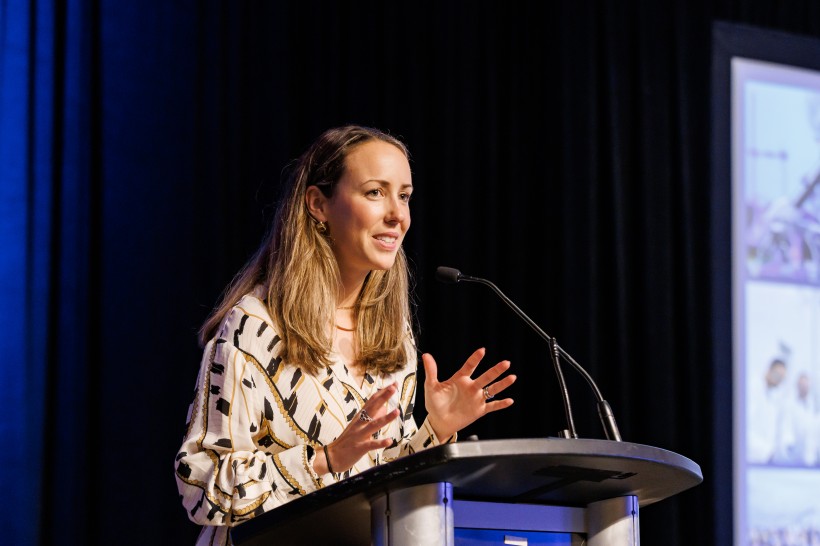
When Lauren Ledwell talks about her vision for the Prince Edward Island life sciences community, it doesn’t take her long to mention two words: investment and infrastructure.
These two words are likely to play a big role in the strategic review now being carried out by the PEI BioAlliance – the organization that named Ledwell its new CEO last autumn.
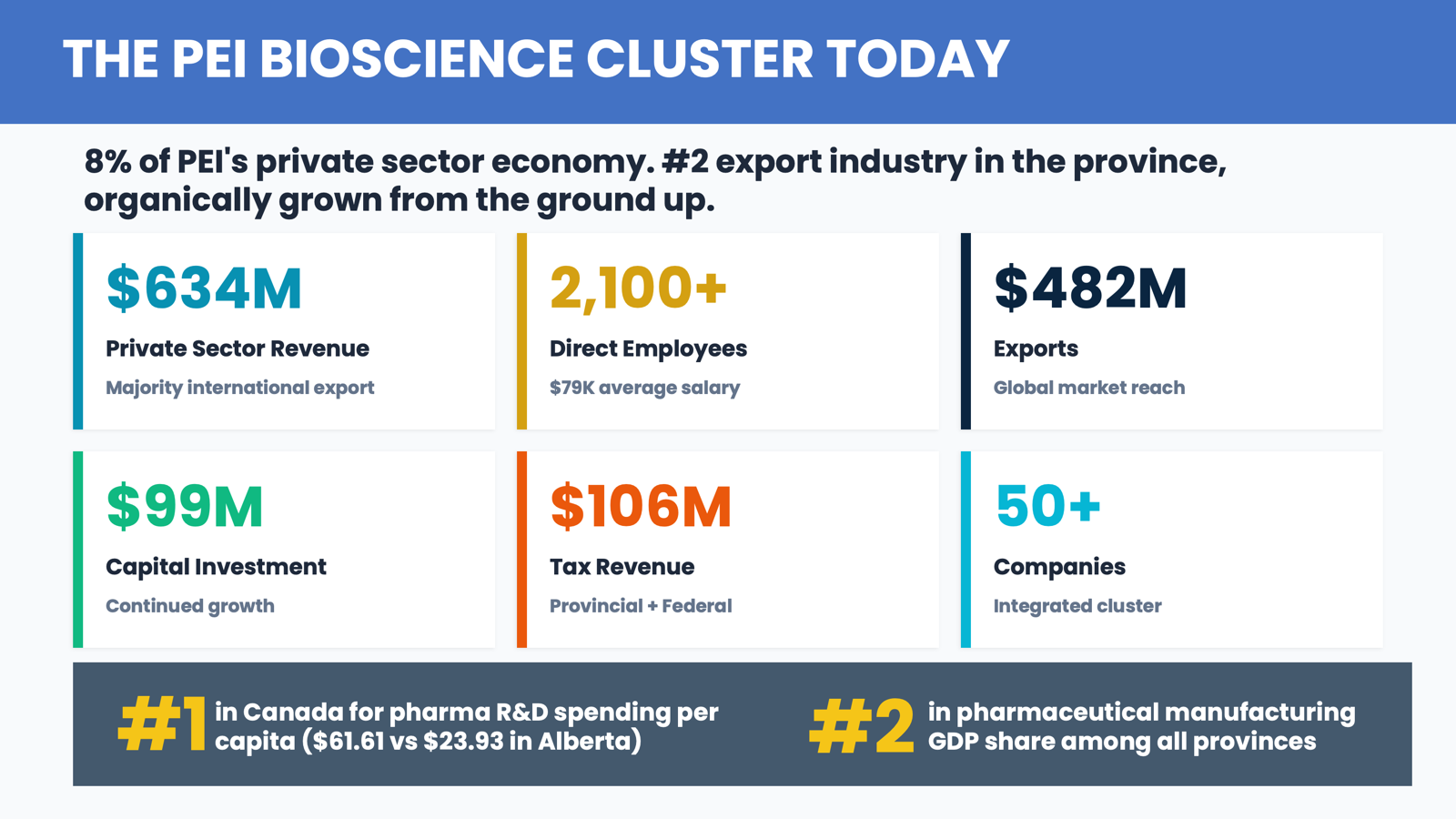
Under her predecessor, Rory Francis, the association for the life sciences cluster on the Island boasted several decades of growth. In fact, its 40-plus private-sector members booked $634 million in revenue in 2024 (the most recent figures available). And one goal of the strategic review is to boost that figure to $1 billion by 2030.
“We have to continue the growth trajectory that we're on,” said Ledwell in an interview. “And there are in 2026, based on the geopolitical environment we find ourselves in, levers that we'll have to pull in order to hit that $1 billion ambition by 2030, which kind of feels some days like it's just around the corner.”
Source: PEI BioAlliance
Ledwell spent the first few months in her new role meeting with members of the Island’s bio-cluster to learn first-hand how its members were doing and what their concerns are. It’s helped to shape the strategic review, which will be formally released in the fall. The overall message is that things have been going well and a few improvements will be needed to ensure the growth continues.
Private investment will be a big part of it, and it’s a subject familiar to Ledwell. Her CV includes stints as the Managing Partner of the Women’s Equity Lab in Atlantic Canada and as a Principal at Sandpiper Ventures, the all-female VC fund. She says there is a gap in seed and pre-seed funding in Atlantic Canada that needs to be filled, and doing so in life sciences is especially challenging because the investment cycles tend to be longer and more complicated than in other sectors.
“My view is that we can and should be doing a better job of attracting capital to our early-stage companies and our scaling companies,” said Ledwell. “I think investment readiness is a function that we need to [improve] here on P.E.I., and that's something that we'll do as part of our new strategy. The second is building a stronger investor network beyond the region.”
Investors in other parts of Canada and the U.S. need to become aware of the success of the cluster, including the fact that two Charlottetown bio-ventures have reached billion-dollar valuations. In 2024, Indiana’s Elanco Animal Health sold its P.E.I. operation to Merck & Co. for US$1.3 billion, or C$1.75 billion. Later that same year, Charlottetown drug manufacturer BIOVECTRA, which Miami-based H.I.G. Capital bought for US$250 million in 2019, was sold again for US$925 million or C$1.27 billion, to another U.S. entity.
The second aspect of the strategy that Ledwell emphasizes is infrastructure. Ledwell described it as a “key pillar” because the PEI cluster’s core disciplines – bio-manufacturing, animal and aquaculture health, nutraceuticals, etc. – require specialized facilities for R&D and production.
The BioAlliance has made huge strides in this area, overseeing the development of the BioCommons Research Park on the outskirts of Charlottetown a few years ago. The next piece of this puzzle will be the $50 million BioAccelerator, which will provide 38,000 square feet of workspace when it opens in September.
A third facet of the review will be people – an area that includes education, training, immigration, and ensuring that venturesome folk are encouraged to start companies and are supported through their journey.
The BioAlliance launched the Canadian Alliance for Skills and Training in Life Sciences, or CASTL, a few years back to help people upgrade their skills in the sector. The group opened its Biomanufacturing training facility in 2022.
As well as CASTL, the BioAlliance is working with post-secondary institutions to ensure their curriculum matches the modern job market. Ledwell also noted that Lab2Market, which helps researchers assess whether their research could lead to a commercial venture, is now working with University of PEI to flush out commercially viable projects from its research complex.
While P.E.I. is the main focus for Ledwell and the BioAlliance, they strive to help improve the ecosystem across Atlantic Canada. A major component of the organization is the Emergence life sciences incubator, which works with companies from all four eastern provinces.
“PEI is great,” said Ledwell. “And you know what? My mandate is certainly centred on driving the cluster in P.E.I., but I think we can work together as a region as well. And so I'm working with my peers in New Brunswick, Nova Scotia, and Newfoundland to make sure that we're aligned and in sync on what each of us are focusing on.”