


The head of Canada’s newest investor group believes the Maritimes would be one of the big beneficiaries if the federal government adopts its plans for the innovation ecosystem.
Jesse Wiebe, the Executive Director of the Canadian Startup Capital Association, or CSCA, said in an interview last week that his group’s recommendations could generate more investment activity in Nova Scotia, New Brunswick, and P.E.I. It’s badly needed, he said, although he also notes the Maritimes overall have a stronger investment climate than his native province of Saskatchewan and neighbouring Manitoba.
His organization’s plan to build and fortify a national network of early-stage investors would aid a region that has been without a general angel network for six years, said Wiebe. While the investment infrastructure in Newfoundland and Labrador is robust with the Venture NL funds and Pelorus Venture Capital, he believes more needs to be done in the Maritimes.
“The Maritimes is where we would like a lot more angel activity,” said Wiebe. “I'd like to see more fund managers. . . . If we can establish a more robust peer network that allows people to learn from others’ mistakes and find the best practices and get access to professional development, I think we'd see a far more robust and vibrant fund management ecosystem in the Atlantic region.”
Launching in April, the CSCA joins other national bodies like the National Angel Capital Organization, or NACO, and the Canadian Venture Capital and Private Equity Association, or CVCA, in advocating for private capital in the country. The new group is arriving at a key juncture for the industry as the federal government has announced a $750 million pool of money to encourage “early growth” investment, but hasn’t revealed what it will be used for.
The CSCA – which wants to support burgeoning investment funds as well as angel networks – recommends the federal government:
* Allocate $150 million over three years for program funding to help angel networks and new funds develop and educate their members.
· *Create two interconnected benefits for the first investors in qualifying startups. First, these investors would pay no capital gains tax on the exit of such an investment. Second, investors in such traditional assets as public shares or real estate would receive a 50 percent capital gains tax reduction as long as the proceeds are re-invested in a “first-cheque investment” in a qualifying startup within 12 months.
* Set up a $100 million fund, managed by a private-sector body, to help fund angel groups across the country.
·* And establish a fund that can provide a secondary market for angel investments. In other words, this fund would buy the shares of long-time investors in successful startups that haven’t exited yet.
The goal is not so much to channel the $750 million directly into startups as it is to develop a robust and well-educated network of investors. Doing that, says Wiebe, would draw more private capital into the innovation economy.
Though a product of Saskatchewan and its agtech sector, Wiebe is familiar with and has an affinity for Atlantic Canada. He was an early investor in the Fredericton agtech company Picketa Systems, and lingered in Nova Scotia after the recent Invest Canada conference, spending time fishing in the Bay of Fundy. He has been discussing the ecosystem with such East Coast investors as Ian Whytock of Tidal Ventures, Peter Hickey of Charli AI and Paul Harrington of Cape Breton Capital Group.
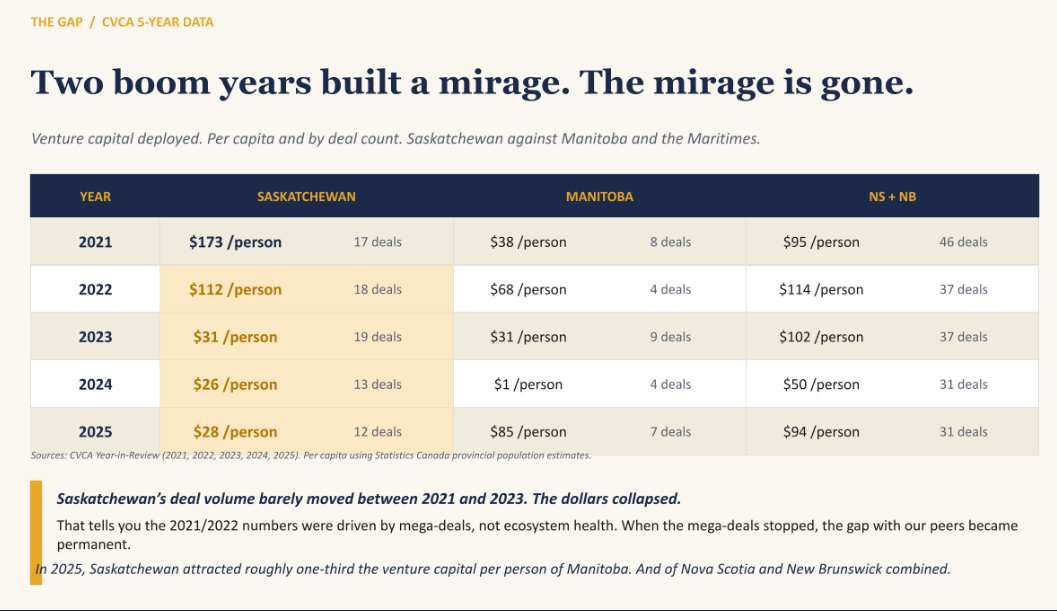
And in his own presentations of funding challenges in Saskatchewan and Manitoba, Wiebe highlights that Nova Scotia and New Brunswick have a stronger track record in venture capital than these two Prairie provinces. He cites CVCA data to prove his point, and his slide is posted below.
“You guys are kicking our ass when it comes to some of the mid- to later-stage stuff,” he said. “Even when you look at the venture capital heat map from the CVCA for the last five years, on a per capita basis you're [generating] four to five times as much as we are out here.”