Halifax-based Stroke of Luck is focused on creating affordable, AI-powered hardware and software that offers home-based brain-training therapy for stroke patients.
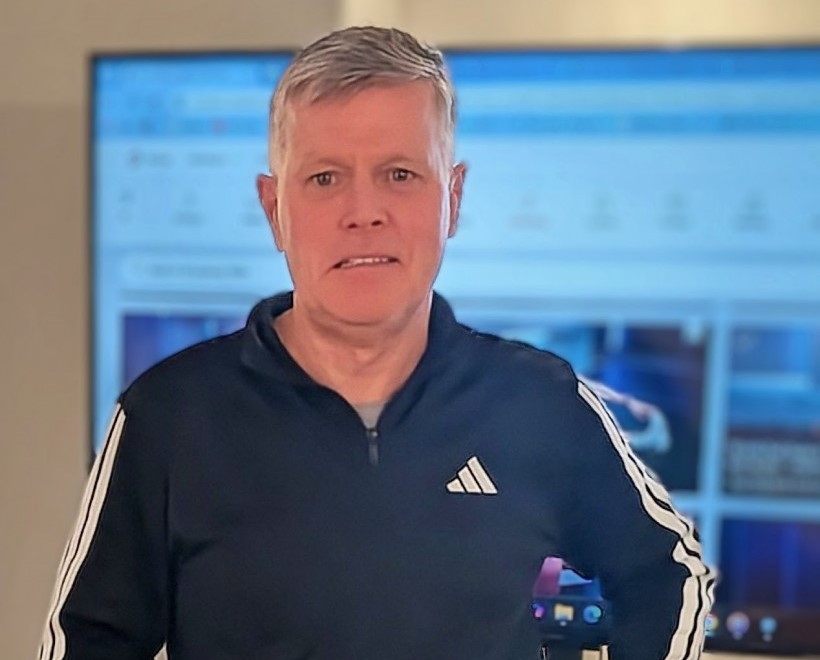
Founder Steve MacDougall himself suffered a stroke four years ago that affected his entire right side. He is still working to recover completely and has realized what he calls “a critical gap in accessible physiotherapy”.
Therapy can be of limited and inconsistent quality, while high costs and a shortage of healthcare workers make occupational therapy and physiotherapy inaccessible for many, he told Entrevestor.
MacDougall is now adapting advanced technology he first used during his career as a mechanical engineer, to help patients re-train their brains at home.
“Two years ago, along with a software developer, I began looking at using tools we were using as an engineering firm to help in stroke recovery.”
He said that as an engineer he used virtual reality goggles in new plant construction. The goggles allow users to see what equipment will look like before it is built. The goggles are also used in gold exploration to indicate the location of gold seams subsurface.
“It’s been four years and a few months since my stroke and I’m still improving,” he said.
His product is a handheld device containing a camera. It plugs into a monitor and allows the patient to do exercises that are analyzed by the system and replayed to the patient. The camera also allows physiotherapists to coach the patient remotely.
MacDougall’s solution utilizes a series of proven clinical protocols that he used during his own rehab, together with AI enhanced assists coupled with record, playback and analysis of his exercises, he said.
“Basically, it fools the brain into thinking your affected arm is working fine,” MacDougall said. “I look at the monitor during my exercise and see that my right hand is working just fine. In reality, it’s not. My body is still suffering the effects of the stroke, but the innate neuroplasticity of the brain is rewiring itself, constructing new neural pathways and ultimately leading to the arm actually working fine.”
He said the feeling he gets from using the device is “kind of magic”.
“I do the exercises every morning and throughout the course of my therapy I can actually feel the response of my arm and my leg improving.”
MacDougall said he is not aware of any similar competing devices and he is currently filing a U.S. patent for the technology. As well as focusing on starting clinical trials, the startup has also joined Charlottetown’s Emergence Bioscience Business Incubator.
So far, MacDougall has bootstrapped the venture but may raise funds after the technology has been derisked through further refinement.
“I am intrigued by the science but I’ve come to see that the road to success is probably longer than I expected,” he said. “I will look for non-diluting funding in time.”
On reflection, he thinks his stroke was likely caused by not taking care of himself.
“I had stopped taking my blood pressure meds, I was travelling a lot for work in different time zones, I was eating out and developed some bad habits which resulted in increased high blood pressure,” he said.
“I had to slow down, and it took the stroke to show me that. I could have died. Now, I use every opportunity to say to friends ‘The best way to recover from a stroke is not to have one.’ We all need to look at our lifestyle. Once a stroke happens it’s hard to go back, and if you are lucky enough to survive one, it’s a long road to recovery.
“Stroke of Luck is more to me than just a play on words. I was lucky to survive the stroke, but I have been equally lucky in having to go through what is probably the biggest learning experience of my life. The stroke inspired me to develop this technology which has helped me immensely. To be able to utilize this technology to try and improve people’s health and recovery is very meaningful for me. We are hoping to prove this device can do what we think it can and put it in the hands of people who can use it.”