


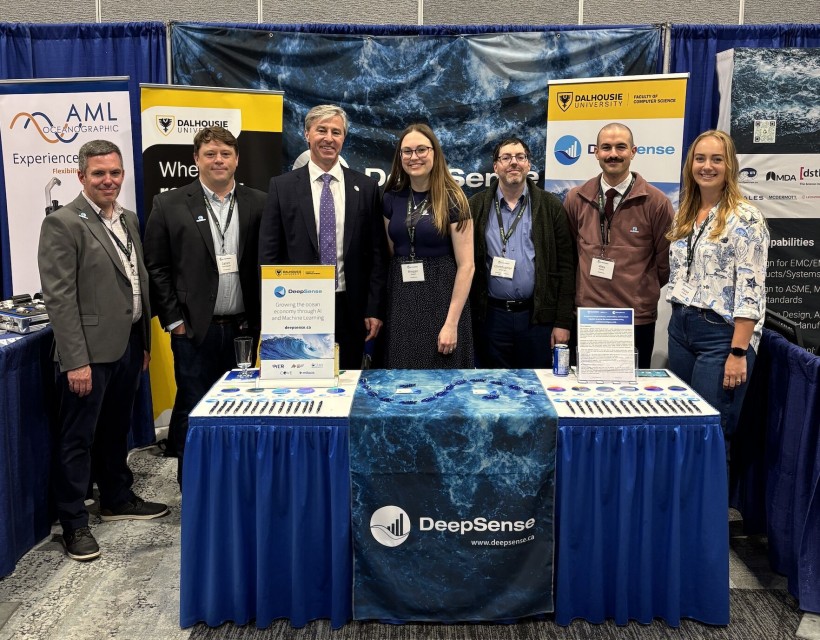
DeepSense, Dalhousie University’s initiative to spread artificial intelligence through the broader community, is expanding its mission to the point where its Executive Director is talking about DeepSense 2.0.
In an interview last week, Iaian Archibald said the organization has already ventured beyond its original mission of working with oceantech companies and is targeting several sectors of the economy. It’s also broken out of the Atlantic Provinces and now has projects in six provinces, including British Columbia, Ontario and Quebec.
The intention, he said, is to continue to grow and help companies and organizations across the country adopt artificial intelligence in their operations.
“What 2.0 is is it’s moving us to scale into new sectors,” said Archibald. “Defence is an obvious one. We also seem to have an expertise in living and environmental systems, so agriculture is a natural area for us to get into. Natural resources is also an area because we have this deep expertise in living systems, and . . . general environmental systems.”
DeepSense began six years ago when Andrew Rau-Chaplin, Dalhousie’s Dean of Computer Science, and some of his professors including Evangelos Milios wanted to export the AI expertise within the university into the broader business community. They formed DeepSense to encourage AI adoption within the oceans community under the leadership of Jennifer LaPlante, who is now Nova Scotia’s Deputy Minister of Cyber Security and Digital Solutions.
After LaPlante’s departure in 2023, the organization decided her successor would be Archibald, the Co-Founder and CEO of Swell Advantage, which had exited in 2021 in a sale to the American company Oasis Marinas Management. Under his leadership, DeepSense won the Tech For Good Award at Digital Nova Scotia’s 2025 Tech Forward Awards.
DeepSense works like this: a company, government agency or organization comes to DeepSense with a problem that it believes can be solved through artificial intelligence or machine learning. The organization works with them to refine the problem statement, and identify what form of AI would be best for them.
The discussion begins with two questions, said Archibald. First, what type of data does the applicant have? Whether it’s their own proprietary data, or data from a partner or public entity, it will be key to the type of system that’s developed. Second, what form of AI or machine learning is best suited to develop a model based on that data and end up with a functional system?
Once these details are nailed down, DeepSense brings in a computer science student for an intensive four-month internship to work with the applicant. The students are managed by the DeepSense staff with the goal of helping gain “outsized” expertise in developing AI-driven systems.
Almost half the past interns are now working in industry in roles involving artificial intelligence, and about 20 percent of them are working for the companies they met through the DeepSense projects, the group said. Archibald hopes to raise that number to 40 percent.
DeepSense has done a lot of work with small and medium-sized enterprises, largely because the organization’s AI supports require less time and money than those offered by enterprise providers. These SMEs include such Atlantic Canadian startups as Halifax-based Glas Ocean Electric, a maker of electric fishing boats, and Bedford-based Innovasea, which develops solutions for aquaculture and fish-tracking.
As DeepSense has expanded into new sectors and geographic regions, it has also begun working with other colleges and universities. Dal’s computer science faculty continues to be its main student pool, but it has also offered internships to students from Holland College in P.E.I., St. Mary’s University in Halifax, and Memorial University of Newfoundland.
The goal now, says Archibald, is to continue scaling so this becomes a truly pan-Canadian initiative.
“We’ve already got a track record of working across multiple education institutions, he said. “And we’ve already got a track record of delivering for companies across Canada. . . . What we’re looking to do now is grow this across Canada.”