

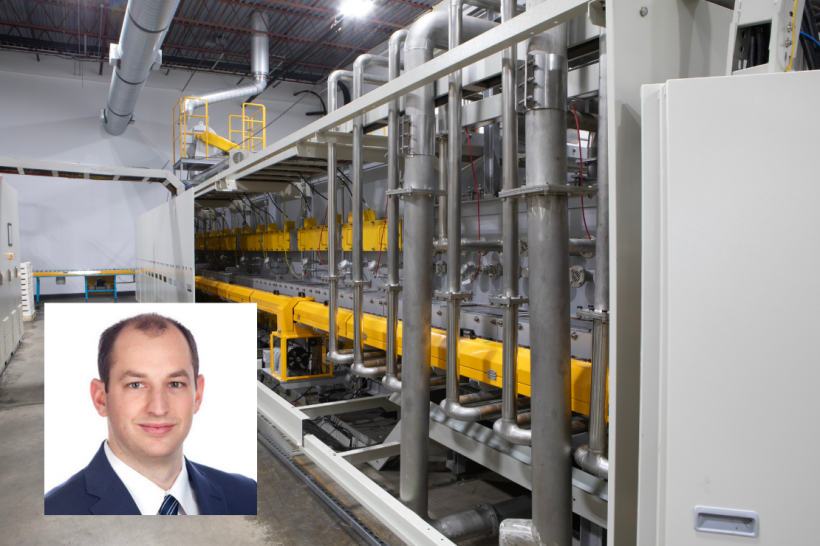
Dr. Chris Burns, the former CEO of Novonix Battery Technology Solutions, has taken the battery innovator’s Halifax operations private, setting up two new companies, each with a distinct focus.
Chattanooga, Tenn.-based Novonix said last week it had completed the transaction, which will result in the creation of a consultancy business called Avrion Battery Labs and a product-focused business called Dryve Battery Materials Inc.
Burns is the CEO of Dryve, which will aim to commercialize a platform for lithium-ion cathode materials. Novonix has taken a 15 percent stake in Dryve and seeded the startup with US$2 million (C$2.7 million) in working capital.
“Dryve is built to fundamentally simplify how cathode materials are made,” said Burns in a statement announcing the new company. “Our dry, pCAM-free synthesis platform eliminates conventional precursor steps and enables a more efficient, lower-cost, and scalable path to cathode production.”
Cathode materials are the positive electrode components in batteries that dictate a battery's energy density, voltage, and lifespan by managing lithium-ion flow during charging and discharging.
Burns came up through Jeff Dahn’s battery innovation lab at Dalhousie University, leaving it in 2013 to set up a company to accelerate R&D in batteries and battery materials. It was bought out by the company that would become Novonix, which is now listed on Nasdaq with a market capitalization of US$160 million.
In an interview, Burns said Novonix has grown to specialize in a few disciplines, with its Tennessee operation focused mainly on producing large-scale synthetic graphite. “The operations in the U.S. are bigger and different than those in Canada, so it made it complex to run,” he said.
The different operations needed to focus, so the board decided to spin off the Halifax operations so the various businesses could each concentrate on best practice in their respective markets. It maintained a stake in Dryve to benefit from any upside as the spin-off brought its cathode products to market.
The divestiture was achieved by Burns paying 1 US dollar for the Halifax operations, with Novonix retaining its stake in Dryve and providing working capital.
Still a pre-revenue company, Dryve now has 16 employees and a 100-tonnes-per-annum pilot facility in Dartmouth. Burns said he is looking at raising equity capital for the company at some point, and is especially interested in strategic investment from industrial companies that would benefit from its cathode materials research.
Burns said the market is looking for battery technology to improve in many different ways, but something that is always paramount is lower costs, and the Dryve team is focusing on this area. He said the team’s work has produced a 30 percent capital cost decrease and a 50 percent drop in operational costs (outside of cost of materials).
Avrion Battery Labs, meanwhile, is a battery research consulting business, or as Burns says, “very similar to where we started 13 years ago.” The 20-person company helps clients – from blue chip companies to startups – conduct research and development on lithium-ion batteries with the goal of helping these companies build new products. Its capabilities range from helping to build prototypes to evaluating performance in extreme conditions, such as high temperatures.
The consulting company will be led by Lori McLeod, who has served as President of Novonix Battery Technology Solutions for the past three years.